Why this matters: An agent uses a rent roll worksheet to disclose rental information when marketing or evaluating an income-producing property, and a comparative analysis projection (CAP) worksheet when projecting income and returns on an income-producing property.
Investigating a property’s worth
A buyer agent on locating an income property for a buyer they represent first obtains and reviews an Annual Property Operating Data Sheet (APOD). The APOD is prepared and provided by a seller agent marketing a property for sale so interested buyers and buyer agents can initially assess the property’s suitability for their buyer. [See RPI Form 352]
When the property and the operating data appears to meet the buyer’s requirements, the agent requests more information about the property, eventually including:
- a rent roll spreadsheet [See RPI Form 352-1];
- occupancy history on each unit;
- information on maintenance and repair services [See RPI Form 324];
- information on security arrangements and criminal activity [See RPI Form 321];
- covenants, conditions and restrictions (CC&Rs) exclusions to the title insurance policy;
- a comparison between income and operating costs of the property and other properties [See RPI Form 353];
- any other material facts about the property’s condition or location which may affect its value; and
- an interview with a property manager.
Related article:
Each agent’s duty regarding information
The buyer agent knows the seller agent owes a duty to prospective buyers and their agents to inform them of all property facts known or readily available to them which may adversely impact the property’s market value. As a necessary practice, the seller agent anticipates potential buyer inquiries and gathers all fundamental property information in a marketing package before posting the property for sale.
When the seller agent has yet to gather facts known or available to them in a marketing package when a request for information is made, they are likely to insist property disclosures are unnecessary before a prospective buyer submits an offer.
However, price negotiations do not commence until the seller agent has disclosed all readily available property data and material information by delivery of property disclosure forms. Without property information, a buyer has insufficient knowledge for a prudent evaluation of a property until the seller agent’s obligation to hand it over takes place. It is too late for disclosure of defects after the seller agrees to sell to the buyer.
The buyer agent hired to locate income property advises the prospective buyer that the seller or the seller agent might insist the buyer enter into a confidentiality agreement before releasing proprietary information about their operations. Thus, the buyer is compelled to identify themselves to the seller and promise not to release the information received to others. [See RPI Form 257]
Otherwise, the seller will not release information on the tenants, their leases and property operations — information the buyer needs to determine the property’s worth and set the price and terms before making an offer.
When the information is received, reviewed and confirmed, it may warrant further investigation into the suitability of the property for acquisition. Either before submitting an offer or after opening escrow, the buyer agent and buyer personally inspect the premises and any vacant units. Further, a thorough discussion into operations needs to take place with those who manage the property.
After receiving initial disclosures and conducting a minimal initial investigation, the buyer agent prepares a purchase agreement when the property disclosures indicate the property is suitable to the buyer for acquisition.
On submission of a purchase agreement offer, the price and conditions to be met for closing are fully negotiated. One critical condition is the buyer’s completion of a due diligence investigation to confirm expectations drawn from prior disclosures and initial appearances of the property’s conditions. Any counteroffer by the seller sorts out the seller’s willingness to allow the buyer to corroborate the agreed price is the property’s value before closing.
The bulk of a buyer agent’s diligent investigation to confirm the property information delivered begins after:
- the buyer sets the price they will pay for the property as previously disclosed;
- the buyer submits an offer; and
- the seller accepts it, initially or on counteroffers.
The confirmation of the veracity of initial property disclosures is conducted by the buyer agent during the escrow period. The buyer agent’s diligent investigation either confirms the facts disclosed or discovers material facts not disclosed before the seller entered into the purchase agreement.
Related page:
Projections or forecasts as opinions
Nearly every transaction offers an agent the opportunity to provide opinions for their clients or the other principals involved, which include:
- approximations;
- predictions;
- pro-forma statements;
- anticipated expenditures; and
- contemplated charges.
These opinions relate to income and/or expenditures, such as exist in:
- forward APODs prepared for an income property [See RPI Form 352];
- anticipated future rent schedules (or rolls) [See RPI Form 352-1];
- Comparative Analysis Projections (CAPs) analyzing rental incomes between similar properties [See RPI Form 353]; and
- any other like-type predictions of costs or charges.
Opinions by their nature are not facts. The predicted amounts are yet to occur and might not. The amount forecasted becomes certain only by its occurrence in the future. The amount actually experienced may or may not equal the amount estimated.
In contrast to opinions, figures entered in a document entitled “estimate” are proper only when based on amounts currently experienced, such as:
- seller’s net sheets [See RPI Form 310];
- buyer’s cost sheets [See RPI Form 311];
- current rental income and operating expenses;
- a trailing APOD; and
- mortgage origination or assumption charges.
Thus, estimates are fairly accurate in amount, not just guesswork. Words used in titles such as “contemplated,” “pro-forma,” “anticipated” or “predicted” indicate forecasts and something less than an estimate since they are not based on current facts. They are an opinion about future activity. Thus, forecasts are opinions and provide far less reason for a buyer’s reliance.
Related video:
Read more about making estimates.
Using a rent roll
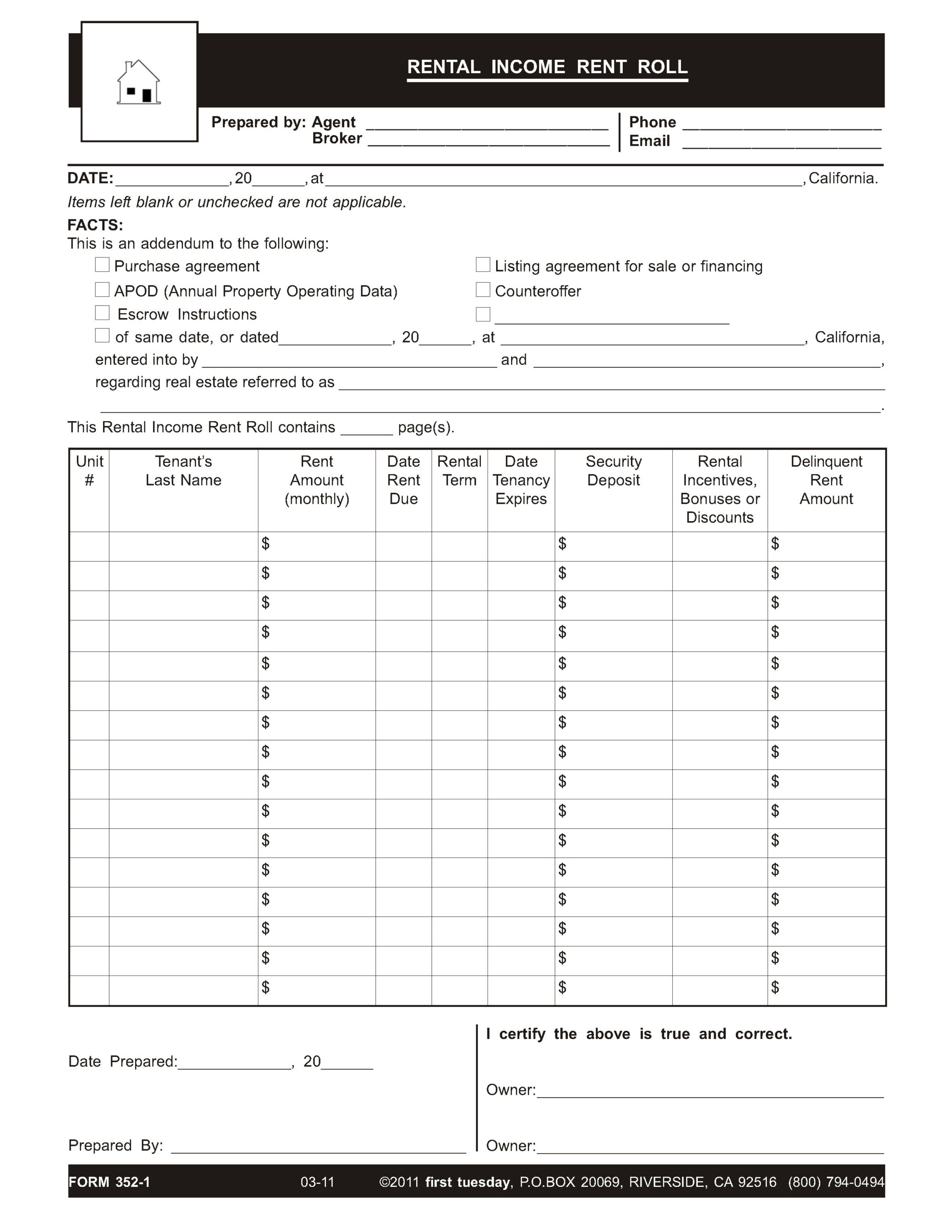
A rent roll is an addendum which lists rental information for every occupied and vacant unit in an income property. [See RPI Form 352-1]
The rent roll is used when marketing a property for sale, seeking mortgage financing or evaluating an income-producing property.
The rent roll is attached to other transaction documents, such as:
- a purchase agreement [See RPI Form 151];
- a seller representation agreement [See RPI Form 102];
- an APOD [See RPI Form 352];
- escrow instructions [See RPI Form 401];
- a counteroffer [See RPI Form 180]; or
- another agreement involving the income property.
The trailing rent roll allows a buyer, buyer agent or lender to quickly analyze the property’s income and tenancies.
A seller agent’s typical marketing package presented to prospective buyers for disclosure includes a:
- forward rent roll of anticipated rental income; or
- trailing rent roll of current rental income data on receipt of a confidentiality agreement from the buyer.
When in escrow, the buyer agent compares the rent roll with the leases and confirm the APOD reflects the property’s current rental income.
A mortgage lender reviews a rent roll to evaluate the property’s rental income as sufficient to support mortgage payments for the amount of funds a buyer seeks to pay the balance of the purchase price after the down payment.
Related video:
Read more about the rental market.
Using a Comparative Analysis Projection (CAP)
A Comparative Analysis Projection (CAP) is a financial analysis worksheet used to establish how an income property might perform after a buyer acquires it and how different mortgage terms affect the rate of return for the owner. [See RPI Form 353]
A CAP is often used in conjunction with an APOD. [See RPI Form 352]
However, unlike an APOD, which reports the property’s trailing or forward income and expenses, the CAP projects a property’s various types of future returns based on the buyer’s anticipated management.
The CAP starts with the property’s trailing operating data, best obtained from a fact-based APOD and rent roll. Using these facts, the buyer or buyer agent make their best projections, such as:
- rent increases to market rates;
- setting a future vacancy rate for the location;
- adjusting operating expenses;
- accounting for planned upgrades; and
- calculating the effect of new mortgage terms.
From these forecast figures, the CAP calculates projected investment performance using measures, such as:
- gross operating income;
- net operating income (NOI);
- net equity;
- before-tax cashflow;
- return on equity; and
- capitalization (cap) rate.
A seller agent uses the CAP worksheet when marketing an income-producing property to investors.
A buyer agent uses it when a buyer-client needs to analyze different financing or operating scenarios for an otherwise suitable property, or to compare multiple investment properties.
Related FARM letter:
Analyzing the rent roll
An agent uses the Rental Income Rent Roll published by Realty Publications, Inc. (RPI) when preparing a marketing package for an income property they offer for sale or are conducting a due diligence investigation for a buyer-client. The form discloses detailed rent roll information needed by any prospective buyer. [See RPI Form 352-1]
The Rental Income Rent Roll includes:
- the date and location the form is prepared;
- the document the rent roll is attached to as an addendum;
- the date the document was entered into;
- the participants of the original agreement;
- the real estate referred to in the document;
- how many pages are included in the rent roll (add extra pages of the rent roll when the property has more than 16 units) [See RPI Form 352-1];
- information for each rental unit, including:
- unit number;
- tenant’s last name;
- rent amount (monthly);
- date rent is due;
- rental term type (month-to-month or lease);
- date the lease expires;
- security deposit amount;
- any rental incentives, bonuses or discounts;
- amount of delinquent rent; and
- the agent’s name and date the form is prepared, and the property owner’s signature verifying the information is correct. [See RPI Form 352-1]
Related article:
Brokerage Reminder: Know the bottom line for investment properties
Analyzing the CAP
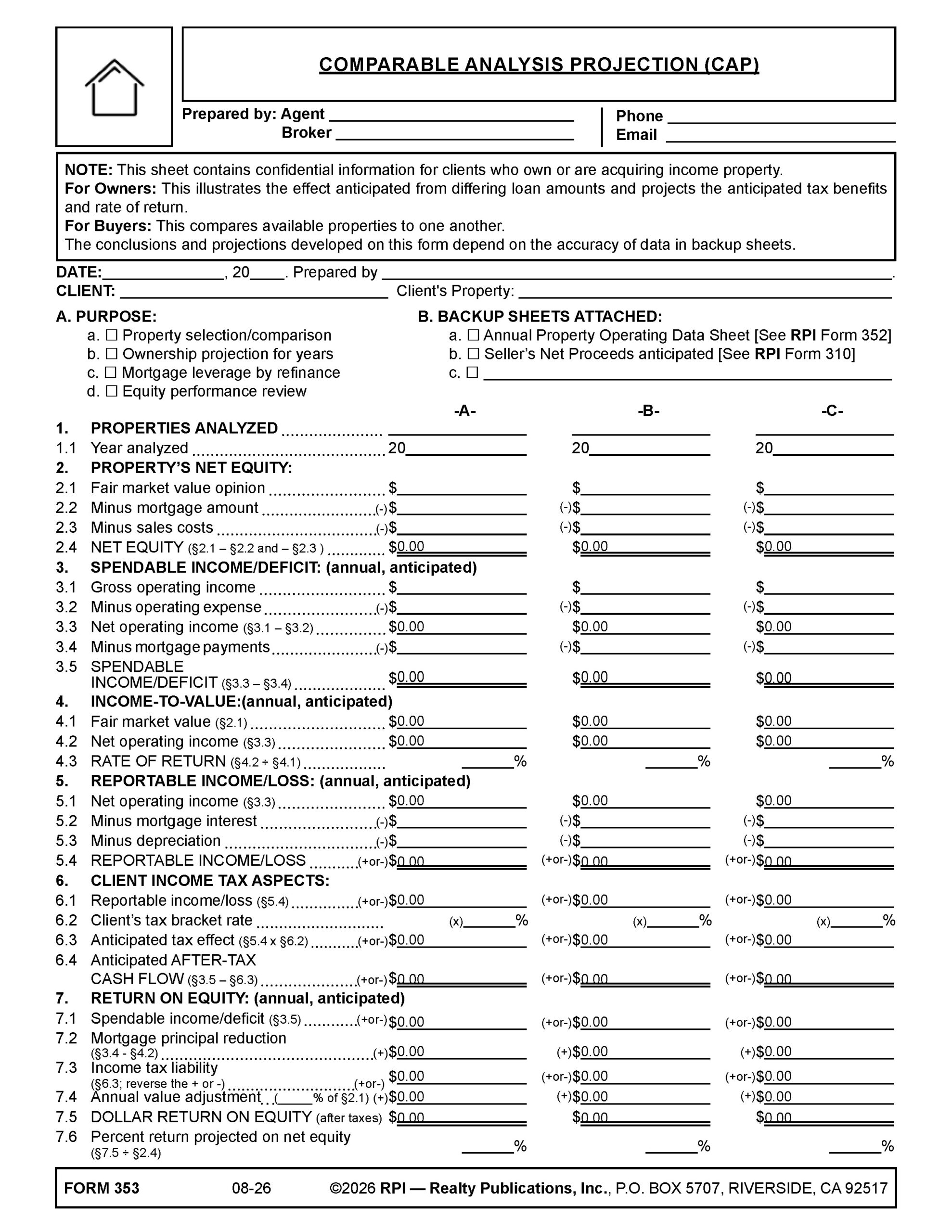
An agent uses the Comparative Analysis Projection (CAP) published by RPI when representing a buyer or owner of income property. The form is designed for the agent to illustrate on a spreadsheet the effects of different mortgage amounts, tax benefits and rate of return over years. Alternatively, use to make a more extensive comparison than a CMA between the subject property and other similar properties offered for sale. [See RPI Form 353]
The Comparative Analysis Projection (CAP) includes:
- the date, name of agent who prepared the worksheet, client’s name and property identification;
- the purpose for the worksheet, including:
- property selection or comparison;
- ownership projection for years;
- debt leverage by a refinance; or
- equity performance review;
- whether backup sheets are attached, including:
- APOD [See RPI Form 352];
- Estimate of Seller’s Net Proceeds [See RPI Form 310];
- Estimate of Buyer’s Acquisition costs [See RPI Form 311]; and
- Other forms, such as rent roll [See RPI Form 352-1];
- three columns containing the following information:
- name of the property analyzed;
- year analyzed [See RPI Form 353 §1];
- property’s net equity, including:
- the fair market value (FMV);
- minus mortgage amount;
- minus sales costs; and
- net equity deduced by subtracting mortgage amount and closing costs from the FMV [See RPI Form 353 §2];
- annual spendable income/deficit, including:
- gross operating income;
- operating expense;
- net operating income (NOI);
- mortgage payments; and
- spendable income/deficit, set by subtracting mortgage payments from the NOI [See RPI Form 353 §3];
- annual income-to-value amounts, including:
- FMV;
- NOI;
- rate of return (cap rate), set by dividing the NOI by the FMV [See RPI Form 353 §4];
- annual reportable income/loss, including:
- NOI;
- interest expense;
- depreciation;
- reportable income/loss, set by subtracting interest and depreciation from the NOI [See RPI Form 353 §5];
- client income tax aspects, including:
- reportable income/loss;
- client’s tax bracket;
- tax liability or loss deduction, figured by multiplying the reportable income/loss by the client’s tax bracket;
- after-tax cash flow set by subtracting tax liability from spendable income [See RPI Form 353 §6];
- annual return on equity includes accounting for:
- spendable income/deficit;
- mortgage principal reduction;
- income tax liability;
- annual FMV adjustment, an estimate of inflation and appreciation;
- dollar return on equity after taxes; and
- percent return on net equity. [See RPI Form 353 §7]
Related article: