

Consumer sentiment about future economic conditions in California declined 14.6% in the first quarter (Q1) of 2025 according to Stanford’s Institute for Economic Policy Research. This represented a drop to 68.6 from 80.3 in the consumer outlook from the previous quarter. This is a larger drop for Californians than consumers experienced nationally at 9%, where the index from the University of Michigan decreased from 72.1 to 64.5 during the same period.
Keep in mind, Californians with their higher incomes and related costs of living, had contrasting higher expectations at the end of 2024 when Californians were more optimistic about the economy than the nation as a whole. Since 2024, with trade taxes on and off then emerging in other ways, wide-spread pricing uncertainty has taken root. The result is caution among consumers as they discovered they pay them in higher prices. Today the US consumer outlook is at its lowest point in recent memory.
For real estate transactions, cash buyers and high-tier residential tenants are the best source of homebuyers for sales agents. Wealthy buyers are not as financially affected by tariffs and mortgage rates compared to low down payment buyers who are mid-tier renters.
Expect consumer sentiment to eventually bottom, then level out before it can rise to support a decision by wage earners to buy a home. To rise, wage adjustments need to keep up with inflation and high mortgage rates, or vice versa. Only then will an upturn in home sales volume take place.
Updated March 10, 2026. 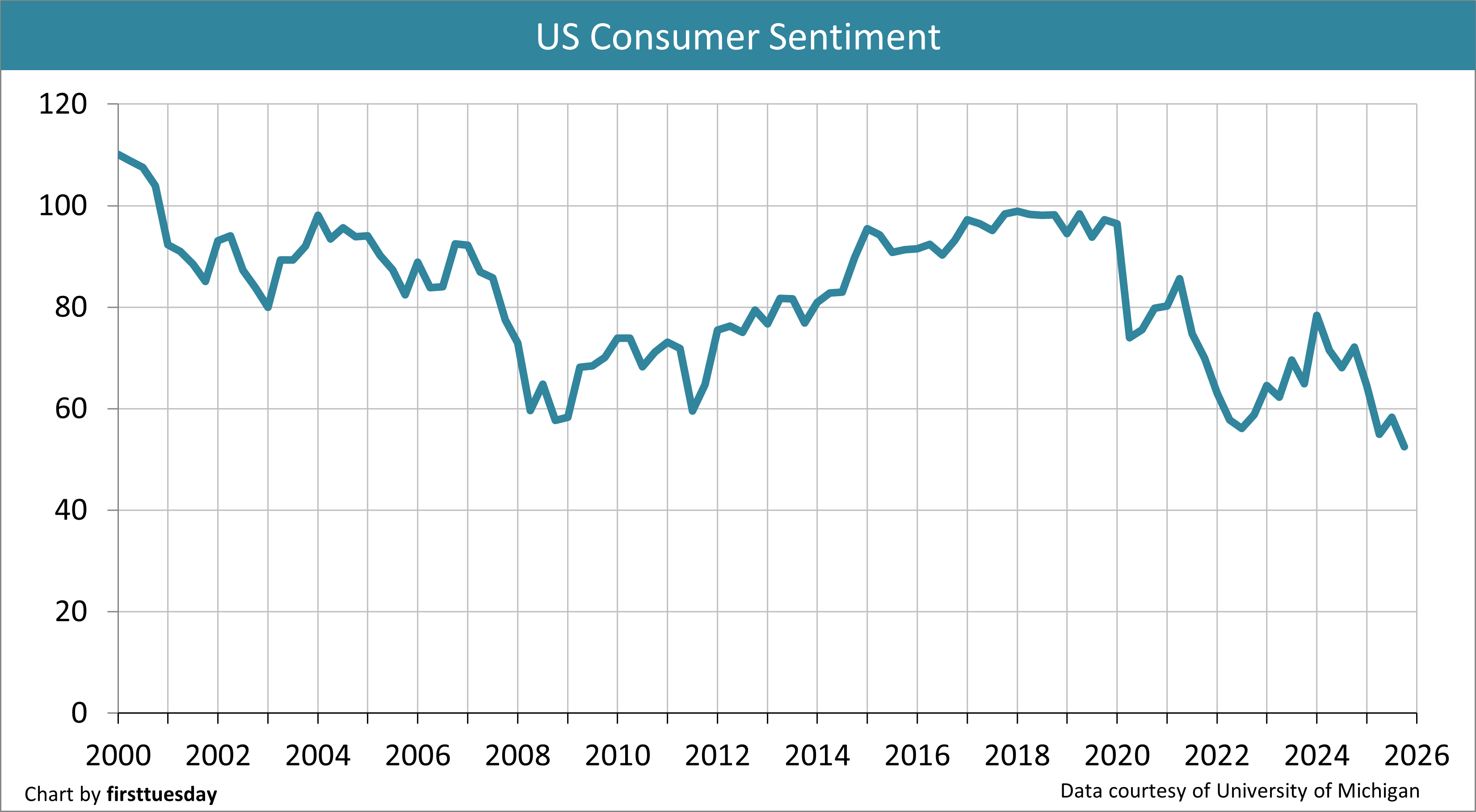
Chart update 3/10/26
| Q4 2025 | Q3 2025 | Q4 2024 | |
| US Consumer Sentiment | 52.5 | 58.3 | 72.1 |
Data courtesy of University of Michigan. Index 100 = 1966. 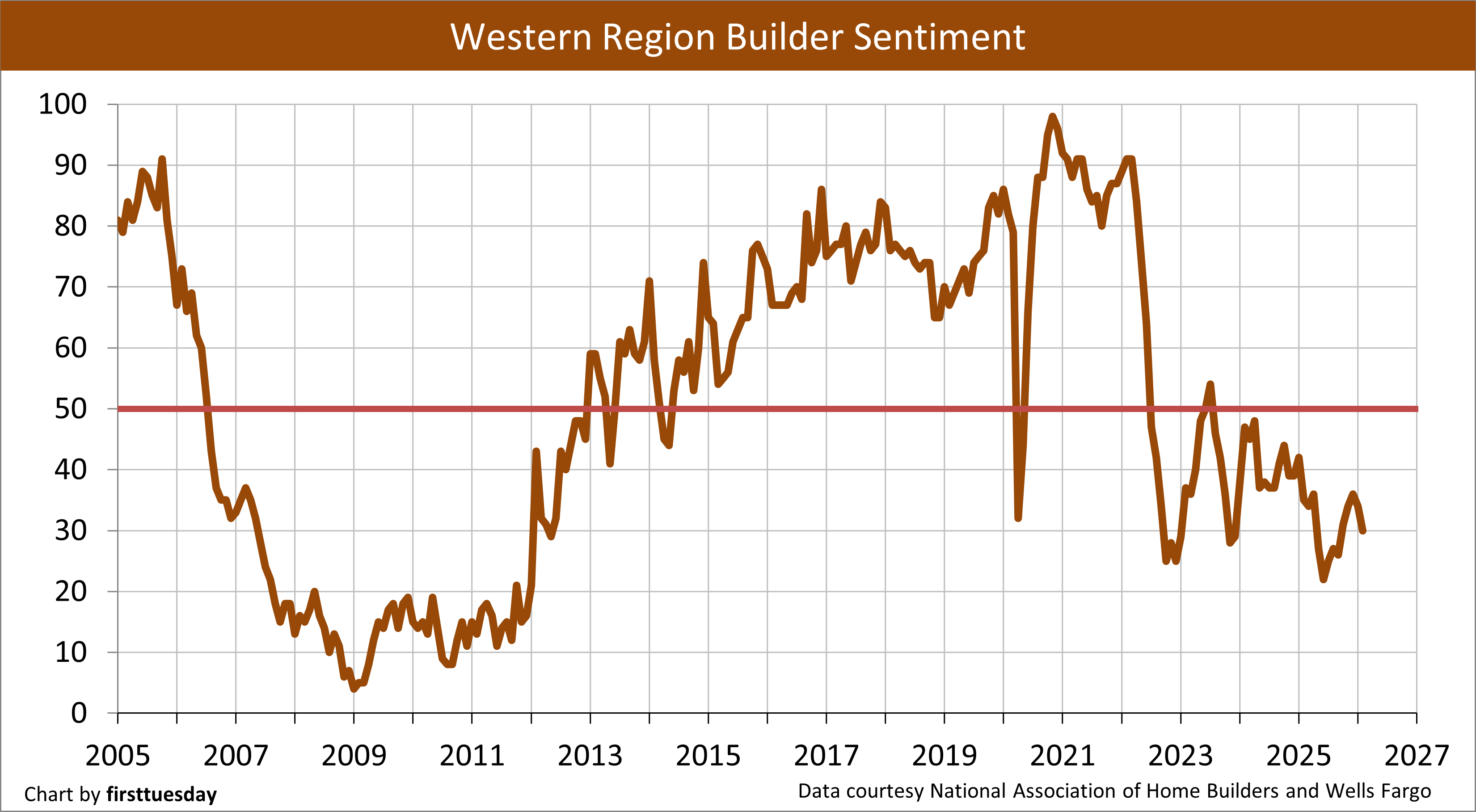
Chart update 3/10/26
| February 2026 | January 2026 | February 2025 | |
| Western Region Builder Sentiment | 30% | 34% | 35% |
Data courtesy of the National Association of Home Builders and Wells Fargo.
Listen to the chart, it is talking to you
Home builder confidence is measured based on the current pace of sales and expected future sales of single-family homes. When the graph is above 50, as marked by the red line, a majority of builders in the Western region (which includes California) are rating the following six months as positive for expected sales transactions.
Builders rely on sales forecasting so they can responsibly allocate the right amount of assets to construction starts. They are far more watchful of data and analytical of future conditions than consumers who judge the future solely by their recent past experience.
From mid-2022 through 2025, home builders maintained confidence about selling their homes, but in February of 2026, 70% of builders do not remain optimistic. This builder confidence in sales is related to but does not directly match consumer confidence.
Nationally, US consumers are increasingly concerned about the job market, interest rates, and their current finances than they were a year earlier. The chart above shows a general decline in consumer willingness to acquire things after exiting the pandemic economy in 2022.
This hesitancy for consumers translates into builders’ wariness for how fast they can move completed homes to these consumers.
Always of builder concern is the trend in home pricing and residential rental rates. Home pricing has been weak for resales and rental rates have been dropping consistently for several months. Sales of new homes in the mid- and higher-price tiers have been consistently satisfactory for builders. However, costs of materials, tariffs and availability of labor – immigrants – are now driving up the cost of a newly constructed home.
Agents and brokers who keep an eye on the trend in spending and sales expectations charted in both graphs maintain — or improve — their awareness of how potential homebuyers and home builders will behave in the coming months. When applied to the growth of available inventory of new and resale housing and how inventory affects pricing, a knowledge of residential construction data for the local area is critical for intelligently advising seller and buyer clients.
Buyer agents have yet to discover they receive a fee when their buyer decides to acquire a new home from a builder — since it is just another sales transaction. However, broker compliance with the buyer representation agreement rules when expecting a fee for assisting a buyer assures the buyer agent a fee on acquiring a new home from a builder. Builder inventory is available for sale for the same reason a property is available for sale through an MLS, just differing as a builder rarely retains a broker so no fee fixing is involved.
Why consumer sentiment matters for transactions
To remain productive earning fees in the months ahead while buyers remain mostly on the sidelines, brokers and agents need the ability to anticipate what services are most likely to maintain or improve their transaction numbers. Information on California consumer sentiment is predictive of present and immediate future real estate sales volume, since it tracks both:
- where we have been, as consumer sentiment reflects their actual experience in recent months, not a forward leaning analysis; and
- where we are going, as the present level of confidence in the economy translates into whether or not buyers today are willing to make large purchases, such as a home.
Further, the level of buyer confidence determines the durability of the current trend in sales volume.
Consumer sentiment: one year forward events
When viewing both lines in the above chart, keep in mind that all survey responses are based on events that have already occurred — as experienced by the person interviewed.
Consumers are greatly influenced by events in the recent past for how they view their future economic outlook. Homebuyers, especially first-time buyers, rely on agents for foresight about shifting conditions in the real estate market going forward.
It is up to agents and brokers, as the gatekeepers for homeownership, to educate their clients on how recent changes do or do not contribute to the developing picture for real estate prices.
As more data and analysis become available and are absorbed and reported by agents and brokers, buyers can conform their opinions about the future for making real estate decisions.
Related articles:
Build your buyers’ confidence to buy a home
Consumer sentiment about future economic conditions will vacillate as we make our way through 2026. Agents influence sentiment by advising their homebuyer clientele to consider financially favorable trends and opportunities developing in the current market, such as:
- a declining number of buyers competing to buy a home;
- an increase in inventory of homes available for sale;
- rising seller concern that high mortgage rates deter potential buyers;
- lower asking prices; and
- mortgage rates steadily decreasing since 2024.
Get your buyers pre-approved in writing by two or three institutional lenders. Initially, the mortgage approval step eliminates a buyer’s anxieties about the amount of mortgage money available and its cost. Most important for negotiations, a bank’s pre-approval statement presented to a seller agent confirms the buyer has the ability to finance and close their purchase of a home.
Related article:











Wavers? That would be waivers!
Please get to the point first and then write the supporting data.
For example: “Trends look good for agents and sellers” or “Trends not optimistic for agents and sellers” or “The trends are not definitive for agents or sellers.”
It seems to me that the big picture is tenuous at best from the chart. Since the trends in the graph are so flat it appears to me that we can draw little inference from the trends other than to say–business as usual.