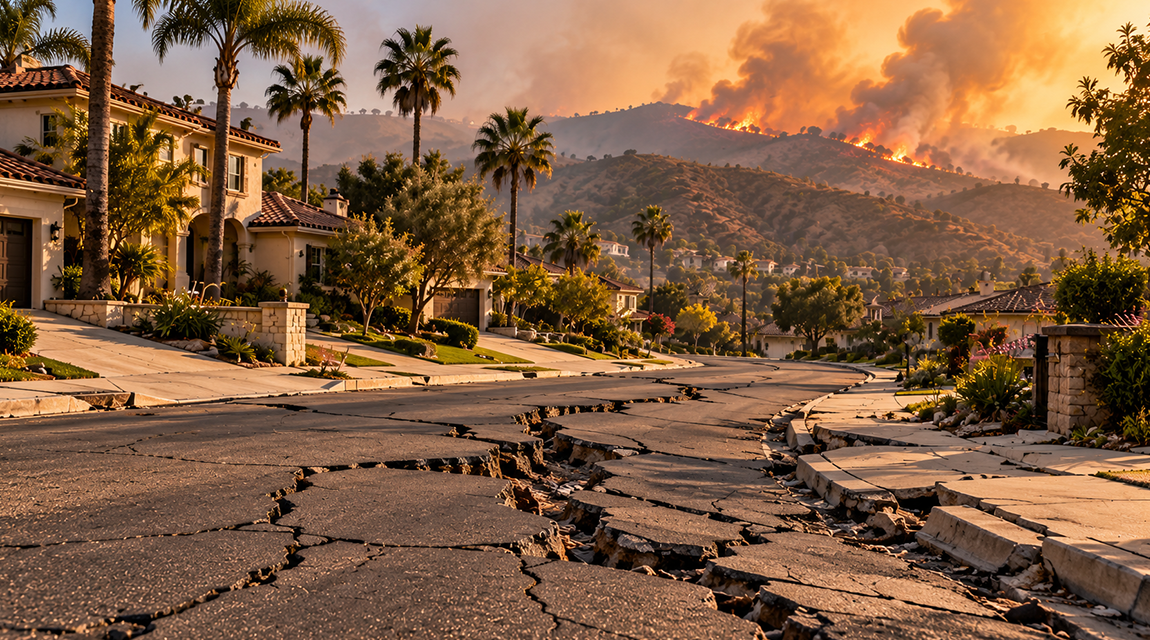
Why this matters: Learn the various types of natural hazards which sellers disclose to buyers, how to comply with seller disclosures of natural hazards and mitigate agent liability by using a natural hazard expert to investigate the public record for known hazards unknown to the agent.
Follow along with an audio reading of this article adapted as a chapter from our upcoming Real Estate Practice course update.
A uniform hazard disclosure for all sales
Natural hazards come with the geographic location of a parcel of real estate, not due to the man-made activities on the property. Locations where a property might be subject to natural hazards include:
- special flood hazard areas, a federal designation;
- potential flooding and inundation areas;
- very high fire hazard severity zones;
- wildland fire areas;
- earthquake fault zones; and
- seismic hazard zones. [Calif. Civil Code §1103(c)]
The existence of a hazard due to the geographic location of a property affects its desirability, and thus its value to prospective buyers. Hazards, by their nature, limit a buyer’s ability to develop the property, obtain insurance or receive disaster relief.
By mandate, prospective buyers of a property are entitled to seller disclosures regarding natural hazards known to the seller, and those contained in public records. A seller makes the natural hazard disclosures whether they market the property for sale themselves or employ an agent to market the property.
To streamline the natural hazard disclosures by a seller of property — and thus, the seller agent — a uniform presentation to prospective buyers was created as a statutory form entitled the Natural Hazard Disclosure (NHD) Statement. [See RPI Form 314]
Related video:
Read more about natural hazards.
The NHD form for uniformity
A seller and the seller agent use the NHD form for their preparation (or acknowledgement when prepared by an NHD expert) and disclosure to prospective buyers of natural hazard information affecting the property for sale. The form includes information both known to the seller and seller agent (and the NHD expert) and readily available to them as shown on maps in the public records of the local planning department. [CC §1103.2; See RPI Form 314]
Use of the NHD Statement by sellers and their agents when marketing any type of property is mandated, with exclusions for non-targeted sellers.
Excluded sellers, but not agents
Sellers in non-targeted transactions need not use the mandated NHD form to make their natural hazard disclosures, which transactions include:
- court-ordered transfers or sales;
- deeds-in-lieu of foreclosure;
- trustee’s sales;
- mortgage loan originator (MLO) resales after foreclosure or a deed-in-lieu;
- estates on death;
- transfers between co-owners;
- transfers to relatives/spouses; or
- transfers to or by governmental entities. [CC §1103.1(a)]
However, a seller agent retained in an excluded non-targeted transaction must make the natural hazard disclosures themselves. It is not the duty of the buyer agent to prepare these disclosures. Here, the distinction is the seller does not need to use the statutory NHD form, but the Department of Real Estate (DRE)-licensed transaction agent involved does. [CC §1103.1(b)]
Also, all sellers of any type of property always disclose what they know about any hazards. Here, the seller’s disclosure is best accomplished by use of the uniform NHD Statement in a non-targeted sales transaction. An NHD expert always includes the NHD statement as part of their report. [CC §1103.2(f)(2)]
On non-targeted transactions, the seller agent complies with their and their seller’s duty to disclose by ordering an NHD report from a natural hazard expert.
Related video:
Read more about the NHD Statement.
The seller agent use of a provider-prepared NHD
On the seller agent’s receipt of the NHD report from a third-party provider, the agent:
- reviews the report themselves and with the seller;
- adds what they and the seller know about hazards which the expert’s report does not include;
- signs with the seller the NHD statement accompanying the report;
- hands the entire NHD report to prospective buyers; and
- does all of this as soon as practicable (ASAP) and always before an offer is accepted or a counteroffer is submitted to a prospective buyer.
Thus, the form, filled out and signed by the seller and the seller agent, is included in marketing packages handed to prospective buyers ASAP when they seek additional information, no matter the type of property.
For excluded sellers, but not the seller agent, the NHD is an optional method for making the mandatory disclosure of natural hazard information to their buyers.
Editor’s note — Any attempt by a seller or seller agent to use an “as-is” provision or a “waiver” provision signed by the buyer to avoid delivery of a seller’s NHD statement is void as against public policy.
Related video:
Read more about natural hazard disclosures.
Mandated delivery of NHDs
Delivery of the information, whether disclosed using one form or another, is not optional. A natural hazard disclosure is mandated on all types of property. [CC §1103.1(b)]
All sellers, and any seller or buyer agent involved, have a general duty owed to prospective buyers to disclose conditions on or about a property. The conditions disclosed include any known to them which might adversely affect the buyer’s willingness to buy or influence the price or terms of payment the buyer is willing to offer.
The existence or lack of natural hazards irrefutably affect a property’s desirability, and thus value to a prospective buyer.
When a hazard is known to the seller or the seller agent, or noted in public records, the seller agent discloses the condition to prospective buyers before the seller accepts an offer from a buyer. When the seller agent fails to disclose material facts, such as a natural hazard, the buyer may cancel the transaction, called termination. And when a buyer discovers a hazard known to the seller or their agent after the transaction has closed escrow, the buyer may rescind the sale and receive a refund of their capital invested, called restoration. [Karoutas v. HomeFed Bank (1991) 232 CA3d 767]
The need for an NHD when a prospective buyer is located, an anticipation held by every seller agent on undertaking representation of a seller, requires the seller agent to prepare (or obtain) and sign the NHD. The NHD is included as part of the property marketing package.
Again, the NHD is delivered to prospective buyers of the property ASAP when a buyer asks for information on the property. Further, the NHD must be delivered before the seller accepts the buyer’s offer or makes a counteroffer. [Calif. Attorney General Opinion 01-406 (August 24, 2001); CC §1103.3(a)(2)]
Related article:
Nine-in-ten homebuyers weigh climate risks when choosing a home
Investigating the existence of natural hazards
Natural hazard information is obtained from public records by the individual who prepares the NHD report.
When the seller or the seller agent prepares the natural hazard information, they are required to exercise ordinary care when gathering the information. Rather than gather the information themselves, the seller may employ an NHD expert to gather and report the information. [CC §1103.4(a)]
Thus, the seller and seller agent may obtain natural hazard information:
- directly from the public records themselves; or
- by employing a natural hazard expert.
For the seller and the seller agent to rely on an NHD report prepared by others, the seller agent need only:
- request an NHD report from a reliable expert in natural hazards, such as an engineer or geologist who studies the public records;
- review the NHD form prepared by the expert and enter any additional knowledge the seller or seller agent may possess about natural hazards, whether contrary or supplemental to the expert’s report; and
- sign the NHD Statement provided by the NHD expert and deliver it with the NHD report to prospective buyers or buyer agents. [CC §1103.2(f)(2)]
When prepared by an NHD expert, the NHD report needs to also note whether the subject property is located within two miles of an existing or proposed airport, an environmental hazard zone called an airport influence area or airport referral area.
Noise and restrictions may affect the buyer’s occupancy of a property within the influence of an airport facility, now and later, which the airport’s land-use commission imposes on the buyer. [CC §1103.4(c)]
Also, the expert’s report notes whether the property is located within the jurisdiction of the San Francisco Bay Conservation and Development Commission.
Related video:
Read more about NHD experts.
Seller agents use NHD experts to limit liability
The Natural Hazard Disclosure scheme encourages agents to use natural hazard experts to report the NHD information rather than prepare it themselves. The use of an expert to prepare the NHD report relieves the seller agent of any liability for errors not known to the agent to exist.
While a seller agent is not mandated to use an expert, the practice is prudent as a risk mitigation step undertaken to manage the risk of liability when marketing properties for sale. The other NHD risk for seller agents is timely disclosure which is eliminated by delivery of the NHD to prospective buyers before the buyer and seller enter into a purchase agreement.
Neither the seller nor the seller agent is liable for an erroneously prepared NHD Statement delivered to the buyer or the buyer agent, when:
- the NHD report/form is prepared by an expert in natural hazards, consistent with professional licensing and expertise;
- the seller and seller agent used ordinary care in selecting the expert and in their review of the expert’s report for any errors, inaccuracies and omissions of which they have actual knowledge; and
- the NHD was delivered to the buyer before the seller accepted or countered the buyer’s purchase agreement offer. [CC §§1103.4(a), 1103.4(b)]
Related article:
Preventing liability for errors in an NHD
The expert who prepared the NHD is liable for any errors, not the seller or seller agent who relied on the report of a non-negligently selected expert to fulfill their duty to check the public records.
The seller and seller agent need not enter into an indemnification agreement with the natural hazard expert to prevent liability for errors.
However, when a buyer makes a claim on the seller agent for lost property value due to the inaccuracy of the expert’s report, an indemnity agreement entered into by the expert in favor of the seller agent in exchange for the request to prepare a natural hazard report will cover the cost of any litigation which might unnecessarily haul the agent into court. [See RPI Form 131]
Caution: The seller agent’s dilatory delivery of an expert’s NHD to the buyer or buyer agent after the buyer’s offer has been accepted does not protect the agent from liability for the buyer’s lost property value due to the nondisclosure before acceptance. When the agent knew or is charged with knowing of a natural hazard noted in the readily available planning department’s parcel list, the seller agent is exposed to liability.
Liability exposure includes:
- costs the buyer may incur to correct or remedy the undisclosed hazardous condition; and
- the portion of the agreed price which exceeds the property’s fair market value based on the undisclosed hazard at the time the buyer entered into the purchase agreement. [CC §1103.13]
Further, the agents, seller and expert are not exposed to liability for claims from transaction providers who might receive the erroneous NHD Statement and rely on it to analyze their risk for involvement in the transaction. These providers include insurance companies, MLOs, governmental agencies and other providers who are involved in the transaction. [CC §1103.2(g)]
Related article:
Documenting compliance with NHD law
By an NHD provision in the purchase agreement, the seller and seller agent document compliance with the delivery of the required NHD Statement to the buyer. [See RPI Form 279 §4.3; CC §1103.3(b)]
When the seller agent makes the NHD disclosures during the escrow period, the buyer has the statutory right to terminate the purchase agreement and avoid the transactions by exercising:
- a three-day right of cancellation following delivery of the NHD Statement to the buyer; or
- a five-day right of cancellation when the buyer receives the NHD Statement by mail. [CC §1103.13; Jue v. Smiser (1994) 23 CA4th 312]
Related article:
Delivery and review of the NHD with the buyer
The buyer agent, on receiving the NHD form from the seller agent, owes the buyer a special agency duty to care for and protect the buyer’s best interest. This agency duty is performed by the agent first reviewing the NHD for issues which might affect the property’s value or its desirability for the buyer.
The buyer agent then delivers the NHD to the buyer and advises on any recommendations or explanations they may have regarding the adverse consequences of its content. [CC §§1103.2, 1103.12]
When the buyer does not have an agent, the seller agent is responsible for delivering the NHD Statement to the prospective buyer.
However, the seller agent, unlike the buyer agent, when in direct contact with the prospective buyer, has no duty and is not required to give any advice on the effect hazards have on the property use or value for the buyer. Also, the seller agent has absolutely no duty to voluntarily explain to a prospective buyer the consequences of natural hazards they disclose.
The task of explaining the consequence of living with a natural hazard is the duty of a buyer agent. When a buyer does not retain a buyer agent, the buyer undertakes the duty to protect themselves and investigate the consequences of the NHD information handed to them.
Delivery may be in person or by mail. Also, delivery is made when the spouse of a buyer receives the NHD. [CC §1103.10]
Sellers occasionally market their property as “For Sale By Owners” and directly negotiate a sale of their property with buyers and buyer agents. Here, the seller is responsible for preparing or obtaining an NHD Statement and delivering the NHD Statement to the prospective buyer — prior to entering into the purchase agreement.
Related video:
Read more about delivery of the NHD.
No warranty, just awareness
A seller’s NHD Statement is not a warranty or guarantee by the seller or seller agent of the natural hazards affecting the property. The NHD Statement is a report of the seller’s and seller agent’s (or the NHD expert’s) knowledge (actual or readily available data) of any natural hazards affecting the property.
However, prospective buyers do rely on the NHD Statement as part of the documentation they review for information on a property. The NHD is designed to assist them in their decisions as to whether they want to buy the property, and when they do decide to buy, at what price and on what terms.
Disclosures concerning the use and desirability of a property to the buyer, such as an NHD Statement, are price-sensitive information, price being the key word. When these material facts are not timely disclosed, the buyer may make claims for price adjustments for lost value either before or after closing. Alternatively, the buyer may exercise their statutory or contractual right to cancel the purchase agreement and have their deposit fully refunded.
Proper agent practice requires delivery of the NHD to the prospective buyer before the seller:
- accepts an offer; or
- submits a counteroffer.
An escrow officer has no obligation to prepare, order or deliver the NHD (or TDS or other reports) to the buyer when the seller agent does not provide them before escrow opens. The obligation remains the seller’s and seller agent’s. However, escrow may accept instructions to perform any of these activities, in which case, escrow becomes obligated to follow the instructions agreed to by the escrow officer. [CC §1103.11]
Related article:
Amid climate change, agents find safety in complete disclosures
Other disclosure statements distinguished
The NHD Statement handed to a prospective buyer is unrelated to the environmental hazards and physical deficiencies in the soil or improvements on the property. The seller or seller agent discloses environmental hazard property conditions by use of the Transfer Disclosure Statement (TDS) and provisions in the purchase agreement. [See RPI Form 304 §C(1)]
The TDS discloses health risks resulting from man-made physical and environmental conditions affecting the use of the property. They are limited to facts known to the seller and seller agent without concern for a review of public records on the property at the planning department or elsewhere.
Related video:
Read more about environmental hazards.
The natural hazards disclosed
Sellers and seller agents of any type of real estate disclose whether the property is located in:
- an area of potential flooding;
- a very high fire hazard severity zone;
- a state fire responsibility area;
- an earthquake fault zone; and
- a seismic hazard zone. [CC §1103.2]
Editor’s note — The following discussion details these different hazards which are disclosed on the NHD Statement.
Flood zones
The passage of the National Flood Insurance Act (NFIA) of nineteen-sixty-eight facilitated the investigation of flood problems.
The NFIA established a means for property owners to obtain flood insurance with the National Flood Insurance Program (NFIP).
The Federal Emergency Management Agency (FEMA) is the administrative entity created to police the NFIP by investigating and mapping regions susceptible to flooding.
Any flood zone designated with the letter “A” or “V” is a special flood hazard area and is a natural hazard disclosed on the NHD Statement. [See RPI Form 314 §1]
Zones “A” and “V” both correspond with areas with a 1% chance of flooding in any given year, called 100-year floodplains. For example, a structure located within a special flood hazard area shown on an NFIP map has a 26% chance of suffering flood damage during the term of a 30-year mortgage.
However, Zone “V” is subject to additional storm wave hazards.
Both zones are subject to mandatory flood insurance purchase requirements.
Information about flood hazard areas and zones come from:
- city/county planners and engineers;
- county flood control offices;
- local or regional FEMA offices; and
- the U.S. Corps of Engineers.
Related video:
Read more about flood zones.
Flood zone resources
Additional information concerning flood hazard areas is available in the Community Status Book. The book lists communities and counties participating in the NFIP and the effective dates of the current flood hazard maps available from FEMA.
You may obtain the Community Status Book via the web at: FEMA.gov.
Flood Insurance Rate Maps and Flood Hazard Boundary Maps are all available at the FEMA Flood Map store by telephone or via the web at: FEMA.gov.
Another flooding disclosure made on the NHD Statement arises when the property is located in an area of potential flooding. [See RPI Form 314 §2]
An area of potential flooding is a location subject to partial flooding when sudden or total dam failure occurs. The California Governor’s Office of Emergency Services prepares the inundation maps showing the areas of potential flooding due to dam failure. [Calif. Government Code §8589.5(a)]
Once the seller agent alerts the buyer agent to the existence of a flooding condition, the buyer agent inquires further to learn the significance of the disclosure to the buyer.
Related article:
Very high fire hazard severity zone
The jurisdiction responsible for providing fire protection identifies areas in the state subject to significant fire hazards as very high fire hazard severity zones. When a property is in a very high fire hazard severity zone, a seller or seller agent needs to make a disclosure to the prospective buyer or buyer agent. [See RPI Form 314 §3]
The city, county or district responsible for providing fire protection have designated, by ordinance, very high fire hazard severity zones within their jurisdiction. [Gov C §51179]
The fire hazard disclosure on the NHD form mentions the need to maintain the property. Neither the seller nor the seller agent needs to explain the nature of the maintenance required or its burden on ownership. Advice to the buyer on the type of maintenance and the consequences of owning property subject to the maintenance are the duties of the buyer agent, when they have an agent.
For example, consider a buyer who is the new owner of a residence located in a very high fire hazard severity zone. The buyer agent advises the buyer is to, among other things:
- maintain a firebreak around the structure of no greater than 100 feet, but not past the property line, unless the state or local law requires more; and
- clear dead or dying wood from trees and plants adjacent to or overhanging the structure. [Gov C §51182]
Also, when the property is in a very high fire hazard severity zone or a wildland area, the buyer agent advises the client of:
- the possible hardships in obtaining fire or hazard insurance; and
- the existence of the California Fair Access to Insurance Requirements program which offers a “last resort” type of policy for properties in these areas. [Calif. Insurance Code §§10095 et seq.]
Further, a seller agent marketing a one-to-four unit residential property located in a high or very high fire hazard severity zone and constructed before January 1, 2010, or subject to local defensible space ordinances, also prepares and hands to prospective buyers a Fire Hardening and Defensible Space Disclosure Statement. [See RPI Form 314-1]
Related video:
Read more about California wildfires.
State Fire Responsibility Areas
When a property is in an area where the financial responsibility for preventing or suppressing fires is primarily on the state, the real estate is located within a State Fire Responsibility Area. [Calif. Public Resources Code §4125(a)]
The offices of the county recorder, county assessor and the county planning agency post notices which identify the location of the map designating State Fire Responsibility Areas. Also, the offices need to post any information received by the county after receipt of a map changing the State Fire Responsibility Areas in the county. [Pub Res C §4125(c)]
When the property is located within a wildland area exposed to substantial forest fire risks, the seller or seller agent needs to disclose this fact. When the property is in a wildland area, it requires maintenance by the owner to prevent fires. [Pub Res C §4136(a)]
In addition, the NHD Statement advises the prospective buyer of a home located in a wildland area that the state has no responsibility for providing fire protection services to the property, unless the Department of Forestry and Fire Protection has entered into a cooperative agreement with the local agency. No further disclosure about whether a cooperating agreement exists need be made by the seller or seller agent. [See RPI Form 314 §4]
However, when property disclosures place the property in a wildland area, the buyer agent has the duty to advise the buyer about the need to inquire and investigate into what agency provides fire protection to the property.
Related article:
Defensible Zone 0 spaces
Properties located in a very high fire hazard severity zone or a State Fire Responsibility Area require at least 100 feet of defensible space surrounding the home or structure. [Gov C §51182(a)(1)]
An ember-resistant zone is required within each property’s Zone 0 space, the area within five feet of the most exterior part of a structure which include its:
- exterior walls;
- roof;
- attached deck;
- exterior stairs; and
- [Calif. Code of Regulations §1298.04(a)]
The ember-resistant Zone 0 requires:
- no combustible materials, such as dead leaves, woodchips, firewood and dead vegetation;
- a vegetation-free buffer;
- trees to be well-maintained and trimmed, with dead wood removed and branches not extending under eaves and within five feet of roofs;
- non-combustible fences or gates within five feet of the structure; and
- sheds or outbuildings within the zone to have non-combustible exterior walls and roofs.
Zone 0 rules are already in effect for new construction. For existing structures, owners are required to remove all combustible items within five feet of the structure prior to August 19, 2029. [Gov C §51182(d)]
Related article:
Earthquake fault zones
To assist seller agents in identifying whether the subject property is located in an earthquake fault area, the State Geologist has prepared maps.
The State Mining and Geology Board and the city or county planning department have maps available which identify special studies zones, called Alquist-Priolo Maps. [Pub Res C §2622]
The maps identify whether the subject property is located within one-eighth of a mile on either side of a fault.
Also, the NHD Statement requires both the seller and the seller agent to disclose to a prospective buyer or the buyer agent whether they have knowledge the property is in a fault zone. [See RPI Form 314 §5]
Related video:
Read more about earthquake disclosures.
Seismic hazards
A Seismic Hazard Zone map identifies areas which are exposed to earthquake hazards, such as:
- strong ground shaking;
- ground failure, such as liquefaction or landslides [Pub Res C §2692(a)];
- tsunamis [Pub Res C §2692.1]; and
- dam failures. [Pub Res C §2692(c)]
When the property for sale is susceptible to any of the earthquake (seismic) hazards, the seismic hazard zone disclosure on the NHD Statement is marked “Yes.” [See RPI Form 314 §6]
Seismic hazard maps are not available for all areas of California. Also, seismic hazard maps do not show Alquist-Priolo Earthquake Fault Zones. The California Department of Conservation creates the seismic hazards maps.
The seismic hazard maps which exist are on the web at: conservation.CA.gov.
When the NHD indicates a seismic hazard, the buyer agent then determines which type of hazard, the level of the hazard and explains the distinction to the buyer or is certain someone else does. The seller agent has no such affirmative obligation to explain the impact of the disclosures to the buyer.
For example, property located in Seismic Zone 4 is more susceptible to strong ground shaking than areas in Zone 3. But which zone the property is in is a question the buyer agent needs to answer. California is mostly in Zone 4, except for the southwest areas of San Diego County, eastern Riverside and San Bernardino Counties, and most of the Northern California Sierra Counties.
Homes in Zone 4 may be damaged even from earthquakes which occur a great distance away.
Related article:
Additional seismic hazards
Ground failure is a seismic hazard which refers to landslides and liquefaction. Liquefaction occurs when loose, wet, sandy soil loses its strength during ground shaking. Liquefaction causes the foundation of the house to sink or become displaced. The condition is prevalent in tidal basins which are fills.
A tsunami is a large wave caused by an earthquake, volcanic eruption or an underwater landslide. Coastal areas are the ones at risk for loss of property and life.
Tsunami inundation maps are available from the National Oceanic and Atmospheric Administration (NOAA) led National Tsunami Hazard Mitigation Program (NTHMP) at: NOAA.gov.
FEMA’s Flood Insurance maps also consider tsunami wave heights for Pacific coast areas.
Dam failure results in flooding when an earthquake ruptures a dam which serves as a reservoir. The city or county planning department has maps showing areas which will flood when a local dam fails.
Areas susceptible to inundation due to dam failure caused by an earthquake are also noted on the NHD Statement as a potential flooding area.
Related article: