
This article continues our series showcasing the basics for a DRE licensee to prepare a Broker Price Opinion (BPO).
In this article, learn to adjust a property’s valuation to reflect deviations based on its geography, the presence of natural hazards, level of improvements, energy efficiency and best use.
Appraisal principles
The principle of highest and best use is the proposition that the greatest market price of a property is realized when its use is maximized.
The test for highest and best use requires the use employed to achieve the maximum productivity be:
- physically possible;
- legally permissible; and
- economically feasible.
For example: an owner of an undeveloped parcel of real estate intends to divide it into two parcels. The owner has coverage under a title insurance policy which did not note a restriction preventing development by excluding it from coverage.
The owner, unaware of the restriction, proceeds with preparation of a map to administratively parcel the property when they discover the title restriction which prohibits division of the property. The owner makes a claim on the title insurer, which accepts liability and tenders an amount of loss based on the property’s undeveloped value as a single parcel of real estate.
The owner obtains an appraisal of the property based on its highest and best use as two parcels of property. The division by recording a parcel map administratively available from the local planning agency is the most productive permissible use. The use allowed by zoning and subdivision codes increases the value of the property.
The owner claims they are entitled to losses equal to the difference between:
- the value set as the highest and best use of the property as two parcels as permitted, and
- the value based on its reduced use as a single parcel as tendered by the title company.
The title insurance company claims the owner is entitled to losses based only on the value of the undevelopable property, not as property capable of parceling. The rationale is that value is set on the date the easement was discovered when the property was not yet administratively divided into two parcels.
Here, the owner’s claims for lost value due to the undisclosed restriction is based on their reasonable likelihood of parceling the property in the near future, not as undevelopable property. The property’s highest and best use was the capability of the owner to develop it as two parcels, not one. Thus, the owner is entitled to recover the value not realized for its use as two parcels permitted by the local agency. [Tait v. Commonwealth Land Title Insurance Company (2024) 103 CA5th 271]
In contrast to division of a parcel to create value, plottage is an owner’s activity which increases a parcel’s value when the parcel is:
- combined with another or multiple parcels under one ownership; and
- put to a higher and better use when combined than were the parcels used separately.
Plottage often occurs in urban areas where a swath of property includes numerous individually owed parcels. Developers acquire several adjacent parcels and combine them to form larger plots to construct a project with a greater number of residential or commercial units to generate more profit than when used separately.
Related article:
Applying the Principle of Consistent Use
Logic holds that a property is always evaluated based on the same use for both its land and improvements. For example, a broker preparing a broker price opinion (BPO) may not evaluate a parcel based on an agricultural use while evaluating improvements for residential use. This evaluation rule is called the principle of consistent use.
Similarly, consider a broker preparing a BPO evaluating a single family residence (SFR) built on land which could also be developed to support a multi-unit income property. Here, the broker may not combine the value of improvements for the single family residence and the value of the land for development of a multi-unit property.
Again, the rule the broker follows to evaluate the land and the structure is to apply the same use to both the land and the improvements — one use or the other, but not both.
Applying the Principle of Balance
The principle of balance comprises guidelines for demonstrating a property’s maximum value is realized and sustained when each of the four factors of production are in economic balance. If not, the costs to replace the land and improvements either exceed or fail to attain its highest and best use. Thus, the value of a property depends on the balance of:
- land;
- labor and materials;
- capital; and
- entrepreneurship.
For example, a parcel that is over improved does not follow the principle of balance, since the labor and materials used to construct the improvements are not in harmony with the land’s size and location. In this example, the BPO of a property’s highest and best use needs to consider the most financially effective improvements for the lot’s size and location.
Further, a BPO for a subdividable parcel considers different lot sizes for the property to determine the size most appropriate for the subdivider to market. In this case, the most appropriate lots sizes are those most successfully sold on completion of the project.
To determine whether the principle of balance is being followed, the broker evaluates the amount of capital needed for investment to produce the highest return.
For example, consider a buyer who intends to invest $200,000 to acquire a parcel and $600,000 to subdivide and improve the property. Once completed and ready to sell, the buyer anticipates the land value at $250,000 (a 25% increase) and the value of improvements at $750,000 (also a 25% increase). Since both the land and the improvements are expected to increase at the same rate, they are following the principle of balance.
Related, the principle of contribution relates to how the cost of adding improvements to a parcel of real estate affects the value allocated to the land on completion of the project.
To apply the contribution principle, the value of one component (the intended improvement) is measured in terms of its contribution to the value of the whole property, rather than adding the out-of-pocket cost of further improvements to the preexisting value.
A related analysis is an additional improvement as increasing or decreasing return on the cost of the added improvement. When the enhancement to the property value realized by adding an improvement exceeds the cost of the addition, this creates an increased return on the invested capital, and vice versa when it does not.
Consider a swimming pool added to a property otherwise valued at $500,000. The swimming pool costs $50,000 to install. The property’s fair market value increases to $525,000 due to the additional improvement. Here, a decreasing return is experienced since the fair market value of the property increased, but less than the cost to install the improvement.
Applying the Principle of Substitution
The principle of substitution is human behavior stated as: a buyer pays no more for a property than the price to acquire a similar property of equal desirability. The principle of substitution supports the real estate industry’s need for BPO comparable market analysis (CMA) investigations to establish pricing. Thus, in the context of BPOs, the evaluation is needed to consider a property marketed for sale, for lease or mortgage origination.
Applying the Principle of Anticipation
For existing income-producing properties, residential or commercial, the principle of anticipation addresses how a property benefits the buyer over time. It requires a look into the future. Essentially, anticipation is a forecast calculated using a cap rate as the present worth/value (PV) of the owner’s right to expected future benefits, both tangible and intangible, capable of flowing from a property.
In this context, the BPO sets a value today, the PV, for the future benefits anticipated based on data in a forward APOD forecast for the NOI a buyer derives from ownership of the property.
For example, consider a home priced at $750,000 and a similar home down the street priced for $700,000. The main difference between the higher-priced property and the lower-priced one is an updated kitchen. However, the cost to install the improvement (the updated kitchen) is only $40,000. Here, the principle of anticipation demonstrates the buyer is willing to pay a cost of $10,000 for the anticipated benefit of being able to skip the kitchen renovation process the lesser valued property needs.
Or, consider a real estate investor weighing the purchase of an office building. They are interested in the property as it is located near a transit station currently under construction. Once the station is complete, the location will become a major transportation hub.
The investor anticipates surrounding development will produce greater desirability for potential office tenants. Thus, through location appreciation, the investor will receive greater amounts of rent beyond a rate of consumer inflation. Due to this increase in anticipated forward NOI (net operating income) for evaluating the property, the investor is willing to pay slightly more for the development than the capitalization the trailing NOI otherwise suggests.
Related article:
Applying the Principle of Competition
The principle of competition is an economic proposition concerning a property or business owner’s excessive profits as likely to trigger excessive competition — and in turn destroy the owner’s ongoing excess profits.
Consider an apartment an investor constructs in a demographically stable, central location. The apartment does extremely well with ever higher rents and a low vacancy and turnover factor, providing an enviable return on investment. Two developers, separately and independently, observe the huge financial success of the apartment project at this location. Each developer, without collaborating, acquires parcels in the same marketing area and construct like-quality structures with more modern components.
As a result of newly existing competitive rentals, the revenue for the previously existing profitable apartment declines as rents and occupancy drop — as does its value. The two new apartments projects don’t perform as well as anticipated, experiencing vacancies and turnover, a condition called overbuilt.
Energy efficient improvements
Homes with an energy efficiency rating sell for 2.7% more on average, according to a Freddie Mac study of homes which sold between 2013-2017.
Editor’s Note — Simply having an energy rating doesn’t mean a home has energy efficient improvements, just that an energy audit was conducted on the property.
Nationwide, homes with solar panels have an even greater premium, selling for 4% more than comparable homes without solar. Here in California, the premium is slightly less — likely due to the ubiquity of solar — but solar homes still sell for 2%-3% more than comparable properties depending on the metro area, according to Zillow.
Thus, homeowners with energy efficient features to show off and enhance the value of their property are more likely to order an energy audit at their agent’s request, to enhance their marketing package. However, even without a full energy audit, brokers preparing a BPO adjust their valuation according to any energy improvements present (or lacking).
Editor’s note — A property’s orientation — the placement of a house upon the lot — is the key determinant of a property’s sun exposure. The advantages and disadvantages of a particular orientation vary depending on geography — important when solar panels are installed.
The Home Energy Rating System (HERS) index is the U.S. standard rating system for energy efficiency in the home. Real estate agents often run across property with a HERS rating, or get requests about a HERS rating by buyers.
The baseline rating is 100. A score higher than 100 means a home is less efficient, and thus more costly to own and operate. A score lower than 100 means the home has more energy efficient features and thus costs less to operate.
For example, a HERS score of 50 means the home uses 50% less energy to operate than a newly built home (using roughly 80% less energy to operate than the typical resale home).
Further, a HERS score of 75 means the home uses 25% less energy to operate than a comparably sized newly built home.
A negative number means the home puts more energy back into the grid than it takes, and the home is designated a positive energy home.
Energy savings table
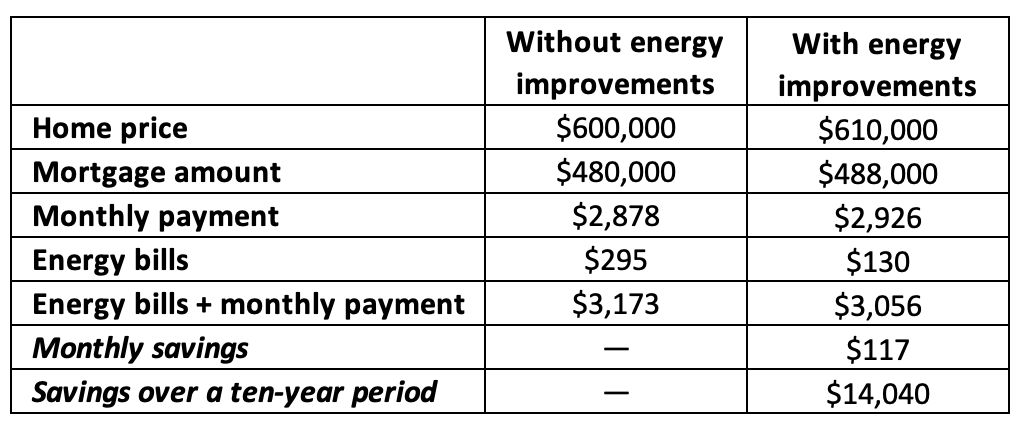
In this example of a home purchased with mortgage funding, the buyer is considering a home with energy improvements, priced $10,000 higher than an equivalent home without energy improvements. The table shows the buyer of the energy efficient home saves $117 during each month of ownership.
At this rate, the energy savings begin to pay off after just over seven years of ownership, resulting in a total savings of $14,040 over ten years.
Whether the higher purchase price is “worth it” to the buyer largely depends on how long the buyer anticipates living in the home — in this example, the buyer needs to live in the home for 7 years or more to realize the energy savings produced by the higher-priced home.
In the absence of a full energy audit, seller agents need to obtain a detailed cost-of-utilities worksheet from the seller. With this operating cost data, the agent prepares a cost-comparison sheet — a CMA BPO report — to compare the energy cost of the seller’s energy-efficient home they offer for sale with similar energy-inefficient homes for sale in the area. [See RPI Form 306]
Geographic influencers
Together with a property’s physical condition, conditions in the neighborhood and surrounding area which affect the property’s value and desirability are material facts. The BPO as an evaluation of their subject property is fully influenced by all material facts about the property.
Unlike property improvements, which can be fixed or replaced to eliminate obsolescence or wear and tear, geographic influences — such as natural hazards — run with the land.
Natural hazard zones include:
- special flood hazard areas, a federal FEMA designation;
- potential flooding and inundation areas;
- very high fire hazard severity zones;
- wildland fire areas;
- earthquake fault zones; and
- seismic hazard zones. [Calif. Civil Code §1103(c)]
Related article:
The existence of a hazard due to a property’s geographic location affects its usefulness or desirability — and thus its pricing offered by prospective buyers and their buyer agents. To unify and streamline the mandated upfront disclosure of natural hazards to a prospective buyer for decisions to buy (and at what price) the seller or seller broker prepares and hands them a Natural Hazard Disclosure Statement (NHD). A broker working up a BPO needs the information in this statement, available by law from the seller or the seller broker, before setting their opinion of value. [See RPI Form 314]
On the other hand, environmental hazards are human-made noxious or annoying conditions which are hazardous for humans. Environmental hazards have an adverse effect on a property’s usefulness — diminishing its value.
As an interference with the use of a property, environmental hazards are defects, material facts the seller agent discloses to prospective buyers and buyer agents by handing over their seller’s TDS on request. [See Chapter 4: Market price influencers]
Environmental hazards located on the property which pose a direct health threat to occupants due to construction materials, the design of the construction, the soil or its location, include:
- asbestos-containing building materials and products used for insulation, fire protection and the strengthening of materials; [Calif. Health and Safety Code §§25915 et seq]
- formaldehyde used in the composition of construction materials; [CC §2079.7(a); Bus & P C §10084.1]
- radon gas concentrations in enclosed, unventilated spaces located within a building where the underlying rock contains uranium; [CC §2079.7(a); Bus & P C §10084.1]
- hazardous waste from materials, products or substances which are toxic, corrosive, ignitable or reactive; [Health & S C §25359.7; Bus & P C §10084.1]
- toxic mold; [Health & S C §§26140, 26147]
- smoke from the combustion of materials, products, supplies or substances located on or within the building; [Health & S C §§13113.7, 13113.8]
- security bars which might interfere with an occupant’s ability to exit a room in order to avoid another hazard, such as a fire; [CC §1102.16; Health & S C §13113.9] and
- lead, found in properties constructed before 1978.
Environmental hazards can also be located off the property but still have an adverse effect on the use of the property — and in turn its pricing. These arise due to noise, vibrations, odors or some other ability to inflict harm, such as:
- military ordnance sites within one mile of the property; [CC §1102.15]
- industrial zoning in the neighborhood of the property; [CC §1102.17]
- airport influence areas established by local airport land commissions; [CC §§1103.4(c), 1353; Calif. Business and Professions Code §11010(b)(13); See RPI Form 308] and
- ground transportation arteries which include train tracks and major highways near the property.
The environmental conditions are also disclosed on the seller TDS a BPO needs to reference for an evaluation.
Related article:
Disclosure of very high fire hazard severity zones
Areas in the state which are subject to significant fire hazards have been identified as very high fire hazard severity zones. When a property is located in a very high fire hazard severity zone, the zone is disclosed to the prospective buyer, and is information needed when preparing a BPO. [See RPI Form 314 §3]
The city, county or district responsible for providing fire protection have designated, by ordinance, very high fire hazard severity zones within their jurisdiction. [Gov C §51179]
The fire hazard disclosure on the NHD form mentions the need to maintain the property. Neither the seller nor the seller agent need to explain the nature of the maintenance required or its burden on ownership. Advice to the buyer on the type of maintenance and the consequences of owning property subject to the maintenance are the duties of the buyer agent, when they have an agent, or the buyer themselves.
Related article:
Wildfire protection is a statewide legislative concern for housing
Disclosure of state-provided water tank
Owners of residential real estate occasionally receive state assistance when their water supply dries up in the form of a water tank from the State Water Resources Control Board.
The state-provided water tank belongs to the state, not the owner of the real estate.
When an owner markets their property for sale with a water tank, the seller broker discloses to potential buyers that the tank is state-owned. [See RPI Form 308 §11]
To make the disclosure, the seller broker provides the buyer a written disclosure of Unique Factors and Conditions Affecting Property and checks the box activating the water tank assistance disclosure with the following information:
- the cause of the dry water well condition;
- information about the Board providing the water tank assistance;
- notice the water tank is not conveyed as part of the sale; and
- notice the buyer needs to inspect the water tank or well and retain a professional to evaluate the suitability of the water for the buyer’s purposes. [See RPI Form 308 §11]
Beyond this information’s use when developing a BPO, it is disclosed by the seller broker in MLS listing data and all other marketing material and communications related to the sale of the real estate. [CC §1102.156]
State Fire Responsibility Area
When a property is in an area where the financial responsibility for preventing or suppressing fires is primarily on the state, the real estate is located within a State Fire Responsibility Area. [Calif. Public Resources Code §4125(a)]
Notices identifying the location of the map designating State Fire Responsibility Areas are posted at the offices of the county recorder, county assessor and the county planning agency. Also, any information received by the county after receipt of a map changing the State Fire Responsibility Areas in the county is posted. [Pub Res C §4125(c)]
When the property is located within a wildland area exposed to substantial forest fire risks, the seller or the seller’s agent discloses this fact. When the property is located in a wildland area, maintenance by the owner is mandated to prevent fires, a cost of ownership affecting its ownership and thus a BPO evaluation of the property. [Pub Res C §4136(a); see RPI Form 314 §4]
In addition, the NHD Statement advises the prospective buyer of a home located in a wildland area that the state has no responsibility for providing fire protection services to the property, unless the Department of Forestry and Fire Protection has entered into a cooperative agreement with the local agency. No further disclosure about whether a cooperating agreement exists need be made by the seller or seller’s agent. [See RPI Form 314 §4]
However, when property disclosures place the property in a wildland area, the buyer’s agent has the duty to advise the buyer about the need to inquire and investigate into what agency provides fire protection to the property.
Related article:
Earthquake fault zones and seismic hazards
To assist seller’s agents and BPO providers in identifying whether the listed property is located in an earthquake fault area, maps have been prepared by the State Geologist.
The State Mining and Geology Board and the city or county planning department have maps available which identify special studies zones, called Alquist-Priolo Maps. [Pub Res C §2622]
The maps are used to identify whether the listed property is located within one-eighth of a mile on either side of a fault.
Also, the NHD Statement requires both the seller and the seller agent to disclose to a prospective buyer or the buyer agent whether they have knowledge the property is in a fault zone. [See RPI Form 314 §5]
A Seismic Hazard Zone map identifies areas which are exposed to earthquake hazards, such as:
- strong ground shaking;
- ground failure, such as liquefaction or landslides [Pub Res C §2692(a)];
- tsunamis [Pub Res C §2692.1];
- dam failures. [Pub Res C §2692(c)]
When the property for sale is susceptible to any of the earthquake (seismic) hazards, the seismic hazard zone disclosure on the NHD Statement is to be marked “Yes.” [See RPI Form 314 §6]
Seismic hazard maps are not available for all areas of California. Also, seismic hazard maps do not show Alquist-Priolo Earthquake Fault Zones. The California Department of Conservation creates the seismic hazards maps.
When the NHD indicates a seismic hazard, the buyer’s agent determines which type of hazard, the level of that hazard and explain the distinction to the buyer, or be certain someone else does. The seller agent has no such affirmative obligation to explain the impact of the disclosures to the buyer.
Related article: