

California’s population stagnated for the first time in living memory starting in 2019, which introduced a decline in population coupled with covid flight lasting until 2022. The rise in 2024 looks like a false start as 2025 stumbles again.
Counties notable for their low-tier priced housing, such as Riverside and Fresno saw a marked rise in population — although nothing close to the 1% growth California is used to.
Steady population growth is essential for the long-term health of the housing market, but it is new household formations which build demand for residential rentals and sales. Expect California’s population to continue its present flat pattern in spite of issues around rent pricing, sales of housing, and the lack of availability by low turnover and weak residential construction starts.
Updated November 13, 2026.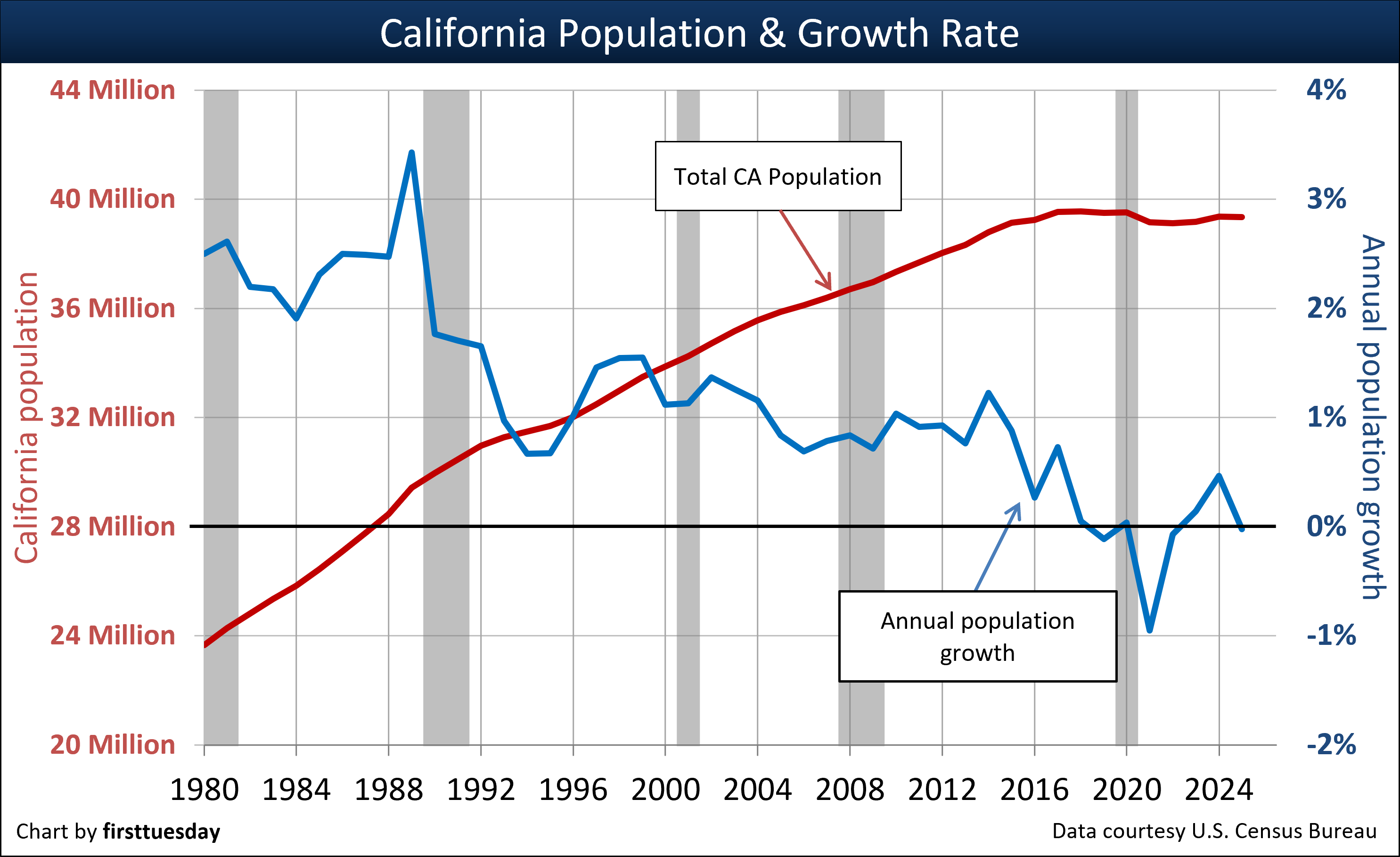 Chart update 11/13/26
| 2025 | 2024 | 2023 | |
| CA Population | 39,355,300 | 39,364,800 | 39,181,700 |
| One-year change | +9,500 | +183,100 | +56,300 |
| Growth rate | +0.02% | +0.47% | +0.14% |
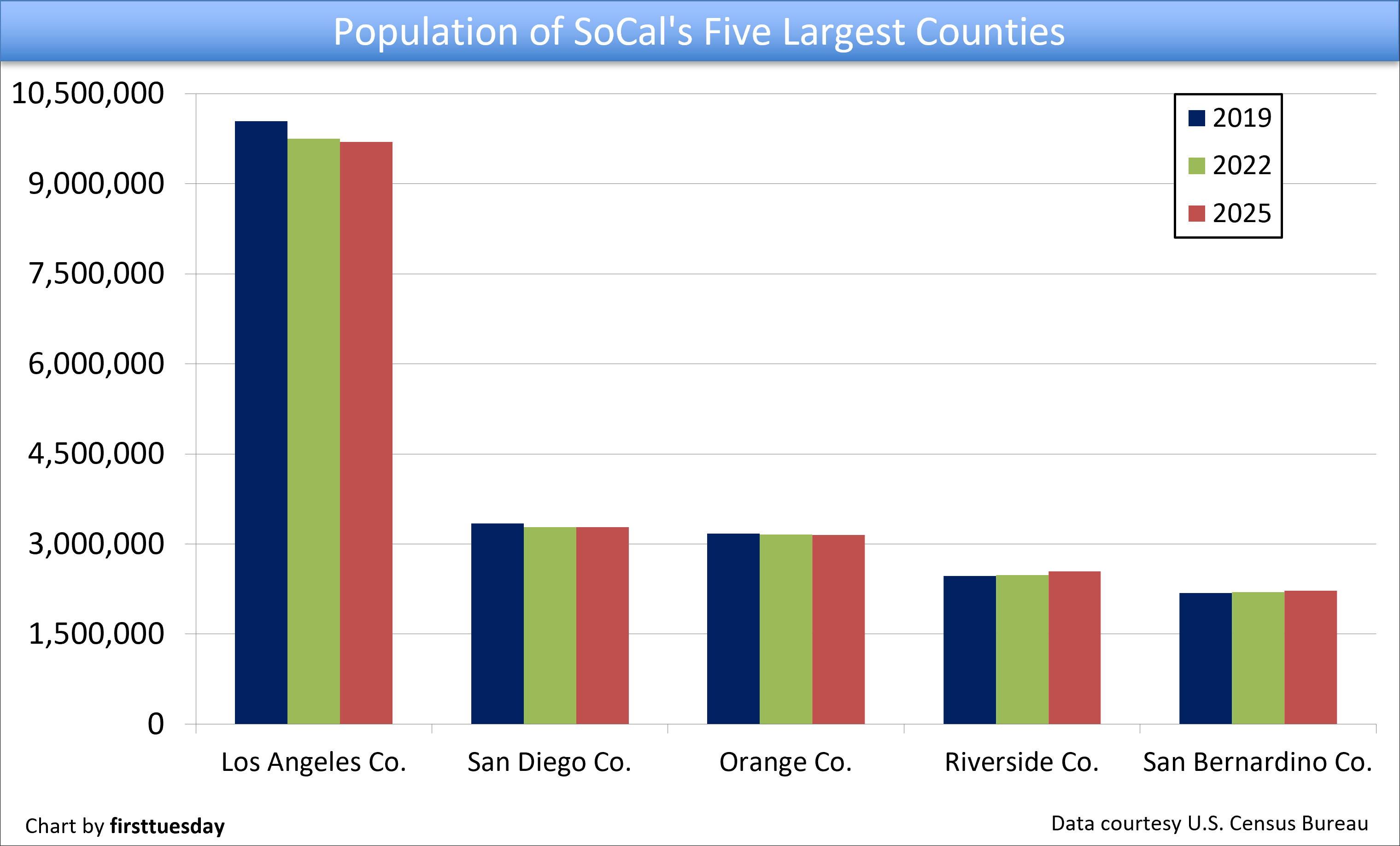 Chart update 11/13/26
| Los Angeles | San Diego | Orange | Riverside | San Bernardino | |
| 2019 | 10,039,100 | 3,301,100 | 3,175,700 | 2,470,500 | 2,180,100 |
| 2022 | 9,748,500 | 3,279,100 | 3,156,300 | 2,479,300 | 2,196,300 |
| 2025 | 9,694,900 | 3,282,200 | 3,149,500 | 2,544,900 | 2,224,100 |
| One-year growth rate | -0.6% | -0.2% | -0.3% | +0.6% | +0.3% |
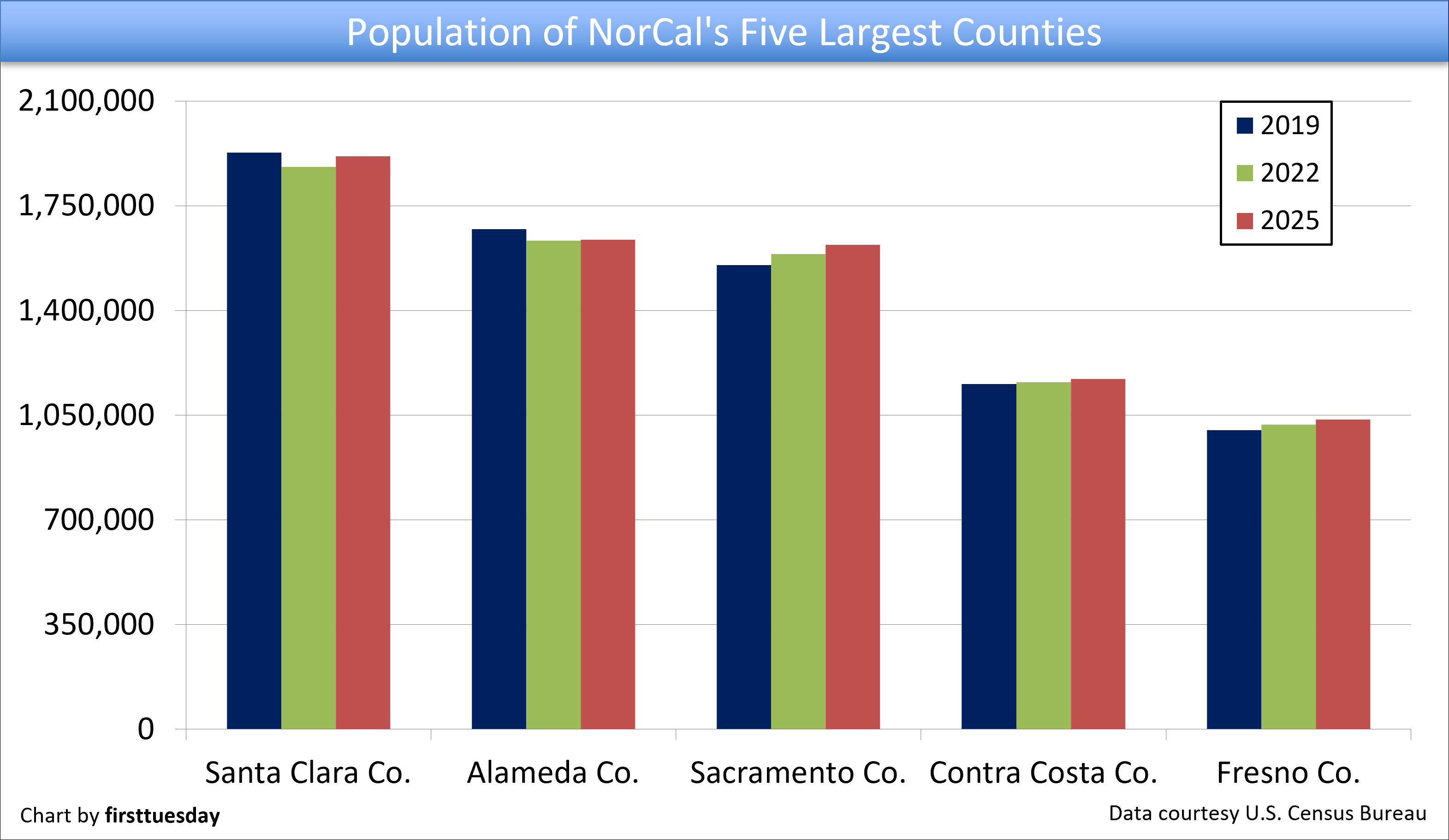 Chart updated 11/13/26
| Santa Clara | Alameda | Sacramento | Contra Costa | Fresno | |
| 2019 | 1,927,900 | 1,671,300 | 1,552,100 | 1,153,500 | 999,100 |
| 2022 | 1,880,200 | 1,633,100 | 1,588,700 | 1,160,200 | 1,017,900 |
| 2025 | 1,914,400 | 1,636,600 | 1,618,500 | 1,170,100 | 1,035,500 |
| One-year growth rate | +0.3% | +0.0% | +0.5% | +0.1% | +0.2% |
This article reviews the current shifts in California’s population and examines the potential impact of migration trends on residential rentals and sales.
Population change: the last thirty years
The first of the above charts tracks the annual change in California’s total population since 1980, based on data about births, deaths and immigration as revealed by the U.S. Census. Two charts track population change in California’s ten largest counties. Coincidentally, the five largest are all located in Southern California, and the following five are all in Northern California.
State population growth is essential for a stable housing market. Brokers and agents who know which demographics are likely to move to and from California’s diverse counties will be better positioned to accommodate the needs of those groups when they arrive.
Population growth in the modern age
The first of the above charts tracks the annual change in California’s total population since 1980, based on data about births, deaths and immigration as revealed by the U.S. Census. Two charts track population change in California’s ten largest counties. Coincidentally, the five largest are all located in Southern California, and the following five are all in Northern California.
State population growth is essential for a stable housing market.
A year without growth in California used to be almost unheard of. Only three counties statewide (Plumas, Sierra and Alpine) saw their populations diminish in the first decade of the new millennium according to the California Department of Finance (DOF).
At the height of the Millennium Boom in 2006, when the population’s decelerating growth rate slipped to 0.5% it was the lowest rate since WWII. Since the second half of the 2010s California has experienced faltering growth lasting until a major dip in 2021 dropped the population by 1%.
While numerous temporary factors influence the rise and fall of California’s population, including birth and death rates, migration, cultural trends and environmental factors, the most important influences by far are economic.
When jobs are plentiful, and housing is available at reasonable prices without the need for significant new construction, people feel empowered to realize the dream of residency in the fabled cities on the Pacific West Coast. A strong economy is an incentive for both interstate and international immigration. A weak local economy discourages the optimistic, causing them to move away.
Related article:
Immigration
Immigration, both documented and undocumented, is a major factor for population growth that contributes to the economy of California. Migration to California drives the need for housing, business space and fee-based services offered by real estate agents.
However, in a recovery period California’s population growth picks up and other states stagnate. California will attract people due to its geography, weather and reputation as it did in the past.
More than half of foreign-born California’s are naturalized US citizens, a number that has increased since 2000. It is important to note that most other immigrants are legal permanent residents. However, California now functions with a negative net migration rate for combined domestic and foreign immigration and has since 2016.
Undocumented immigrants are legally able to buy property, borrow mortgage funds and pay property taxes by use of an Individual Taxpayer Identification Number (ITIN). Thus, the undocumented are of equal importance to the state’s real estate market as they live in residential property and work in commercial property.
Nearly 14 million undocumented immigrants lived in the United States in 2023 with 2.3 million of those in California, as estimated by the Pew Research Center. This California figure is down over half a million people compared to its peak in 2007.
Immigrants have a variety of reasons for being in the country with immigrants originally entering the country legally or immigrants with other statuses protecting them from deportation such as asylum seekers. Of those 14 million nationally, about 6 million have some protection from deportation.
California’s high rate of immigration, including unauthorized immigration, is a largely positive economic force for everyone involved and generally improves the standard of living and employment situation for California’s general population.
Related article:
The result is increased wealth and wellbeing across the state. Reports of competition with the native-born population are exaggerations meant to fog the extensive economic and cultural benefits migration brings to California.
Again, in spite of opinions to the contrary, immigrants have a positive effect in the housing market — they have the power to buy and sell property, pay taxes and contribute to all forms of economic and cultural activity.
As brokers and their agents develop the services they offer to meet the real estate paradigm demanded by each new generation, immigrants become a crucial part of their fees in all locations in the state. This takes place despite often being neglected by trade union brokerage offices.
Further, as Boomers located in suburban and rural areas retire and sell their property, brokers must locate and guide the new Gen Z and Millennial generations of wary buyers considering property ownership.
Intra- and interstate migration
In 2025, Californians numbering 4,049,498 moved from one residence to another (10% of the total state population). 49% of relocating Californians remained in the same county as their former residence in 2024. Another 24% remained in California but moved to a different county.
Renters are far more likely to relocate to take advantage of opportunities than homeowners because of the inherent flexibility of a leasehold estate. The annual rate of relocation was around 15% for renters, and 6% for owners in 2025. Negative equities will return with the coming recession to again drive up owner relocation percentages. Sales agents and MLOs will immediately benefit, to the dismay of builders, until a recovery lifts all real estate activity.
Related article:
Location is everything, when moving
In collaboration with the U.S. Census Bureau, the California Department of Finance (DOF) monitors and forecasts both interstate immigration and intrastate migrations. They present a clear view of which parts of the state are growing or shrinking fastest. While some county populations have remained stable over the last ten years, others have seen their populations explode.
The enormous popularity of Riverside County during the decade is easily explained: as the DOF data indicates, it’s all about housing. For much of the last decade, housing prices in Riverside County grew at a steady rate (one which forecasters erroneously predicted would last forever) while still remaining far more affordable than the coastal cities in nearby counties of Los Angeles, Orange and San Diego.
Related article:
As the West’s largest city, Los Angeles will undoubtedly remain the population center for the foreseeable future. Los Angeles County is forecast to have a population of 9,723,118 by 2030 but wind down to 9.4 million by 2050.
For comparison, the DOF predicts California’s second and third largest counties in 2050 to be Orange and San Diego, both with anticipated populations of over 3 million. Riverside County is predicted to be close behind.
Although nothing is fact when predicting the future, one thing does seem most probable: the recent national politics inhibiting trade and immigration has greatly influenced DOF’s forecast for California’s growth. DOF expects the state to remain stagnant around 39-40 million people for decades to come.
Further, California’s large and influential populations have introduced new challenges in water management, energy and housing sectors. Satisfying these activities has been a source of new talent and new opportunities.
No other state in the nation has the wealth, resources, entrepreneurial spirit, innovative history and stable governance that enables California to maintain its distinctive appeal to the rest of the nation. As time passes, and more come to share the appeal of success, the Golden State can expect its population to grow in more than just number.












In my view, seasonal work patterns alter these movement figures quite a bit. Dreamy Spring Water
The authors say that immigrants “tend to take jobs in different sectors than their English-speaking neighbors. Reports of competition with the native-born population are often exaggerated to become myths.”
Oh really? Ever try looking for a customer service job in a southern California city, when you don’t speak Spanish? You will soon see they will hire a Hispanic person instead of the “English-speaking neighbor.”
NIce article. I really would like to know how many people move here from other states vs. leave to go to Arizona, NV, etc. I’m 99% sure that births over deaths and foreign Immigration (legal or not) accounts for way more than the 286,700 we grew. That means that we have a net out-migration when it comes to legal interstate moves right? Am I missing something? Thanks
It just doesn’t feel like a .7% growth rate, especially in SoCal. Lots of new housing developments being built outside the bigger cities. Lots of new apartments and condos going up in the cities. People converting garages to rental housing everywhere. Multiple generations of the same family doubling up. Homeless people not able to find housing. Freeways getting more jammed. It just feels more like 7% than .7%.
Oh…. Bradley Markano, great charts based on MS Xcl…
More stupid people voted for Brown vs. Genius Meg Whitman…. another “gang of olive size brain adults”.
Stupid Voted 4 Obama, Stupid now experiences 4 years of KRAP. Be smart & Vote for a Hedge Fund Genius!