

Why this matters: During recessions, landlords and tenants may need to enter into partial payment agreements. Landlords generally want long-term tenants to avoid turnover costs of vacancies, and tenants want to avoid costly and time-consuming moves. Commercial landlords and tenants agreeing to partial payments use RPI Form 558, and residential landlords and tenants use RPI Form 559.
The forms commit to writing the portion of remaining delinquent rent the tenant owes the landlord, the date the balance is due, and when not paid by the due date, what action the landlord may take to enforce payment.
Accommodating tenants in a recession
Lost income for businesses and employees is a hallmark trait of recessions. Adapting quickly, not as much.
Landlording is a business which generates significant income in California. Tenants pay rent from their income, whether they are a business or a household.
The right to occupy a property is by mutual agreement. In the context of negotiations, landlords, tenants and their agents need to work together to consider molding an acceptable agreement for a continuing occupancy when incomes are temporarily disrupted. When an economy weakens, it weakens the tenant’s income and in turn the landlord’s income.
A recessionary period is best viewed as likely to bring occasional instability to both tenants and landlords — occupancy for the tenant, rental income for the landlord. The tenant’s income is the landlord’s income, an economic truth.
When a tenant offers a landlord a partial payment, the landlord is best advised to always accept the payment — it’s rent, just less than the amount due. No rights lost by acceptance, as provided in lease agreements.
The organic issue on receipt becomes: when can the landlord expect the balance due?
Commercial and residential landlords and tenants have alternatives at their disposal when the tenant is unable to pay the agreed rent timely and in full. Even unlawful detainer (UD) courts will keep the tenant in place when an eviction is reasonably unnecessary and everyone is returned to their originally intended positions.
Though the tenant is obligated to pay the amount of rent called for in the rental or lease agreement, instances arise where a landlord needs to consider a reasonable alternative: accepting partial payment of rent. [See RPI Form 558 and 559]
Here, both the landlord and the tenant have an income problem in a ripple effect. The landlord expects a rent amount now uncertain due to the tenant’s income weakened by cyclical changes in the economy. Classic, and common in a recession.
Neither is at fault. It is the nature of a recession that most people are affected adversely to some degree, if only to instill caution. Once the recession sets in, it is too late for a tenant to insulate fully against the downturn in their business or employment income. The same goes for a landlord, except the landlord cannot relocate their building to avoid vacancies whereas tenants have mobility.
However, a landlord, aware of the precise steps involved when accepting partial payments, can flexibly deal with delinquent rent.
Related article:
Partial payments and noticing procedures — residential vs. commercial landlords
Acceptance of partial payment toward delinquent rent is within the discretion of the landlord.
Exercising their judgment call ranges from belligerent resistance to an accommodation which sorts out a mutually satisfactory result.
Landlords might reasonably agree to accept partial payments of rent when:
- the partial payment is equal to or near the rent accrued at the time the tenant makes the payment;
- the tenant is creditworthy — economically viable with a source of income;
- the tenant has a decent payment history; and
- the tenant is better retained than replaced.
Both residential and commercial landlords may accept a partial payment of rent. [See RPI Form 558 and 559]
Unless they agreed to the contrary, immediately on receiving a partial payment of delinquent rent, the landlord has the legal right to serve the tenant with a notice to pay demanding payment of the remaining balance of the delinquent rent. [See RPI Form 575-3]
Related article:
Partial payment agreement
It may be reasonable for a landlord in a partial payment agreement situation to accept a partial payment of rent. Thus, they hold off serving a notice to pay when the landlord and tenant agree in writing for later payment of the balance. [See RPI Form 558 and 559]
The partial payment agreement states:
- the amount received is partial rent;
- the amount of deferred rent remaining unpaid;
- a promise to pay the deferred rent;
- the date the payment is due; and
- the consequences of nonpayment.
Related article:
Commercial partial payments
Consider a commercial tenant who experiences cash flow difficulties due to a business downturn. As a result, the tenant will become delinquent in the payment of rent.
Discussions between the landlord and tenant follow with no immediate resolution. To enforce collection of the rent, the landlord serves the tenant with a three-day notice to pay rent or quit. [See RPI Form 575]
Prior to the filing of a UD action, the tenant offers to make a partial payment of the delinquent rent. Further, the tenant offers to pay the balance of the delinquent rent by a specific date conditioned on the landlord not filing a UD action, called a partial payment agreement. [See RPI Form 558]
When the deferred rent is not paid as scheduled, the commercial landlord may file a UD action to evict the tenant without serving another three-day notice. [See RPI Form 558 §7]
Here, the partial payment agreement only temporarily delays the commercial landlord’s eviction process whether the agreement is entered into before or after service of a three-day notice on the tenant.
When the commercial tenant fails to pay the deferred balance of the delinquent rent on the date scheduled for payment, the landlord, without further notice, may file a UD action. If the tenant pays as agreed, the situation of delinquent rent is resolved.
However, in our example, the commercial tenant does not pay the balance due as scheduled, and the landlord files a UD action without further notice to quit. The tenant now claims the landlord’s acceptance of the partial rent payment invalidated the prior three-day notice since the notice no longer states the amount of rent that remains unpaid and due.
Can the commercial landlord accept a payment of partial rent after serving a three-day notice and later file a UD action against the tenant without serving another notice to pay rent or quit for the amount remaining due and now delinquent?
Yes! A commercial landlord can accept a partial payment of rent after serving a three-day notice and before filing the UD action for eviction. Without further notice to the tenant, the commercial landlord can proceed with a UD action and evict the tenant. [Calif. Code of Civil Procedure §1161.1(b)]
Related article:
Form-of-the-Week: Commercial Lease Agreement — Form 552 series
Residential partial payment of rent
A residential landlord who serves a three-day notice demanding payment of delinquent rent and later accepts any amount of rent from the tenant invalidates the notice. It may not be used to support a UD action to evict the residential tenant. [Calif. Civil Code §1945]
Further, when a residential landlord files a UD action and, prior to an award for eviction, accepts a partial payment of rent, the acceptance of rent nullifies the UD action, and the landlord may not continue the action. A new three-day notice to pay needs to be prepared and served on the tenant.
The reason the UD action may not proceed lies in the difference in the dollar amounts between:
- the amount of rent demanded in the notice to pay used as the basis for supporting the UD action; and
- the amount remaining unpaid at the time of the UD hearing.
In residential UD actions, the rent amounts due must be stated as the same in both the notice to pay and the amount owed by the tenant at the time for the hearing on the UD eviction. Once the residential landlord accepts a partial payment of delinquent rent, the notice served on the tenant no longer states the correct amount due for the tenant to avoid losing their right of possession.
This residential rental rule for the money claims in the UD filing does not apply to commercial tenancies, as reviewed above.
Also, a residential tenant served with any notice to pay delinquent rent which overstates the amount of delinquent rent owed by the tenant also invalidates the UD action. It may not be an estimated amount for residential tenancies as it may be for commercial tenancies. [Jaysinghe v. Lee (1993) 13 CA4th Supp. 33]
After receiving partial rent, a residential landlord who does not receive the further payment of rent as agreed prepares and serves the tenant with a notice to pay. The new notice states the exact amount of delinquent rent now remaining unpaid. When the notice expires without receipt of the entire stated amount, the landlord may file a UD action claiming the same amount of unpaid rent. [EDC Associates, Ltd. v. Gutierrez (1984) 153 CA3d 167]
Related article:
Residential partial payment agreement
The partial payment agreement entered into by a tenant and a landlord to document the acceptance of partial rent memorializes:
- the landlord’s receipt of partial rent;
- the amount owed on the deferred portion of the delinquent rent;
- the tenant’s promise to pay the remaining rent owed on or before a specific date; and
- notification of the landlord’s right to serve a notice to pay on failure to pay the remaining balance as agreed. [See RPI Form 559]
Consider a recently unemployed residential tenant who informs the landlord they will be unable to pay the full monthly rent before the payment becomes delinquent. The tenant offers to pay part of the rent prior to delinquency and the remainder ten days later.
The tenant appears creditworthy, has not been seriously delinquent in the past and the landlord would rather retain the tenant than locate another tenant and relet the unit. Here, the residential landlord agrees to accept the partial payment.
However, to avoid disputes regarding the amount of rent remaining due and when it will be paid, the residential landlord always prepares, and the landlord and tenant sign, a partial payment agreement to document their understanding. [See RPI Form 559]
Now consider a residential landlord who serves a notice to pay delinquent rent, files a UD action and, before the UD hearing, accepts a partial payment of rent. By accepting a partial payment, the residential landlord understands the notice is now invalid and no longer supports a UD action.
Again, when the residential landlord accepts payment of partial rent, it is prudent to have the tenant enter into a partial payment agreement stating the balance owed and the date it is due. The partial payment agreement prevents future disputes with the tenant about what amount is owed or when it is due.
When the balance is not timely paid, a notice to pay may be served. When payment is not received and the tenant has not vacated, the landlord may then file a UD action. [See RPI Form 575]
Related article:
Get it in writing, always — it’s real estate
Without a written partial payment agreement, tenants may claim the landlord, by accepting partial rent:
- treated acceptance of partial rent as satisfaction of all the rent due;
- waived their right to continue eviction proceedings; or
- permanently modified the lease agreement, establishing a semi-monthly rent payment schedule.
When a residential or commercial landlord accepts a partial payment of rent, the evidence provided by a signed partial payment agreement overcomes tenant claims that the landlord waived UD enforcement rights by accepting rent.
Inducing a tenant to stay
In most cases, landlords desire a long-term tenant who will pay rent as a steady stream of income for a set period of time.
Thus, a landlord has financial incentive for the tenant to stay and continue to pay rent rather than find another tenant to fill a vacant property while incurring turnover costs.
Most business owners have long known their current clients are the best source of clientele. This business model is a point often overlooked by corporate ownership of rental property, a passive business requiring material participation by the owner.
Likewise, tenants generally want to stay in the property to avoid the laborious task of finding a suitable replacement property and the expense of moving.
Thus, landlords and tenants have the same objective in mind: retaining an ongoing occupancy by the existing tenant throughout the term of their lease — or longer by extension. The catch is all this change in circumstances requires discussion and negotiations, a retraining of landlords during recessions and periods of rising vacancies.
As recessions take hold of the economy, vacancies increase, tending to force rent reductions to induce tenants to extend occupancy of a property or simply achieving an additional vacancy.
For the landlord to induce a current tenant to stay, they need to offer competitive rental rates or otherwise risk the loss of a stream of income until a replacement tenant is located and accommodated. The adjustment in rent in a recession is the other side of the adjustment in rent in a period of recovery to boom, and for the same reasons: market rates.
A landlord may reduce a tenant’s rent to match market rates by modifying a month-to-month rental agreement or lease agreement. [See RPI Form 550 and 551]
Related article:
Analyzing the commercial partial payment agreement
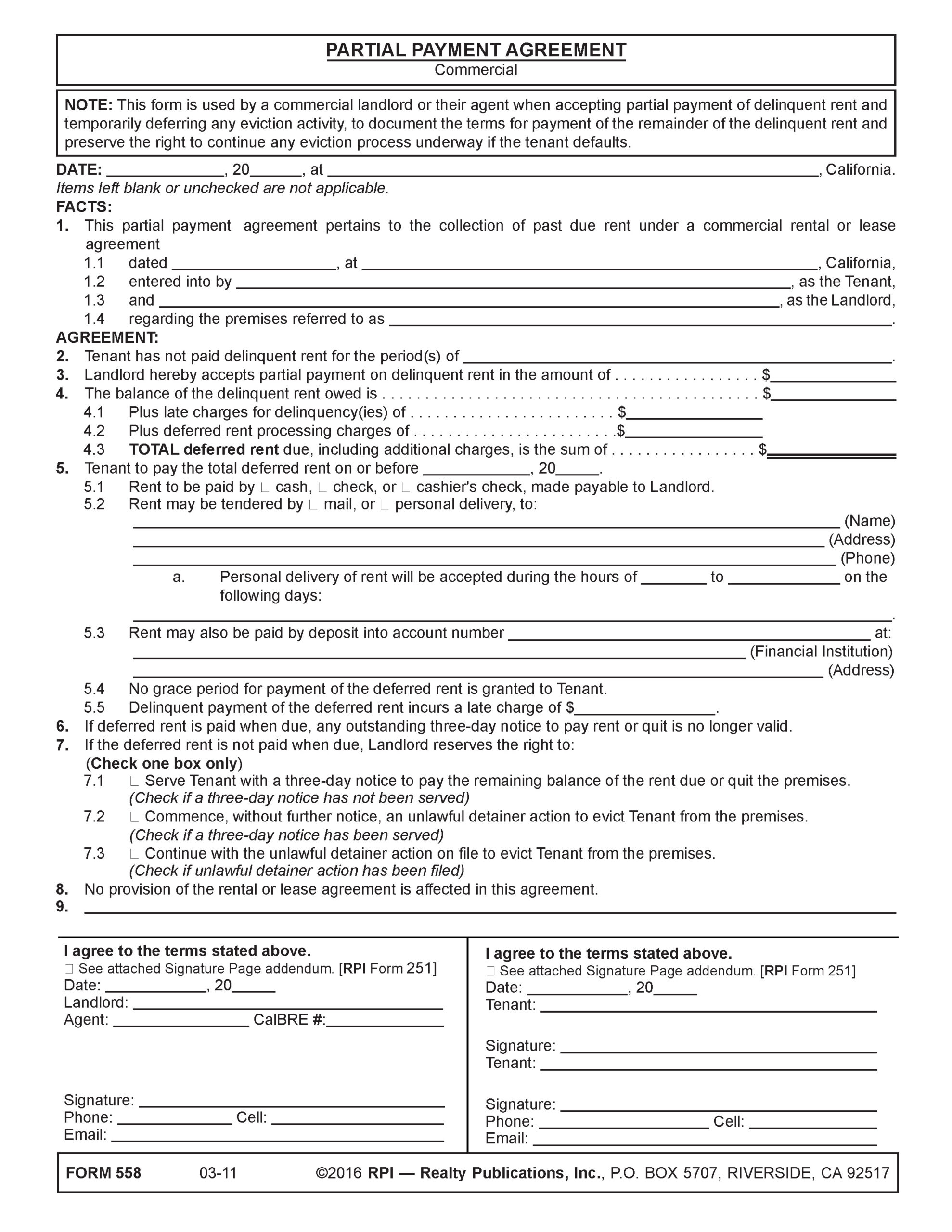
A commercial landlord or their agent uses the Partial Payment Agreement — Commercial published by Realty Publications, Inc. (RPI) when accepting partial payment of delinquent rent and conditionally deferring any eviction activity. The form documents the terms for payment of the remaining delinquent rent and reserves the right to continue any eviction process underway on failure to pay. [See RPI Form 558]
The Partial Payment Agreement — Commercial includes:
- Facts: the date of the partial payment agreement, identifying the tenant, landlord and leased real estate [See RPI Form 558 §1];
- Agreement: the landlord and tenant agree on:
- the period for which the tenant owes the delinquent rent [See RPI Form 558 §2];
- the amount of the partial payment the landlord accepts [See RPI Form 558 §3];
- the amount of delinquent rent still owed [See RPI Form 558 §4];
- late charges, if any [See RPI Form 558 §4.1];
- processing charges, if any [See RPI Form 558 §4.2];
- total rent due, including any charges [See RPI Form 558 §4.3];
- the date the tenant agrees to have paid the amount of deferred rent [See RPI Form 558 §5];
- the method for payment of rent (cash, check or cashier’s check) [See RPI Form 558 §5.1];
- the name, address and phone number where rent can be paid [See RPI Form 558 §5.2];
- the account number, financial institution and address where rent may be paid [See RPI Form 558 §5.3];
- a boilerplate notice that no grace period exists for payment of deferred rent [See RPI Form 558 §5.4];
- the amount of late charge for delinquent payment of the deferred rent [See RPI Form 558 §5.5];
- a boilerplate notice stating when deferred rent is timely paid, any outstanding three-day notice to pay rent or quit is no longer valid [See RPI Form 558 §6];
- the landlord may select one of three checkboxes indicating what will happen when deferred rent is not paid when due, including:
- the landlord will serve the tenant with a three-day notice to pay the remaining balance of the rent due or quit the premises [See RPI Form 558 §7.1];
- the landlord has already served a three-day notice to pay rent or quit, and the landlord will commence a UD action to evict the tenant [See RPI Form 558 §7.2];
- when a UD action has been filed, the landlord will continue with the UD action to evict the tenant [See RPI Form 558 §7.3];
- no provision of the lease agreement is affected by the partial payment agreement [See RPI Form 558 §8]; and
- Signatures of the landlord and tenant. [See RPI Form 558]
Analyzing the residential partial payment agreement
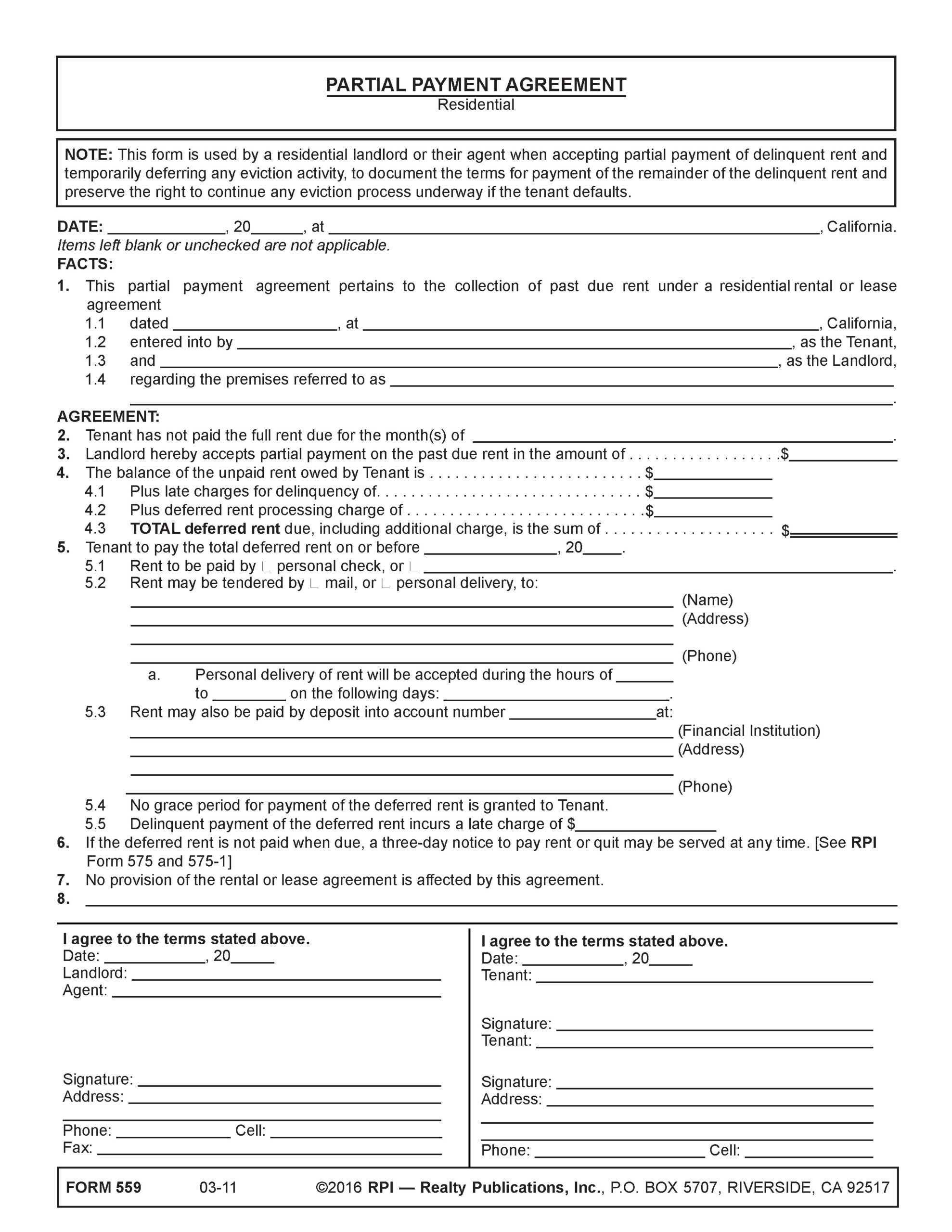
A residential landlord or their agent uses the Partial Payment Agreement — Residential published by RPI when accepting partial payment of delinquent rent which automatically cancels any prior notices to pay or UD filing. The form documents the landlord’s agreement with the tenant stating when the delinquent rent is due, and when not paid, that the landlord may serve a notice to pay rent or quit to enforce collection or eviction of the tenant. [See RPI Form 559]
The Partial Payment Agreement — Residential includes:
- Facts: the date of the partial payment agreement, identifying the tenant, landlord and leased real estate [See RPI Form 559 §1];
- Agreement: the landlord and tenant agree on:
- the month(s) the tenant has not paid delinquent rent [See RPI Form 559 §2];
- the amount of the partial payment the landlord accepts [See RPI Form 559 §3];
- the amount of delinquent rent still owed [See RPI Form 559 §4];
- late charges, if any [See RPI Form 559 §4.1];
- processing charges, if any [See RPI Form 559 §4.2];
- total rent due, including any charges [See RPI Form 559 §4.3];
- the date the tenant agrees to pay the amount of deferred rent [See RPI Form 559 §5];
- the method for payment of rent (personal check, other) [See RPI Form 559 §5.1];
- the name, address and phone number where rent can be paid [See RPI Form 559 §5.2];
- the account number, financial institution and address of where rent may be paid [See RPI Form 559 §5.3];
- a boilerplate notice that no grace period for payment of deferred rent is granted [See RPI Form 559 §5.4];
- the amount of late charge for delinquent payment of the deferred rent [See RPI Form 559 §5.5];
- a boilerplate notice that when the deferred rent is not paid when due as agreed, a notice to pay rent or quit may be served at any time [See RPI Form 559 §6];
- no provision of the lease agreement is affected by the partial payment agreement [See RPI Form 559 §7]; and
- Signatures of the landlord and tenant. [See RPI Form 559]
Related article:
Form-of-the-Week: Accepting partial rent payments – Forms 558 and 559











Great website for discovering the latest Android games and APKs. I really like how APKS Market provides a variety of gaming apps in one place with easy access to popular titles. Keep up the great work!
You can also check out **apksmarket.com.pk** for more latest APKs and gaming updates.
This is a useful and well-structured article with some interesting insights for readers exploring digital entertainment. I especially liked how it explains the topic in a straightforward and easy-to-follow way. For readers looking for more entertainment apps, this could also be worth exploring. Overall, a helpful read with practical information.
This is an excellent breakdown of the differences between Forms 558 and 559. The point about residential landlords needing to issue a fresh three-day notice after accepting any partial payment is something many property managers overlook — it’s a procedural trap that can derail an otherwise straightforward UD action.
One thing I’d add from experience: documenting the payment method in the partial payment agreement (as covered in §5.1) is more important than it might seem. Disputes about whether a payment was actually received on time are far easier to resolve when the agreement specifies whether it’s a check, cashier’s check, or bank transfer, and where exactly it needs to be delivered.
For anyone managing multiple units during an economic downturn, having these forms ready — and understanding when accepting rent resets your legal clock versus when it doesn’t (the commercial vs. residential distinction here) — is genuinely valuable. The framing of the tenant’s income being the landlord’s income is a practical mindset that makes negotiating partial payments feel less adversarial and more collaborative.