

Why this matters: Informed real estate agents and brokers understand how changes to California’s median age and level of education relate to the population’s debt obligations, available savings, and interest in ownership. Among recent high prices and mortgage rates, the amount potential clients are qualified to borrow determines the areas they choose to live in and their ability to enter into homeownership.
Changes county by county
The median age of Californians has increased steadily over the past decade, as has the rate of high school and college graduation. The median age of all major counties in Northern and Southern California increased or remained the same in 2025 over the previous year.
High school graduation rates fell or remained stagnant for most counties. In contrast, the growth of those 25 and older with a bachelor’s degree experienced some decline in Riverside and Fresno, but otherwise grew throughout California.
These factors fluctuate yearly in response to local economic and demographic trends. Changes are more pronounced in younger, less wealthy counties of the Inland Empire and Central Valley and subtler in older, wealthier coastal counties.
Greater educational achievement translates to higher lifetime earnings and increased purchasing power. As California’s larger demographic profile changes to primarily older, more educated residents, agents must learn about their local demographics and adjust their practice to cater to the weight of local trends.
Post updated December 29, 2025.
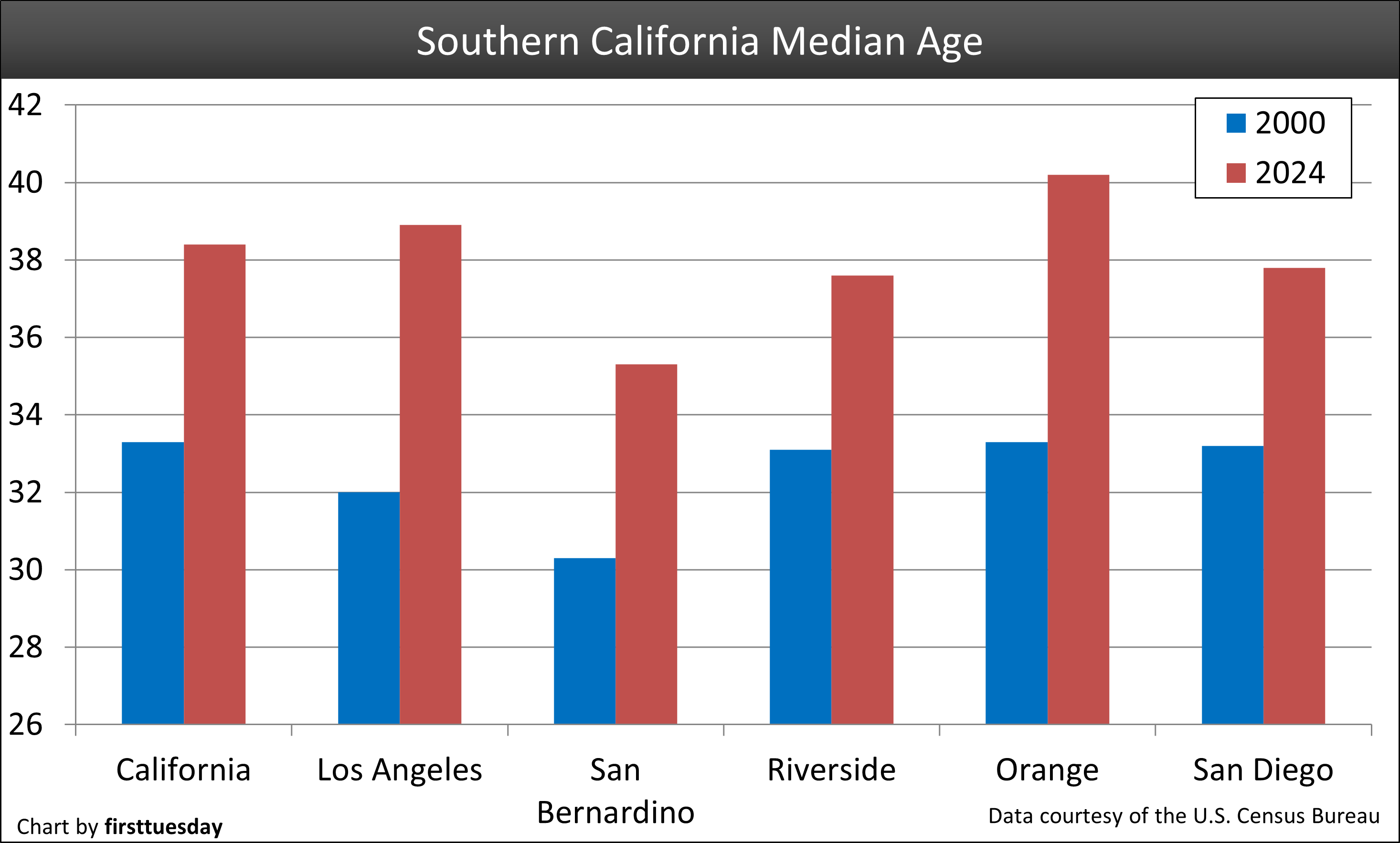
Chart update 12/29/25
| Los Angeles | San Bernardino | Riverside | Orange | San Diego | |
| 2000 | 32.0 | 30.3 | 33.1 | 33.3 | 33.2 |
| 2024 | 38.9 | 35.3 | 37.6 | 40.2 | 37.8 |
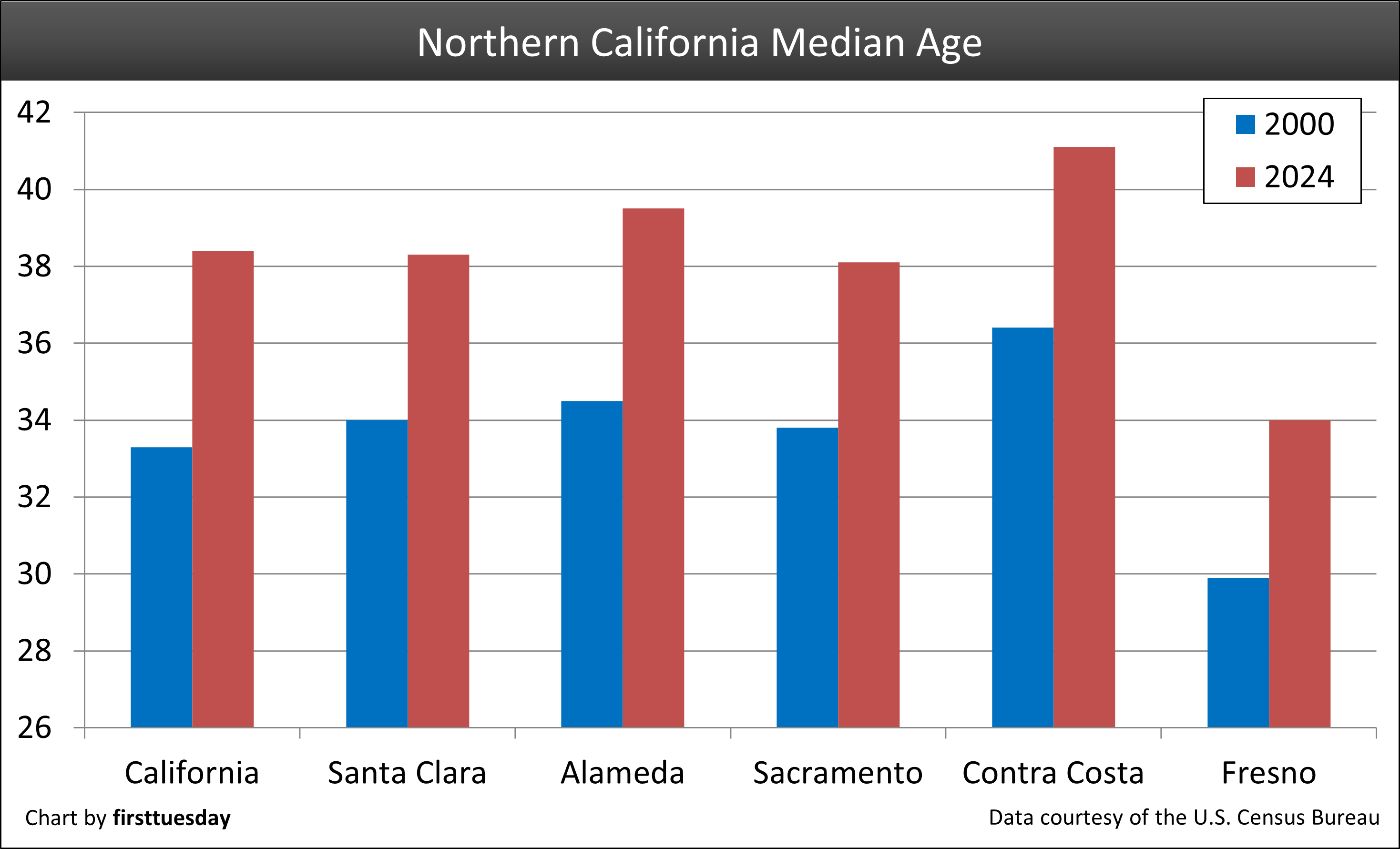
Chart update 12/29/25
| Santa Clara | Alameda | Sacramento | Contra Costa | Fresno | |
| 2000 | 34 | 34.5 | 33.8 | 36.4 | 29.9 |
| 2024 | 38.3 | 39.5 | 38.1 | 41.1 | 34 |
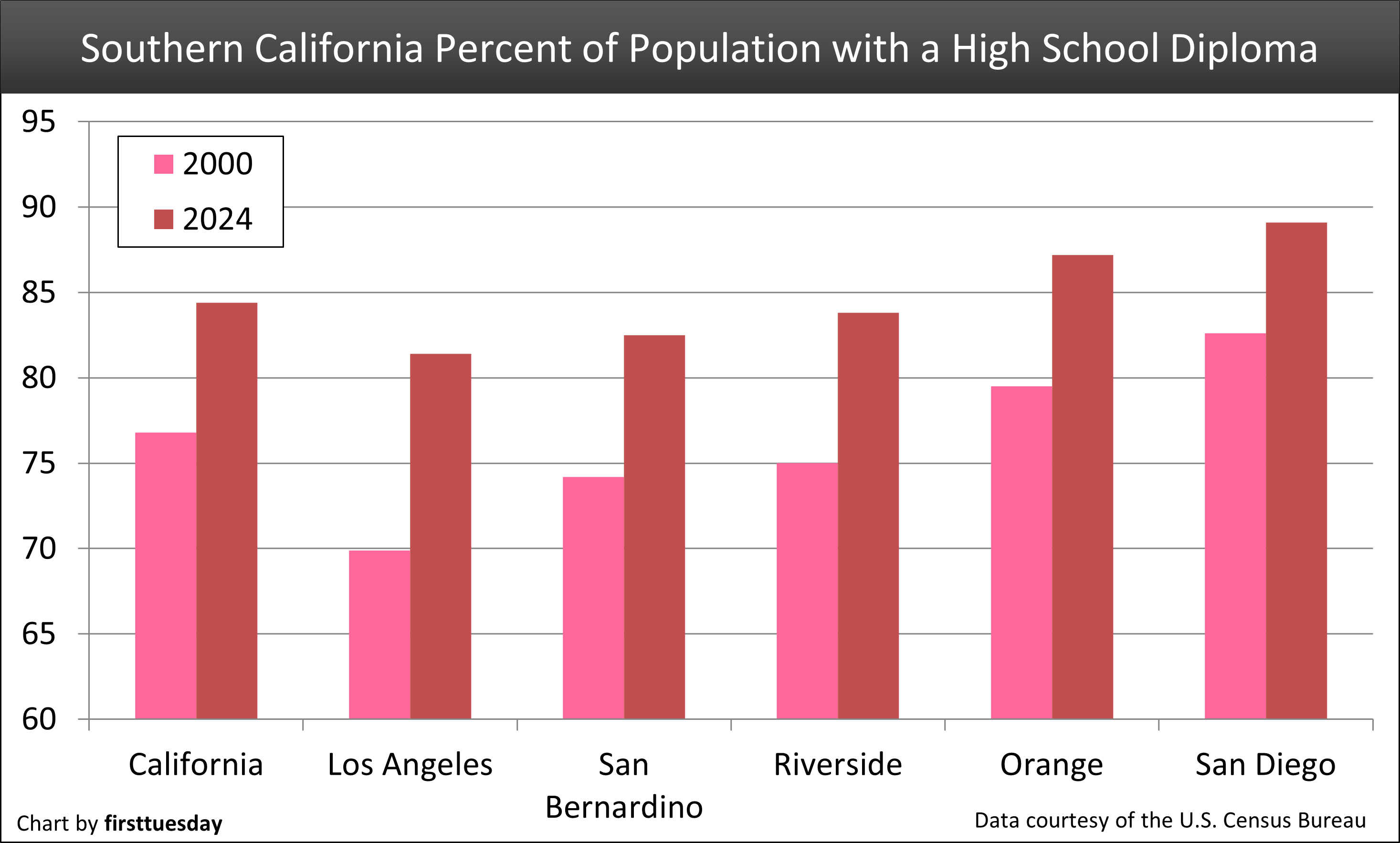
Chart update 12/29/25
| Los Angeles | San Bernardino | Riverside | Orange | San Diego | |
| 2000 | 69.9% | 74.2% | 75% | 79.5% | 82.6% |
| 2024 | 81.4% | 82.5% | 83.8% | 87.2% | 89.1% |
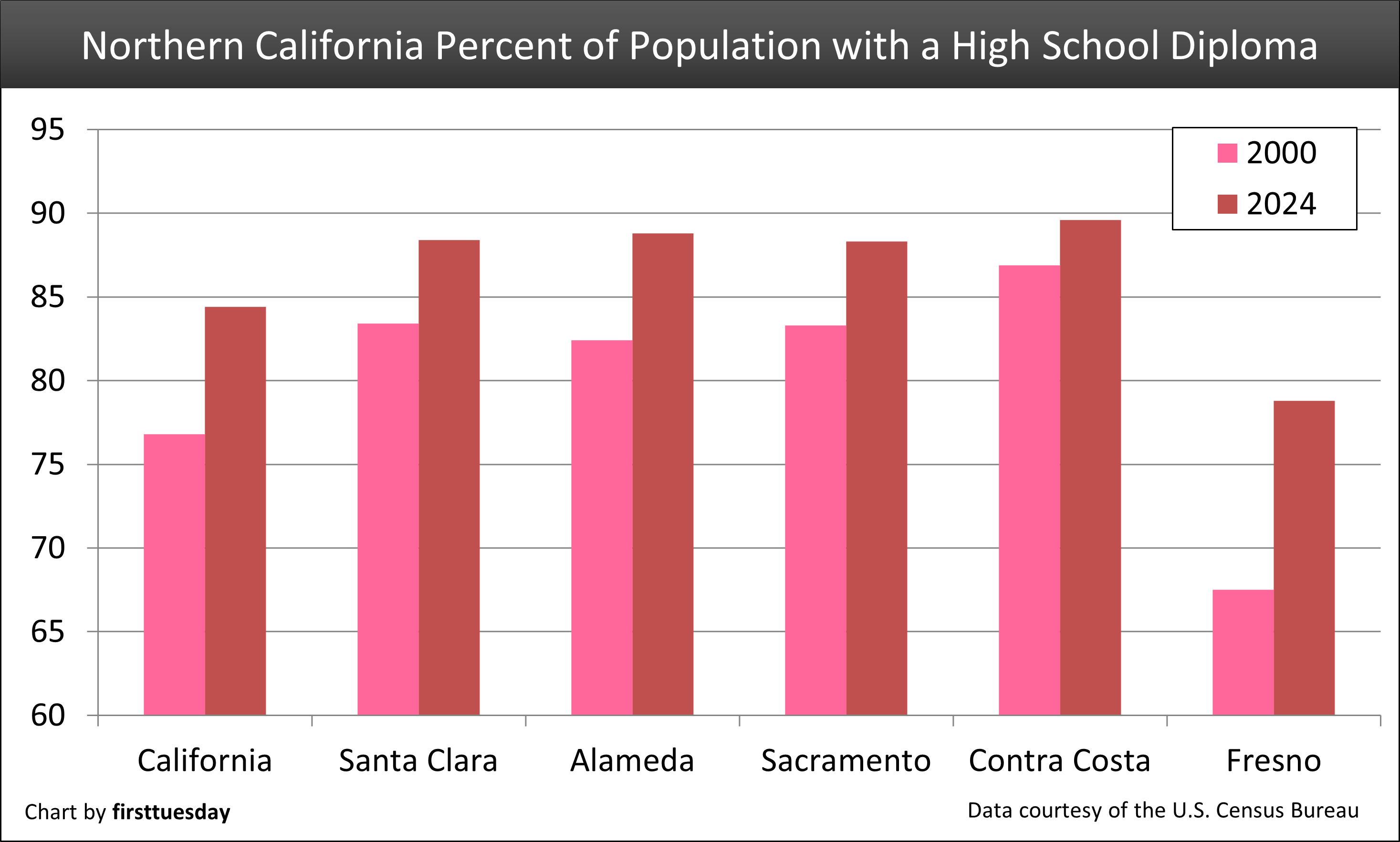
Chart update 12/29/25
| Santa Clara | Alameda | Sacramento | Contra Costa | Fresno | |
| 2000 | 83.4% | 82.4% | 83.3% | 86.9% | 67.5% |
| 2024 | 88.4% | 88.8% | 88.3% | 89.6% | 78.8% |
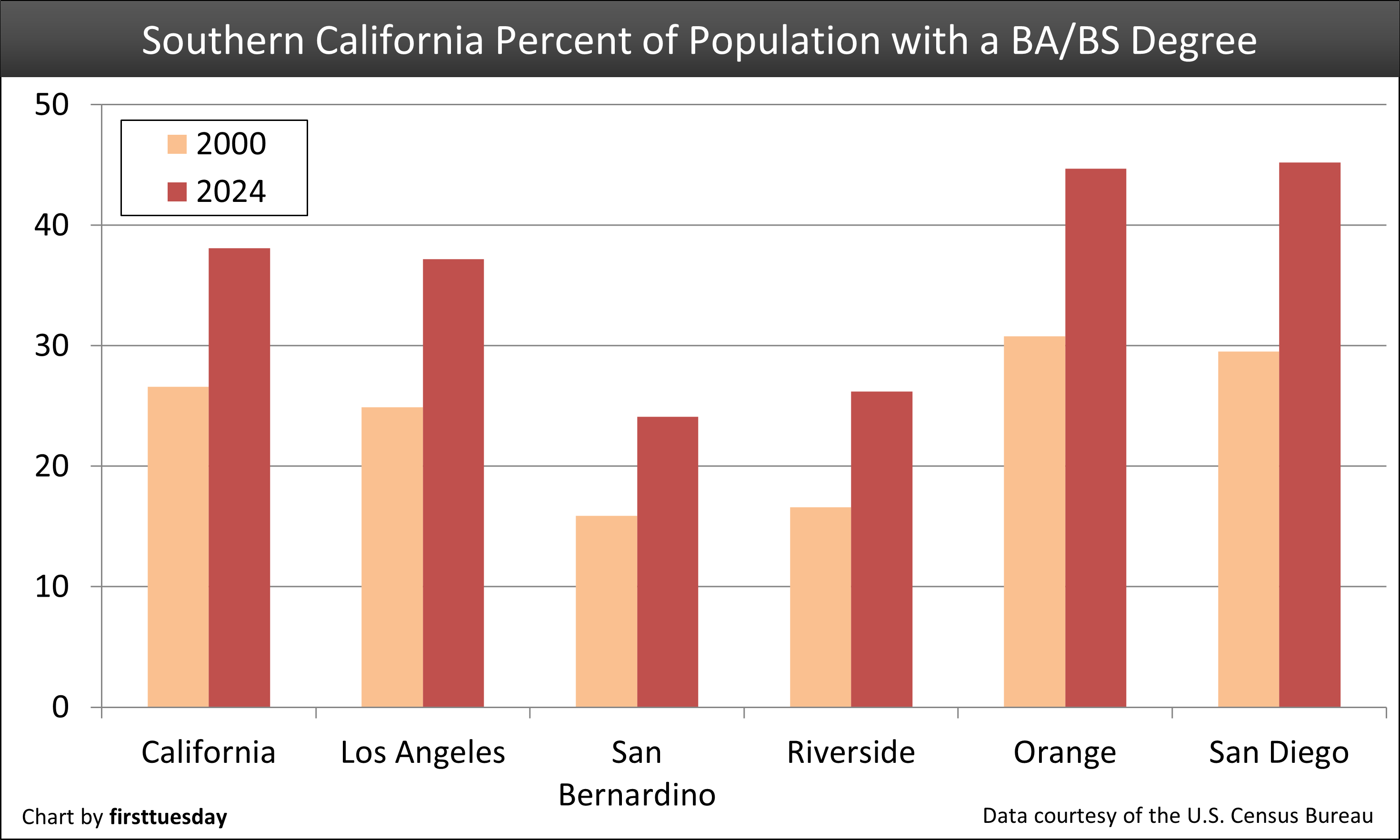
Chart update 12/29/25
| Los Angeles | San Bernardino | Riverside | Orange | San Diego | |
| 2000 | 24.9% | 15.9% | 16.6% | 30.8% | 29.5% |
| 2024 | 37.2% | 24.1% | 26.2% | 44.7% | 45.2% |
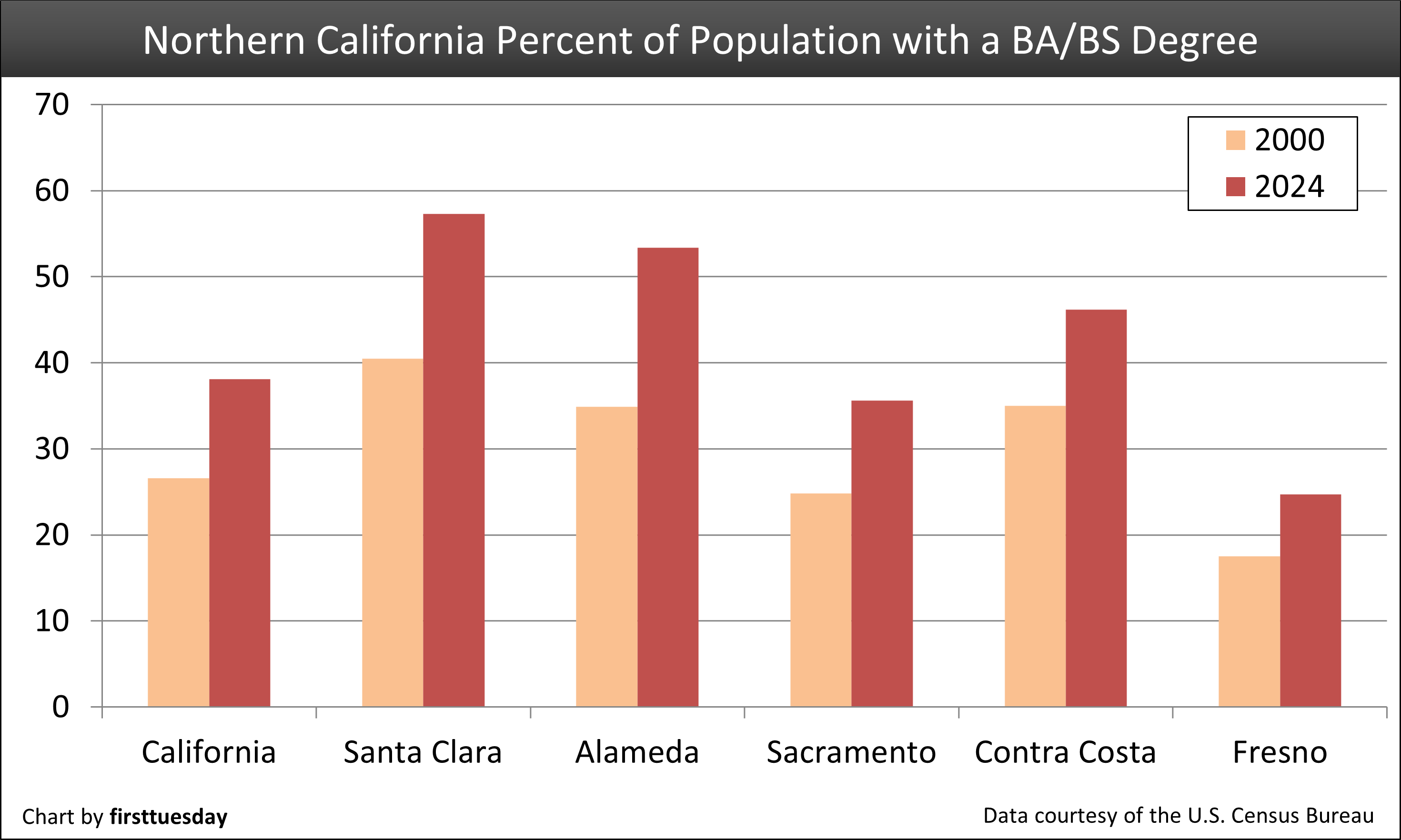
Chart update 12/29/25
| Santa Clara | Alameda | Sacramento | Contra Costa | Fresno | |
| 2000 | 40.5% | 34.9% | 24.8% | 35% | 17.5% |
| 2024 | 57.3% | 53.4% | 35.6% | 46.2% | 24.7% |
Data courtesy of the U.S. Census Bureau
The above charts track age and education levels at the start of the last two decades for the five largest counties in Southern California (SoCal) and Northern California (NorCal), as well as the state as a whole. Together, these charts present the ten most populated counties statewide.
Age and propensity to own
Homebuyers may purchase a house at any time throughout their lives, but certain age groups are more likely than others to buy and sell their homes. Historically, agents can count on young adults aged 25-34, the primary demographic of first-time homebuyers, to sense they need to own rather than rent and, with little encouragement, purchase their first small single family residence (SFR).
But note the age of first-time buyers has steadily crept up, a long-term trend which set in years ago. Two connected forces drive this delay in buying:
- those with higher education tend to be very mobile, allowing them to relocate and take advantage of a better job opportunity and greater income as renters; and
- those with student loans carry a monthly payment burden and few savings which does not qualify them for the mortgage borrowing necessary to fund the standard of living achieved by renting.
A further economic double whammy unrelated to education is mortgage rates and home pricing. Mortgage rates have more than doubled since 2013 to greatly reduce the amount of purchase-assist funds a household’s gross income qualifies to borrow.
Property pricing has risen excessively since the early 2000s and now remains at peak levels. Homes rent today for around 25% less than the monthly cost of owning the same or similar residence with a 20% down payment. A lesser down payment increases the monthly cost spread for owning rather than renting comparable property.
On the opposite end of the spectrum, the newly retired generally sell their oversized homes and buy a replacement home in a new location. Relocation is often along the coast, to enjoy better weather, a closer proximity to their professionally employed Millennial children, or for access to cultural, hospitality and medical centers.
Related article:
Will first-time homebuyers save California’s homeownership rate?
While no hard distinction exists between “youthful” and “elderly” communities in California, some useful generalizations can be made. As the charts demonstrate, median age is rising throughout California. The median age today is over five years older than it was in 2000 suggesting greater retention of the elderly and fewer new families moving in. Some communities have grown more exclusionary and less appealing to young career-seekers, such as Orange County, and thus are ageing out much faster than others.
Related article:
Golden state population trends
The most dramatic changes have taken place throughout Southern California, where Los Angeles and especially Orange County both aged faster than the state average. This may be due largely to the boom in housing prices, which drove out less established young homebuyers while drawing in skilled older citizens with accumulated wealth who buy their homes. As prices drop in a recession the youth will return, and the recent age rise will level out.
In the meantime, the young population staying in California has concentrated itself in California’s Inland Empire. There, low cost-housing remains accessible within driving distance of major cities and career opportunities. Not incidentally, Riverside’s population grew faster over the last twenty years than any of the other counties listed, gaining 984,500+ people – a 64% increase in size – in the first two decades of the 2000s. San Bernardino and Sacramento followed suit, growing by 30% and 32% respectively.
The counties of Northern California have aged more uniformly, generally keeping pace with the state as a whole. Orange County residents who want a glimpse of their future should have a look at Alameda and Contra Costa counties, which retain the highest median ages in the state. Accompanying this population are high home prices, strong employment in careers that cater to the elderly (especially in the field of medicine) and a low number of rentals.
An aging population means a different kind of home sales activity. Retirees very frequently remove their wealth from the financial markets, called dis-saving, and relocate to a smaller, more accommodating home upon their retirement.
Brokers in Orange County and most of NorCal might better prepare to assist these buyers and sellers looking to relocate to enjoy their golden years.
NorCal’s exceptions, again, were the less wealthy Central Valley counties of Sacramento and Fresno, where low home prices and available jobs in untrained positions (especially agriculture jobs in Fresno) served to keep the population young. The population in these counties, like that of Riverside and San Bernardino, lacked the accumulated wealth and home equity necessary to retain homeownership on a broad scale during the 2008 recession, as an economically debilitating number of jobs were lost statewide.
Education
More highly educated populations tend to seek out higher-paying white-collar jobs, which are most available in higher-density population centers, i.e. cities. The educated also have a tendency to be more socially connected in civic concerns and more conscious of their personal behavior as environmental issues, dispositions best satisfied by renting rather than owning in California’s urban centers.
In times of economic stagnation like the present, renters by choice are augmented by renters by necessity; those for whom traditional SFR ownership is no longer an economically feasible option. Keep in mind that even in the next economic recovery, buyers will be intimidated by high mortgage rates to wait on homeownership.
Brokers and agents who take the extra step to get a wavering homebuyer pre-approved by two or three MLOs may give their client the extra boost of confidence needed to go for owing their home.
With the charts and data presented above, you might be tempted to make useless generalizations about California areas. Remember, there are young people in Contra Costa and Alameda counties, wealthy people in Fresno and San Bernardino, and extremely well-educated people in the Inland Empire and Los Angeles.
Nonetheless, agents with a broad base of clients are those who most need to be familiar with the differing needs of tenants and buyers of residential property in their specific county. While agents act as gatekeepers by ushering in home buyers and tenants, investors and business owners tend to follow the crowd, not lead it.











I appreciated learning how age and education levels vary across California counties — it gave me a clearer picture of demographic trends
Interesting perspective. I liked how you highlighted the important aspects without overcomplicating things. It definitely gave me something to think about.