Why this matters: A commercial leasing agent and a landlord have several options for including addenda in a commercial lease agreement, including the Maintenance Modification Addendum, Alienation Addendum, Subordination Addendum and a lease agreement addendum with blank spaces.
Commercial lease agreement
A lease agreement conveying possession to real estate for a period exceeding one year is only enforceable when evidenced in a written document signed by the landlord and the tenant — a statute of frauds requirement. [CC §1624(a)(3)]
In an analysis, provisions in a lease agreement are separated into three categories of landlord and tenant activities:
- conveyance of the leasehold interest;
- money obligations of the tenant for payment of rent and property operating expenses; and
- responsibility of the tenant and the landlord for care and maintenance of the property. [See RPI Form 552]
Further, commercial lease agreements exist in many variations. The landlord and tenant choose one based on:
- whether the property is for single or multi-tenant use;
- the type of tenancy conveyed; and
- who is responsible for maintenance.
Realty Publications, Inc. (RPI) publishes and maintains gross and net lease agreements tailored to common variations in commercial rental and lease agreements, including:
- Single Tenant Gross Lease [See RPI Form 552];
- Multi-Tenant Gross Lease [See RPI Form 552-1];
- Single Tenant Net Lease [See RPI Form 552-2];
- Multi-Tenant Net Lease [See RPI Form 552-3];
- Percentage Lease [See RPI Form 552-4]; and
- Month-to-Month Tenancy. [See RPI Form 552-5]
A landlord and tenant may further customize and modify their lease agreements with different addenda, such as:
- Maintenance Modification Addendum [See RPI Form 552-6];
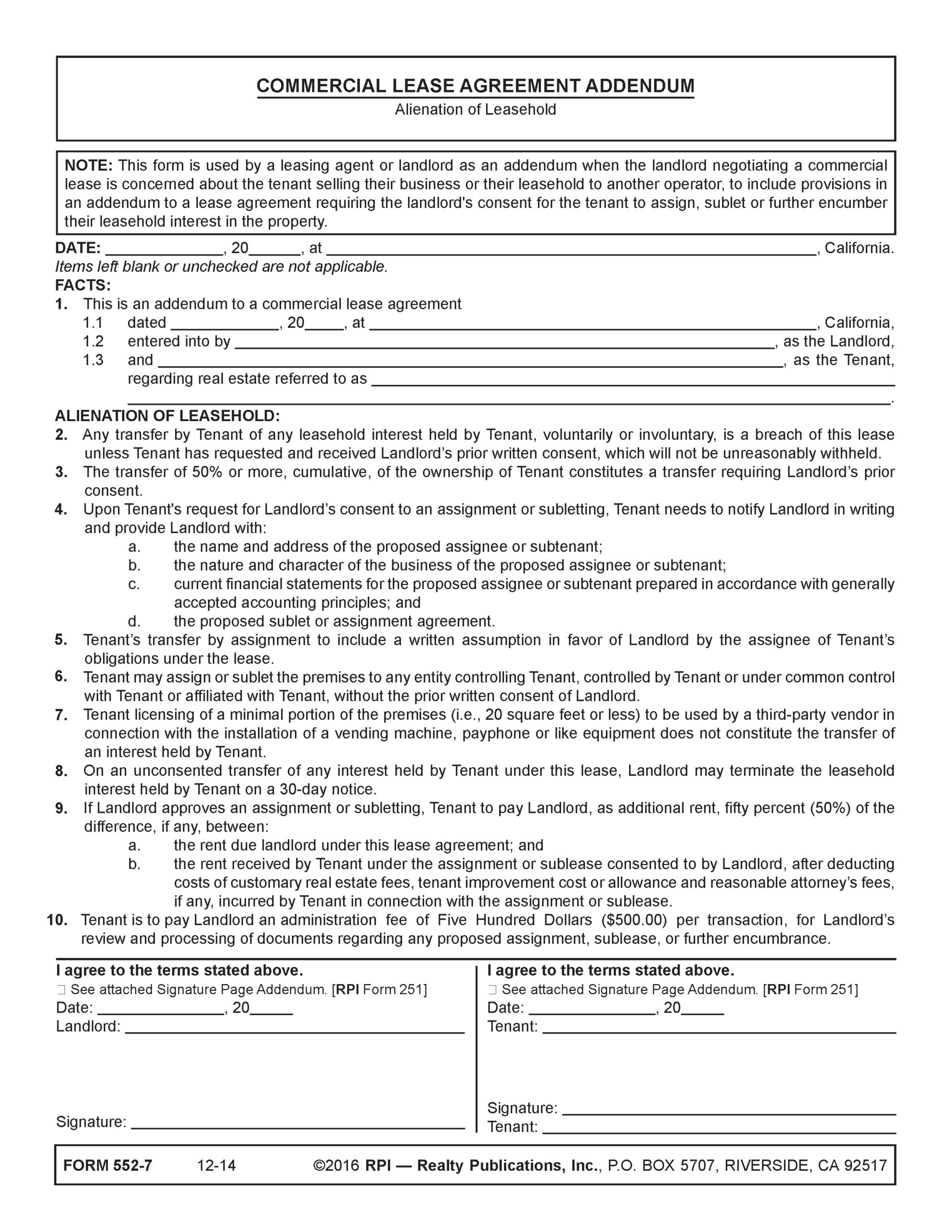
- Alienation Addendum [See RPI Form 552-7]; and
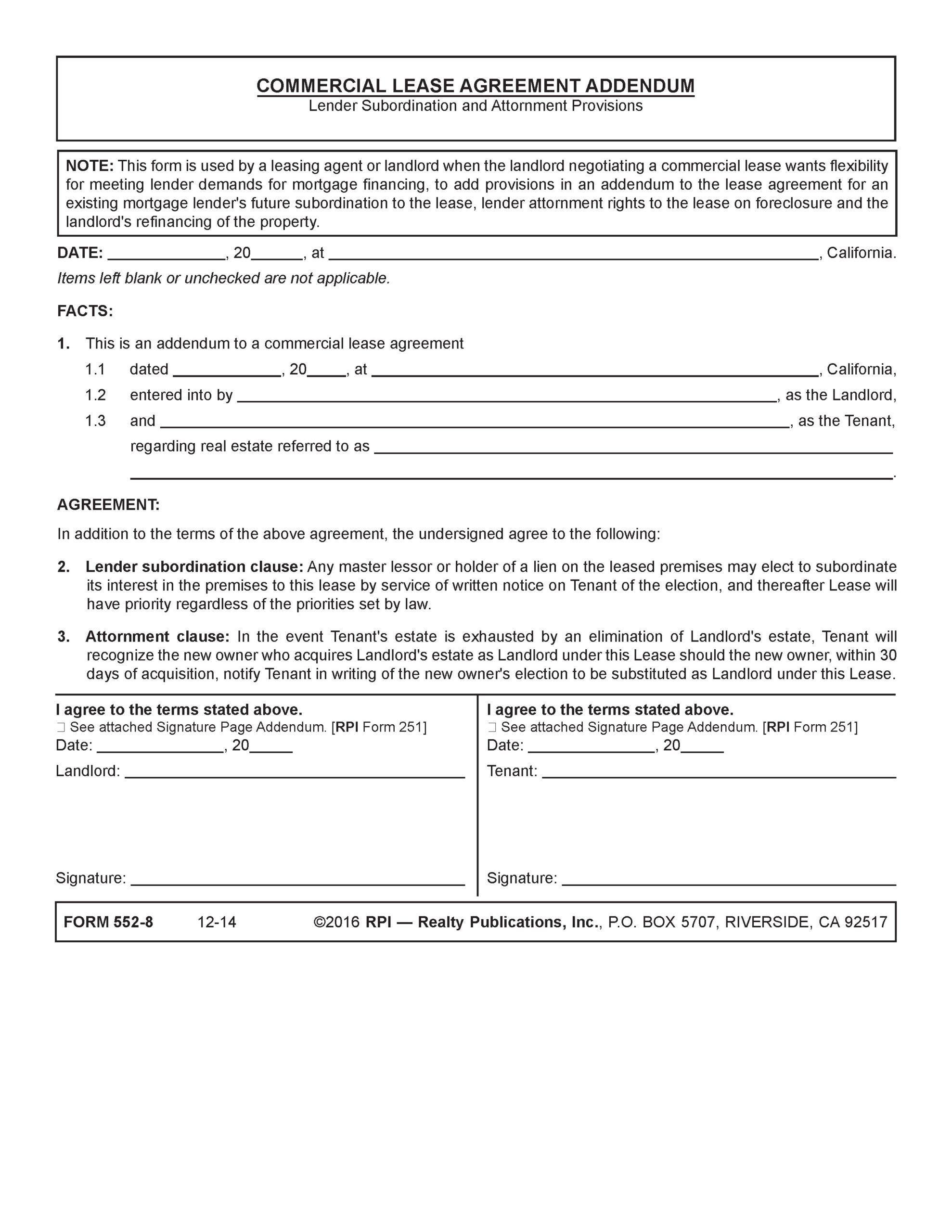
- Subordination Addendum. [See RPI Form 552-8]
To be enforceable, a lease agreement:
- identifies the location of the leased premises with reasonable certainty;
- sets forth the term of the tenancy conveyed; and
- states the rental amount and other sums due, and the time, place and manner of payment. [Levin Saroff (1921) 54 CA 285]
Related article:
Form-of-the-Week: Commercial Lease Agreement — Form 552 series
Overview of the commercial lease addenda
Addenda are used to modify, clarify or add terms to an existing boilerplate lease agreement form.
Landlords and property managers have multiple options available to modify a commercial lease agreement, including:
- use a pre-printed form tailored to the specific purpose requiring the addendum [See RPI Form 552-6, 552-7 and 552-8]; or
- use a generic addendum form to enter terms when a boilerplate addendum does not contain those terms. [See RPI Form 550-1]
The boilerplate addenda used with a commercial lease agreement include:
- Maintenance Modification, which allocates the responsibilities and expenses for maintenance of the leased property between the landlord and tenant when they differ from the terms set out in the boilerplate lease agreement. [See RPI Form 552-6];
- Alienation of Leasehold, which requires the landlord’s consent for the tenant to assign, sublet or further encumber their leasehold interest in the property [See RPI Form 552-7]; and
- Lender Subordination and Attornment Provisions, which repositions the priority of the tenant’s leasehold rights as junior or senior to a mortgage encumbering the property and requires the tenant to recognize the lender or buyer in a foreclosure of a mortgage on the landlord’s fee interest as the new landlord. [See RPI Form 552-8]
Related article:
Form-of-the-Week: Commercial lease agreements — Gross variety — 552 and 552-1
Analyzing the maintenance modification
A landlord or property manager uses the Commercial Lease Agreement Addendum — Maintenance Modification published by RPI when negotiating a commercial lease agreement on terms for maintenance differing from the terms provided for maintenance in the boilerplate form lease agreement. The maintenance addendum allows the leasing agent or landlord to modify the terms of the lease agreement regarding the allocation of responsibilities and expenses for maintenance of the property between the landlord and tenant. [See RPI Form 552-6]
The Commercial Lease Agreement Addendum — Maintenance Modification contains:
- Facts: the date of the commercial lease agreement, the landlord’s and tenant’s names, and the real estate involved [See RPI Form 552-6 §1];
- Repair and maintenance: a list of components and equipment the tenant is responsible for maintaining, including:
- HVAC;
- electrical systems;
- exterior walls;
- plate glass in exterior walls;
- governmental mandated retrofitting;
- plumbing and sewers;
- structural foundations;
- store front; and
- roof [See RPI Form 552-6 §2];
- Blank: a blank space for listing additional terms on the landlord and tenant’s responsibility for maintenance and property expenses; and
- Signatures: the landlord and tenant sign and date the form. The addendum is then attached to the commercial lease agreement.
Analyzing the alienation of leasehold
A landlord or property manager uses the Commercial Lease Agreement Addendum — Alienation of Leasehold published by RPI as an addendum when the landlord negotiating a commercial lease is concerned about the tenant selling their business and their leasehold to another owner-operator. The addendum requires the landlord’s consent for the tenant to assign, sublet or further encumber their leasehold interest in the property. [See RPI Form 552-7]
The Commercial Lease Agreement Addendum — Alienation of Leasehold contains:
- Facts: the date of the commercial lease agreement, the landlord’s and tenant’s names, and the real estate involved [See RPI Form 552-7 §1];
- Alienation of leasehold:
- A tenant’s transfer of any leasehold interest is a breach of the lease agreement unless consented to by the landlord [See RPI Form 552-7 §2];
- The transfer of 50% or more, cumulative, of the tenant’s ownership requires the landlord’s consent [See RPI Form 552-7 §3];
- For landlord’s consent to an assignment or subletting, the tenant to provide the landlord with information on the proposed assignee or subtenant as follows:
- name and address;
- the nature and character of the business;
- current financial statements; and
- the proposed sublet or assignment agreement [See RPI Form 552-7 §4];
- A written assumption in favor of the landlord of the tenant’s lease agreement [See RPI Form 552-7 §5];
- The tenant may assign or sublet the premises to any entity controlling the tenant, controlled by the tenant or under common control with the tenant or affiliated with the tenant, without the prior written consent of the landlord [See RPI Form 552-7 §6];
- Tenant licensing of a minimal portion of the premises (20 square feet or less) to be used by a third-party vendor in connection with the installation of a vending machine or like equipment is not an alienation [See RPI Form 552-7 §7];
- On an unconsented transfer, the landlord may terminate the leasehold interest held by the tenant on a 30-day notice [See RPI Form 552-7 §8];
- When the landlord approves an assignment or subletting, the tenant is to pay the landlord, as additional rent, 50% of the difference between:
- the rent due the landlord under the commercial lease agreement; and
- the rent received by the tenant under the assignment or sublease consented to by the landlord, after deducting costs of customary real estate fees, tenant improvement cost or allowance and reasonable attorney’s fees incurred by the tenant in connection with the assignment or sublease [See RPI Form 552-7 §9];
- An administration fee of $500 per transaction for any proposed assignment, sublease or further encumbrance [See RPI Form 552-7 §10]; and
- Signatures: the landlord and tenant sign and date the form. The addendum is then attached to the commercial lease agreement.
Analyzing the lender subordination and attornment provisions
A landlord or property manager uses the Commercial Lease Agreement Addendum — Lender Subordination and Attornment Provisions published by RPI when the landlord negotiating a commercial lease agreement wants flexibility for meeting lender demands for mortgage financing. The addendum adds provisions to the lease agreement for an existing mortgage lender’s future subordination to the lease, lender attornment rights to the lease on foreclosure and the landlord’s refinancing of the property. [See RPI Form 552-8]
The Commercial Lease Agreement Addendum — Lender Subordination and Attornment Provisions contain:
- Facts: the date of the commercial lease agreement, the landlord’s and tenant’s names, and the real estate involved [See RPI Form 552-8 §1];
- Agreement:
- Lender subordination clause: A lienholder of the commercial property may choose to make their interest junior to the tenant’s and give the commercial lease agreement priority by service of written notice on the tenant —otherwise, the lienholder has priority [See RPI Form 552-8 §2];
- Attornment clause: In the event of a foreclosure, the tenant will recognize the foreclosure buyer as the new landlord when the foreclosure buyer notifies the tenant in writing of the buyer becoming the landlord within 30 days of acquisition [See RPI Form 552-8 §3]; and
- Signatures: the landlord and tenant sign and date the form. The addendum is then attached to the commercial lease agreement.
Related article:
Form-of-the-Week: Commercial lease agreement — percentage and month-to-month — Forms 552-4 and 552-5