More households are occupying California today than in 2000, but the increase has not been a steady upward march for owners and renters alike. Within that increase of 21% more California households in 2025 compared to 2000, homeowner growth was suddenly reduced by the growth of renters in 2024 and 2025.
Consider that 24% more households rent in California compared to the year 2000. Meanwhile, the number of homeowner households increased 18% during that same time.
During the mid-2000’s Millennium Boom, the formation of homeowner households outpaced new renter households significantly due to extensive SFR construction and predatory mortgage lending deregulation. That pattern reversed after the 2008 recession. However, as the following 2010’s recovery gained steam coming out of that recession, ownership growth finally crossed over in 2021 as a result of the two-year pandemic-era buying spree. This trend reversed in 2022 when mortgage rates more than doubled coming out of the pandemic period.
As we look ahead to 2030, expect to see another slowdown in homeowner household formations similar to 2006-2009. The real estate sales decline beginning in 2022 has homebuyers hesitant to take on mortgage debt. Their concerns over trade taxes, unstable federal governance, and high mortgage rates are logically causing them to stand aside until prices bottom and show signs of recovering.
Meanwhile, a growing number of households are consolidating, many moving in with roommates and family members. Don’t expect to see household formations pick up until the next recovery, expected to begin after 2030.
Updated November 9, 2026.
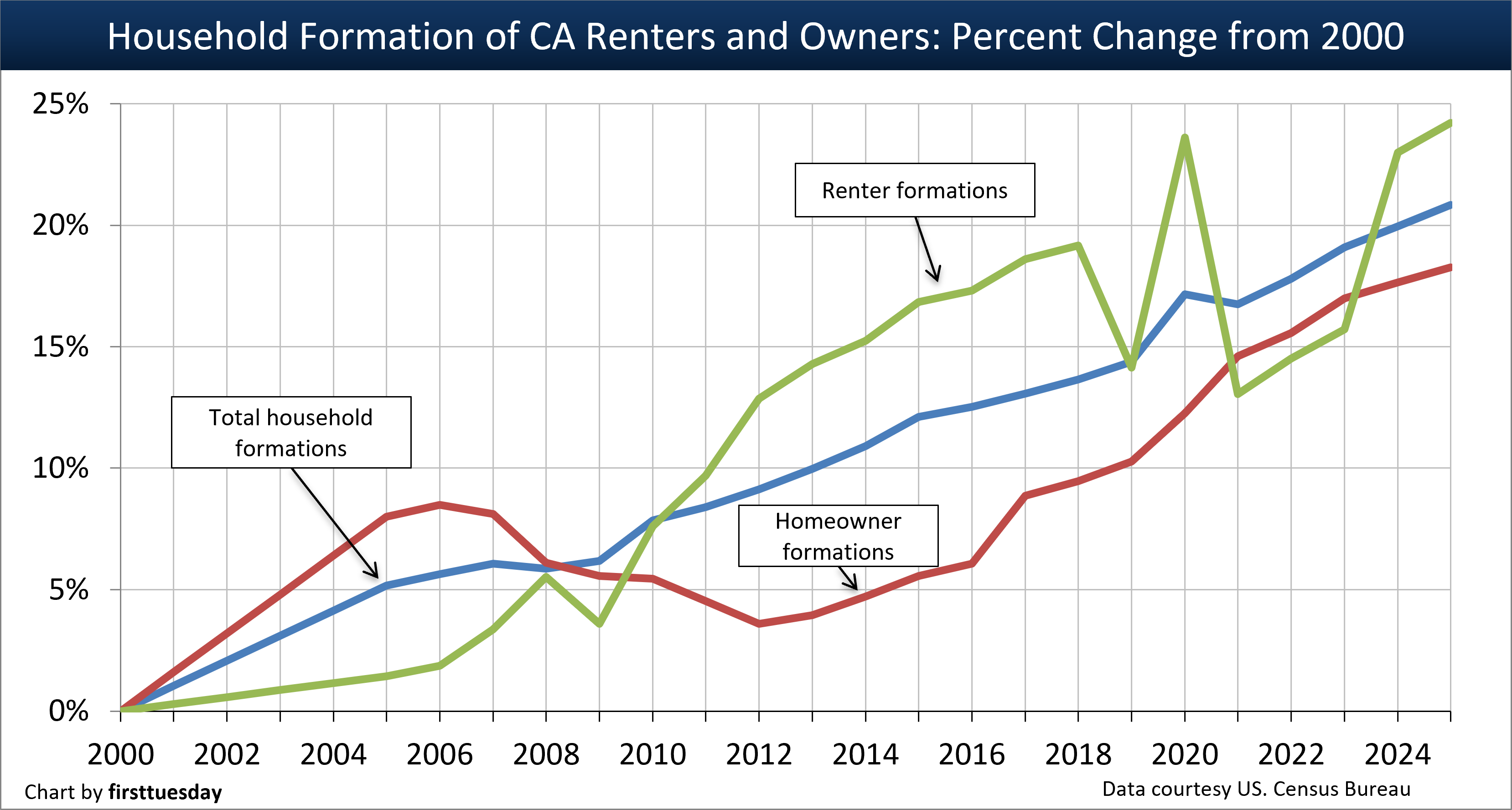
Chart update 11/9/26
| 2025 | 2000 | Percent change: 2000-2025 | |
| Total households | 13,898,600 | 11,502,900 | 20.8% |
| Homeowner households | 7,741,500 | 6,546,300 | 18.3% |
Renter households | 6,157,100 | 4,956,500 | 24.2% |
While total household formations continue to rise at a steady clip, significant trends have taken shape. About 24% more households rent today than in 2000, whereas 18% more households are owner-occupied.
During the mid-2000s Millennium Boom, homeowner formations increased more quickly than renters, due to the allure of easy financing and instant wealth from rising home values. However, the trend reversed suddenly in 2007 forcing 15% of homeowner households out of ownership by 2011 due to foreclosure-related non-conventional sales.
Today, growth in renter households is volatile but exceeds the growth of homeowner households.
Sensibly, the trend of fewer tenants moving into multi-family units reverses in a housing market of rising home sales driven by a construction economy. Expect a greater share of new renter households to move into multi-family units with a smaller share moving into SFR rentals.
Consider the recent trend toward renting as a reflection of the mass of foreclosures in 2007-2013. Many SFRs lost to foreclosure were converted into rentals, which foreclosed-upon families occupied as tenants no longer qualified to borrow and buy though able to pay rent at 31% of their household income. This irony has failed to be observed by mortgage lenders and credit reporting agencies
On the other hand, recent college graduates or those moving out of the nest for the first time make up a significant portion of new renter households moving into multi-family units. This generation — Gen Z and their older counterparts, Millennials — will spend more or all of their lives as tenants unlike their parents’ generation. As tenants, they accumulate wealth in other assets.
Most Millennial households are now forced to delay homeownership, perhaps indefinitely. Currently, the homeownership rate for individuals aged 25-34 in California is 34% down from 43% during the height of the Millennium Boom.
That’s because young adults were hit by the pandemic just as they completed their formal education. Gen Z and Millennials’ income has been stunted irreparably and their attitudes about ownership have been damaged by the Great Recession and the Covid lockdown.
This means first-time homebuyers will save for a down payment over a longer time period. The process has not even begun for a significant portion of this demographic. Detrimentally, residential rents have increased much faster than incomes, making saving difficult. In higher density regions of the state, it’s common for renters to pour half of their income into rent, not the 33% historical standard of creditworthiness for landlords.
But if you look ahead far enough, there is a bright spot on the horizon. Once Millennials make a solid showing in the jobs market and their savings accumulate sufficiently, Millennials’ massive population bulge will give California’s low-tier to mid-tier housing market a boost. This wave of first-time homebuyers are expected to enter the housing market in the years following the current real estate recessionary period, say, 2030.
At the same time, Baby Boomers will be retiring and looking for replacement homes. All of this activity will result in the Great Confluence of homebuyers with different demographics, increasing both home sales volume and prices as we head into the next decade.
In the meantime, agents use marketing materials that speak directly to renters in their area. Too often tenants simply assume they’re unable to qualify to borrow and buy rather than rent. And even if they are not yet financially able — 20% down as the imperative — to buy for a few years, set them up with the MLO in your office to learn what amount their household income allows them to borrow.
Then give them the financial reasoning to commit to a savings program for a 20% down payment. Establish a relationship now as the agent they can trust for solid advice, the first step in becoming their buyer agent when they are positioned to buy. Then stay in touch with them for when they can.
Related article: