This form is used by a buyer agent when preparing a purchase offer and performance by the buyer is contingent on their further approval of aspects of hazard insurance, to add as an addendum a boilerplate contingency provision for buyer approval or cancellation of the transaction.
Addenda add conditions to a purchase agreement
In real estate, a purchase agreement is the primary document prepared by a buyer broker and used to establish the fundamental terms and conditions of a generic property transaction sought by a buyer.
While the purchase agreement encompasses critical details of the transaction such as the purchase price, disclosures the buyer is to receive and closing conditions, it doesn’t contain conditions unique to a property, the market or the buyer.
A buyer agent preparing an offer for submission on behalf of their buyer-client needs to add terms unique to the transaction but not covered in the boilerplate language of the purchase agreement form.
One easy solution is for the buyer agent to write these additional terms and conditions in a General Use Addendum which is attached as referenced in the purchase agreement. [See RPI Form 250]
Examples of additional terms and conditions the buyer may want in a purchase agreement include:
- personal property acquired from the seller;
- early occupancy by the buyer;
- complete a related task before or on closing;
- occurrence of an event before or on closing;
- approval of property conditions; and
- address an unusual property condition.
Specific buyer agent addenda
Pre-printed addenda are available for specific situations which address related terms and conditions.
These situations include:
- ensuring the condition of the roof is satisfactory;
- the availability of hazard insurance; and
- the relationship of the purchase price to the property’s fair market value.
The addenda used for these purposes are:
- Roofing Inspection Addendum — Due Diligence Contingency [See RPI Form 260];
- Hazard Insurance Addendum — Availability Contingency [See RPI Form 261]; and
- Confirmation of Value Addendum — Fair Market Value Contingency. [See RPI Form 266]
Analyzing the Hazard Insurance Addendum
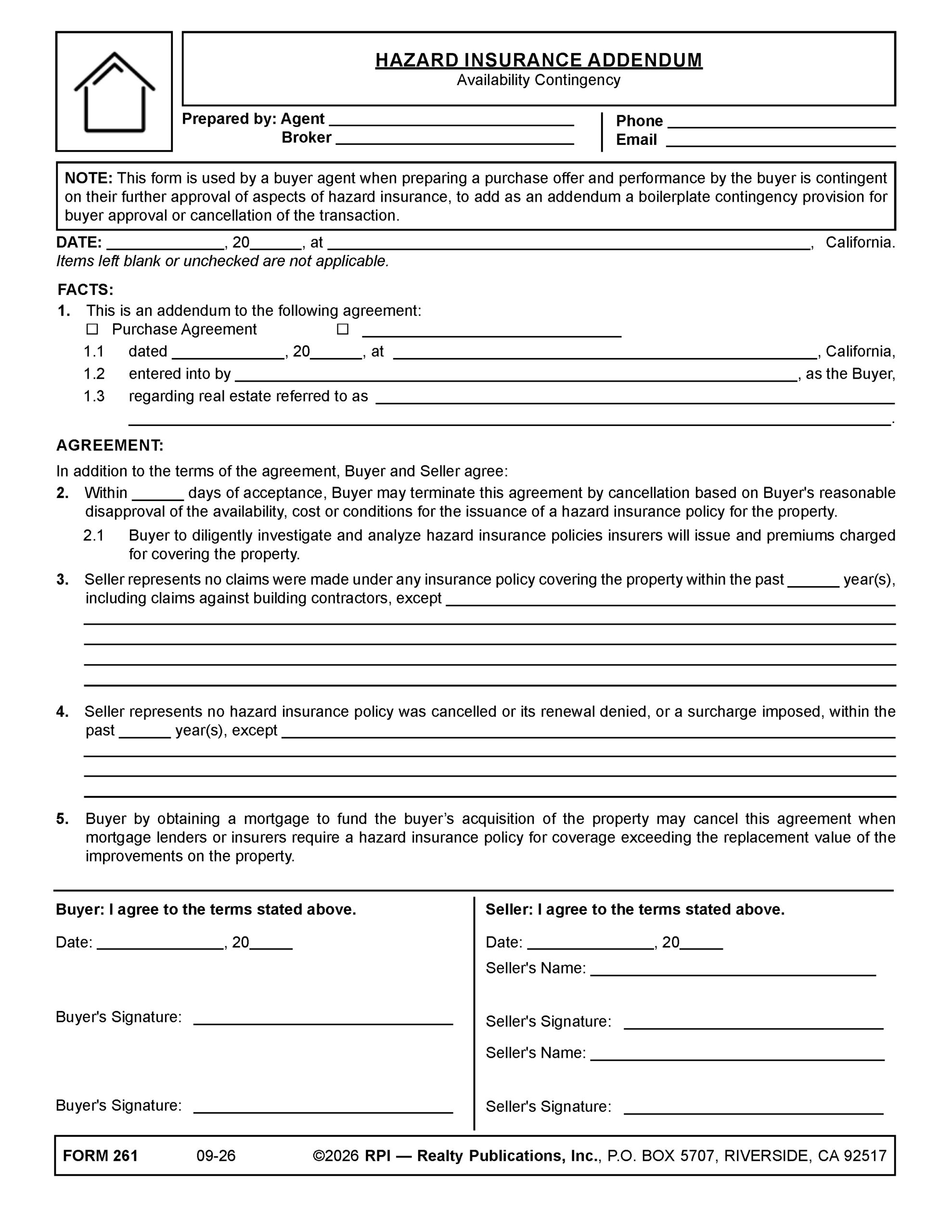
A buyer agent uses the Hazard Insurance Addendum — Availability Contingency published by RPI as an addendum to prepare a purchase offer when the transaction is contingent on the buyer’s further approval of available hazard insurance or disapproval and cancellation of the transaction. [See RPI Form 261]
The Hazard Insurance Addendum — Availability Contingency contains:
- Facts:
- the agreement to which the addendum is attached:
- purchase agreement; or
- other;
- the date of the agreement;
- the buyer’s identity; and
- the real estate involved [See RPI Form 261 §1];
- the agreement to which the addendum is attached:
- Agreement:
- the number of days after acceptance during which the buyer may terminate the agreement based on the buyer’s reasonable disapproval of the availability, cost or conditions for the issuance of a hazard insurance policy for the property [See RPI Form 261 §2];
- the number of years during which no claims were made on insurance policies covering the property [See RPI Form 261 §3];
- the number of years during which no hazard insurance policy was cancelled, denied or a surcharge imposed [See RPI Form 261 §4]; and
- the buyer may cancel the agreement when mortgage lenders or insurers require a hazard insurance policy for coverage exceeding the replacement value of the improvements on the property [See RPI Form 261 §5]; and
- Signature:
- the buyer enters their name, and signs and dates the form. [See RPI Form 261]
Form navigation page published 09-2026.
Form updated 2026.
Form-of-the-Week: Purchase agreement addenda for buyer agent — Forms 260, 261 and 266
Form-of-the-Week: Purchase Agreement variations and their addenda
Article: Homeowners insurance and wildfires
Article: As wildfire threats flare, so do home insurance premiums
Letter to the Editor: Why are addendums from other publishers not published by Realty Publications, Inc.?
Client Q&A: Do I need hazard insurance?
Recent Case Decision: Is a mortgage holder obligated to pay interest on hazard insurance proceeds deposited with the mortgage holder for rebuilding a structure?