

Why this matters: Brokers and agents maintain their licenses based on their own interpretation of the real estate market and how it affects fee-generating services. For those most invested in maintaining their practice — namely brokers — their steadily increasing decision to go inactive is following transaction volume.
Active licensees in the field
In April 2026, California had 84,237 active real estate brokers, about 2,500 fewer than one year earlier. Today, the number of active brokers continues to decrease, in search of a bottom since declining from the January 2010 peak of 109,500.
Conversely, the number of active sales agents steadily climbed from a 2014 low of 171,100 to a November 2022 peak of 226,300. Since then, agents have begun a slower descent than brokers and as of April 2026, active agent numbers tapered to 209,853.
firsttuesday forecasts a dramatic fallback in sales agent licensing and renewals in 2026-2027. The decline is the result of the 2021 pandemic surge in new licensees (which has already begun) and reduced present and future sales and leasing activity and branch office operations by employing brokers.
Watch for the next big wave of licensees after prices bottom — first with the return of speculators, then end-user homebuyers — to rebound the housing market, not expected until after 2028.
Updated June 4, 2026.
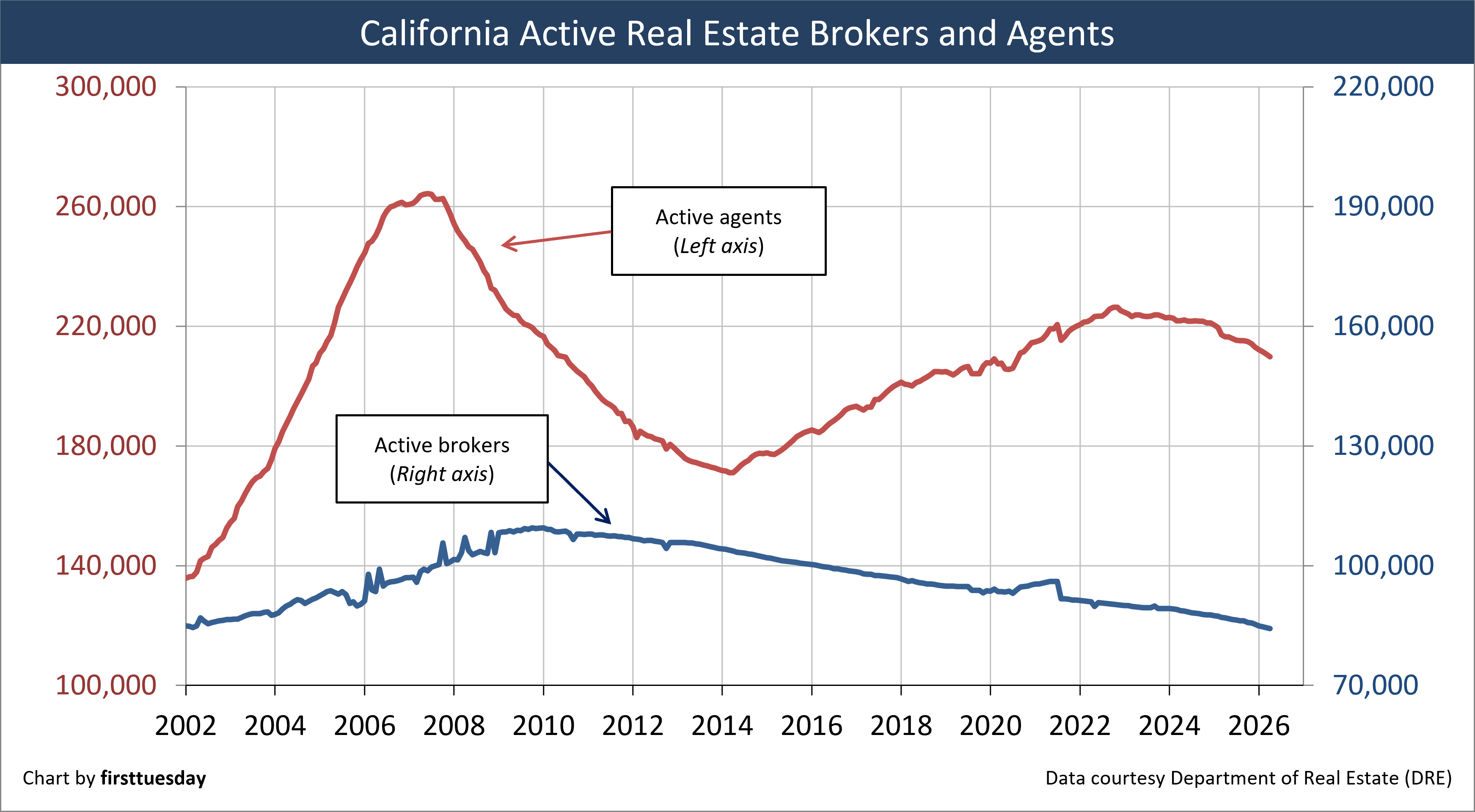
Chart update 6/4/26
| April 2026 | April 2025 | Annual change | |
| Active Agents | 209,853 | 216,411 | 3.0% |
| Active Brokers | 84,237 | 86,932 | -3.1% |
Today’s inflated agent-to-broker ratio
In a stable market, a natural equilibrium develops between active real estate agents and brokers. This ratio has historically found balance at the level achieved in 2002: approximately 1.5 active agents for every active broker.
As real estate transactions entered the recovery phase of a market cycle in the early-2000s, new agents arrived en masse for the Millennium Boom. The greatly inflated agent population grew to as high as 2.7 agents per broker as big brokers filled their cubbies. These individuals obtained a license with the optimistic belief that extra money was to be had working real estate.
The agent-to-broker ratio fell in the Great Recession 2008 aftermath of the Millennium Boom, and in seven years reversed direction in 2014 to begin rising again.
Currently, the ratio hovers around 2.5 active agents per active broker. In Q2 2026, we are four years into constantly lowered sales and leasing volume as we trudge our way past the disruptive pandemic economy and adjust to the current migratory and trade war disturbances.
Expect the current ratio to decrease through 2029, following the downward path of home sales volume to its bottom, not rising for another three or so years. The public is fast to respond and run with boom times, but very unwilling to leap before a rise in sales prices becomes a media headline.
Agents speculate on the market
The real depth of agent inactivity is obscured by active licensee figures. Many “employed” agents simply do not report to work – at least not as a real estate agent. Their license is left “to hang” with a broker. They are underemployed, working as part-timers when deals pop up, while they gear up in a different occupation, a drain of clientele from full-time agents.
28% of all 293,158 sales agent licensees report to the DRE as “inactive” – around 83,000 licensed individuals who are not employed by a broker. Many inactive licensees do speculate in property as principals or negotiate purchases for family members, often presenting themselves as holding a license.
Related article:
Licensing in an economic recovery
Will the ideal 1.5:1 agent-to-broker ratio return when a trough develops in licensee population in the late-2020s?
Probably. A deep recession appears likely unless another pandemic-level monetary and fiscal stimulus is again initiated as occurred in 2020, and again as infrastructure upgrading in 2023 with the present military-industrial expenditures.
With the pandemic stimulus well-implemented to pump up the economy, new sales agent and broker licensing jumped in 2021 as sales transactions accelerated. Greater numbers of new licensees arrived and an increased percentage of existing agents renewed their licenses. Real estate sales volume came to an abrupt peak by mid-2022. The following downward trend saw enthusiasm to become an agent rapidly wane, which continues in 2026 – and likely into 2028.
Related article:
Brokerage Reminder: CAR membership NOT required for MLS access
Boomtime distractions, consumer protection and DRE licensing
Mortgage rates do tend to decline in a recessionary period. Less costly money becomes extra mortgage funds for buyers of property. However, the better borrowing power at lower mortgage rates is very quickly absorbed by sellers raising prices rather than buyers acquiring property with greater amenities.
When news media reports a rapid increase in pricing, the appearance of profits generates increased numbers of new DRE-licensed agents. Most become employed by well-advertised larger brokerage operations and franchised brands.
With any boom, the standards applied by real estate service providers diminish in quality and quantity, temporarily set aside to cash in on the increased sales and leasing.
The DRE alone is tasked with actively protecting our consumer society from adverse licensee conduct. To do so, the DRE needs to become more aggressively involved during business recoveries. Initially, during the boom times, a tightening up of the agent licensing exam is needed to limit the licensing of new agents to the most qualified, persevering and committed individuals.
Whether the DRE is politically able to do this is questionable. The DRE faces opposition from big brokerage offices and their entrenched trade group. Large brokerage operations require a constant high number of agents-for-hire to blanket the market to capture rising fees when sales momentum takes hold.
Related article:
Market variables are changing
For the next years into 2028, fewer brokers and agents are needed to assist owners and users (aka sellers/landlords and buyers/tenants) to service the sale and leasing of real estate. It is simply licensee numbers adjusting to:
- the current cyclical multi-decade increase in long-term interest rates now underway, and
- the return of a focus on owning real estate to occupy it or for income over the long haul.
Related article:
Agent and broker population, past and future
2021 saw home sales volume leap as a result of historically low interest rates, individual stimulus checks and a fierce fear-of-missing-out (FOMO).
Sales agent numbers accelerated rapidly during 2021, and through mid-2022, with an influx of “quick-buck” real estate agents. As expected, these new-career agents dropped out as sales volume from mid-2022 through 2026 declined.
Easy money, all the time, does not exist in any industry due to inevitable recurring business cycles.
Related article:
Industry behavior
Large single family residence (SFR) brokerage operations with branch offices have always depended on a constant flood of newly-licensed agents to fill their cubicles. These brokerage operations generate a high turnover rate for agents. Freshly-minted agents burn through their family members and social contacts without a parallel personal marketing effort to brand themselves and develop a viable client base.
The big brokers and their office managers have been able to mitigate the eventual loss of sales production experienced by client-exhausted agents through aggressively soliciting new licensees as replacements (and all the personal contacts who come with them).
Previously, during the peak years of 2004-2006, new agents were licensed at the unsustainable rate of 5,000 monthly – almost five times the 2025 pace.
Despite this history, the number of new hit-and-run agents crept higher in the pandemic years of 2020-2021. And again, brokers spent little time training and supervising new agents and more time mining them for prospects.
Related article:
Pivot to find profits during a recession: Focus on homebuyers
Facing economic reality
firsttuesday forecasts an ongoing fallback in sales agent licensing in 2026-2027, the result of reduced buyer, leasing and MLO activity. Watch for the next wave of licensees to arrive, first upon the return of speculators, then end-user homebuyers, to propel the housing market into the next virtuous expansion period, likely after 2028.
When viewed in terms of disappearing short-term agents, rather than vanishing homebuyers — the rate of homeownership statewide was stuck at 55% at end of 2024 — what appears is an economic reality which forces employing brokers to:
- shutter their least productive branch offices;
- release the weakest office managers and under-performing agents;
- attempt to locate licensed agents who actually generate business;
- upgrade office locations and cut rent expenses by taking advantage of office and retail vacancies offering ever lower rent;
- develop new profit centers with service divisions for escrow, finance, homeowner/tenant insurance, appraisal/broker price opinions (BPOs), property management, investor syndication and other brokerage services; and
- require agents to “get back on the street” to engage in the community, gather property information in greater detail from local agencies, and smoke out new leads which generate transactions.
Related article:
Fee splitting problems
Gradually, the younger and more aggressive agents employed by large brokerage offices will look for new opportunities. They may become brokers or team up with other brokers and agents, transitioning into smaller flexible operations. Others with a long-term client base will join “rent-a-desk” operations to reduce the fee percentage extracted by the broker in anticipation of greater net earnings.
Agents jumping out on their own too often do not have the business acumen to set up and operate a broker office, whether they employ agents or operate independently. Their motivation is too often based on the belief, right or wrong, that their current broker is taking too large a share of the fees.
Survival and success
During short-lived bursts of speculative fervor, discussion of a stable, disciplined office environment sounds like nonsense to brokers and agents with a short-term outlook. However, real estate is not a business where you can “fake it until you make it.” Misrepresentations by non-disclosure (or otherwise) and carelessness due to inexperience undo agents quickly, as the market turns into a multi-year decline – a cyclical recession.
Brokers who learn to cut overhead and eliminate operating inefficiencies on early entry into a recessionary period, while beefing up their staff with competent agents and broker-associates are in the best position for the following long-term uptick in annual transaction numbers, likely to begin after 2028.
Employing brokers operating successfully through 2026 and 2027 will be defined by their ability to plan ahead for their needs.
A look ahead to reduced size of brokerage operations
Brokerage offices with fewer than 16 agents will probably continue to recruit agents in the manner they always have. Single-office brokerages traditionally recruit by local word-of-mouth referrals and family members.
Brokers maintaining a single office with a staff of agents and broker-associates tend to have several different types of business clientele. They do not focus on the numbers game of market share to drive property owners, buyers and tenants to their office for representation.
These smaller brokerage offices are the most likely to attract the more thoughtful agents who enter into the real estate industry. These entrants seek a long-term advantage of diverse training by teaming up with agents and broker-associates who work income property, land and property management as well as SFR and MLO transactions.
The broker takes charge
To operate a successful brokerage office, the broker needs to employ viable agents, those with talent and skill.
It is the maturity of the agents in a brokerage business model that produces the end result sought by successful employing brokers, i.e., broker fees. As in all service businesses, the linchpin for achieving success is the ability of management to orchestrate the efforts of agents to act and earn as permitted by DRE regulations and real estate law.
Brokers are best served when employing agents who practice beyond the small and limited circle of friends and family. Of course, some brokers dismiss the duty to provide training while supervising their agents. Brokers who do not dedicate sufficient time and energy to their agents will spend time and energy seeking replacement agents.
Brokers are more than distant observers limited to providing remote oversight for the agents and sharing fees. They or their administrative assistants and managers are required to supervise and police the business-related activities and conduct of the agents they employ.
Related video:
Policing of business-related conduct
Further, the broker needs to be actively involved in the agent’s fulfillment of the duties the broker owes to clients the agent has contact with. Thus, the agent knows from the beginning just what level of production their broker expects of them to remain with the office.
Accordingly, an office environment needs to nurture a greater probability of producing closings based on written client commitments to broker representation, purchase agreements, leasing agreements and mortgage originations, which collectively spell financial success for all involved.











The chart shows the agent‑to‑broker ratio is now over 2.5 to 1, way past the 1.5 balance we used to see back in 2002. No wonder they’re warning of a licensing crash in ’25‑26.
There was a lot of interest in this story. I hope you continue to create great content for the community.
This look at the rises and declines of real estate licensees provides context that helps explain broader market shifts and career dynamics. It’s interesting to see data paired with trend interpretation. What factor do you think most influences licensee numbers in today’s market?
It’s fascinating to see the shifting landscape of real estate licensing in California, with a decline in active brokers but a steady rise in sales agents. The forecasted fallback in licensing due to the pandemic’s impact is a critical insight. I’m curious about how this trend will influence the housing market dynamics and opportunities for new entrants in the coming years.
Great Blog. Thank you.
The energy of the video is uplifting.
Real estate is expensive, and the MLS is too complicated for newcomers like me. You also need solid training and a mentor. Mentoring is difficult to come by.
The simple answer is no. Real estate brokers are unlikely to follow in the footsteps of the Caspian tiger or the Guam flying fox any time soon. Nonetheless, it appears that demand for real estate agents will fall during the next decade. Actually, the writing is on the wall.
I liked that you said that one reason to consider hiring a real estate broker is that they will be able to analyze the market for you in order to determine when the right time to buy is and where to buy. I have been thinking about going without the help of a professional to look at homes but I have been worried that II wouldn’t be able to complete this task efficiently. I will be sure to use the assistance of my broker in order to ensure that I buy the right home at the right time.
This article will certainly help me I am in the beginning of my real estate venture.
Real estate agents are now in high demand. You should check how real estate is growing and become a great career option.
I am planning on purchasing some Real Estate in your country. I would like you to help us find good real estate for immediate rent or purchase.
Also of importance to me is the need for you to provid full information on expected tax or any other charges that are required for foreign purchase.
Hope to hear from you soonest
HELLO IN 2002 I TOOK MY REAL ESTTE PRINCIPLES AND A FEW OTHER COURSES AND I WAS WODERING HOW CAN I FIND OUT IF I TOOK MY COURSES WITH YOU ?
LUCY ROBLES
Dear Lucy,
Thank you for reaching out! Feel free to call our customer service team Monday through Friday 8:30am – 5pm at 951-781-7300. They will be happy to look up whether or not you took your courses with firsttuesday.
Best regards,
Editorial Staff