
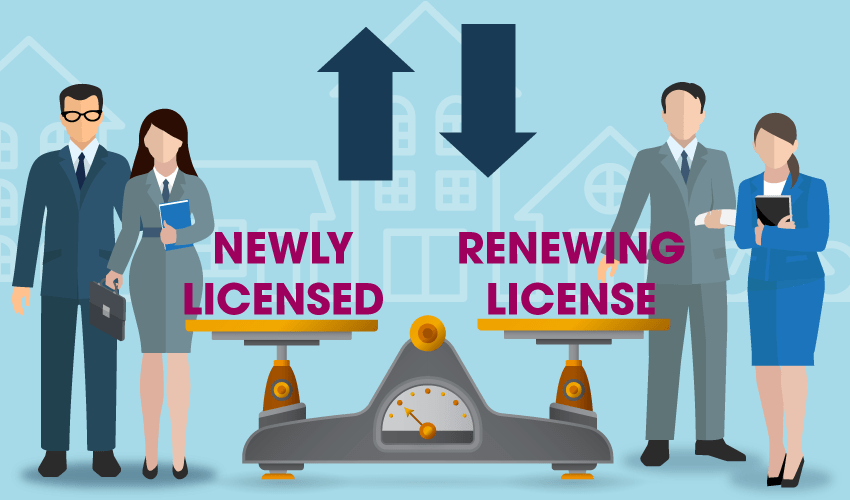
Why this matters: New licensees often enter the occupation of providing real estate services based on reports of high home prices, unaware of other earlier and stronger indicators of a durable or weakening real estate market. The number of new sales agent licenses issued annually is a lagging response to moves in property pricing, which in turn is a lagging response to movement of home sales volume driven primarily by the outlook on jobs and mortgage rates.
To renew or not to renew
The number of new sales agent licenses issued by the Department of Real Estate (DRE) in December 2025 was just under 1,300, almost exactly the 12-month average of new licensees entering each month over the past year. This is a further low since a modest licensing peak in 2021.
License renewals began to rise in the first months of 2025 but trended down by end of the year. An average of 73% of expiring sales agents renewed their licenses over the 12 months ending in December 2025, below the 75% 12-month average one year earlier.
The direct correlation between home sales volume and newly licensed agents shows licensing movement changes 6-12 months after a consistent reversal in property sales volume. Today’s lower renewal rate is directly related to the notable decreases in home sales volume experienced in 2025, which previously peaked in the 2021-2022 pandemic-era buying spree.
A total of 294,900 agents and 92,300 individual brokers are currently licensed by the DRE as of February 2026. This represents a 4.4% drop in total agents from one year earlier in February 2025 and 3.6% decline in individual brokers during the same time period. This declining trend across both licensed agents and more established brokers demonstrates the perception of the real estate market.
Expect the number of licenses issued or renewed to fall back throughout 2026 due to downward pressure from rising interest rates and increased consumer caution diminishing income from transaction fees.
The next increase in newly licensed sales agents is expected to occur when buyers sense prices have bottomed and seek out assistance acquiring property they believe to be a deal. The return of willing buyers will push prices up, a fact which entices new sales agents to join in the recovery.
Updated April 13, 2026.
Chart 1
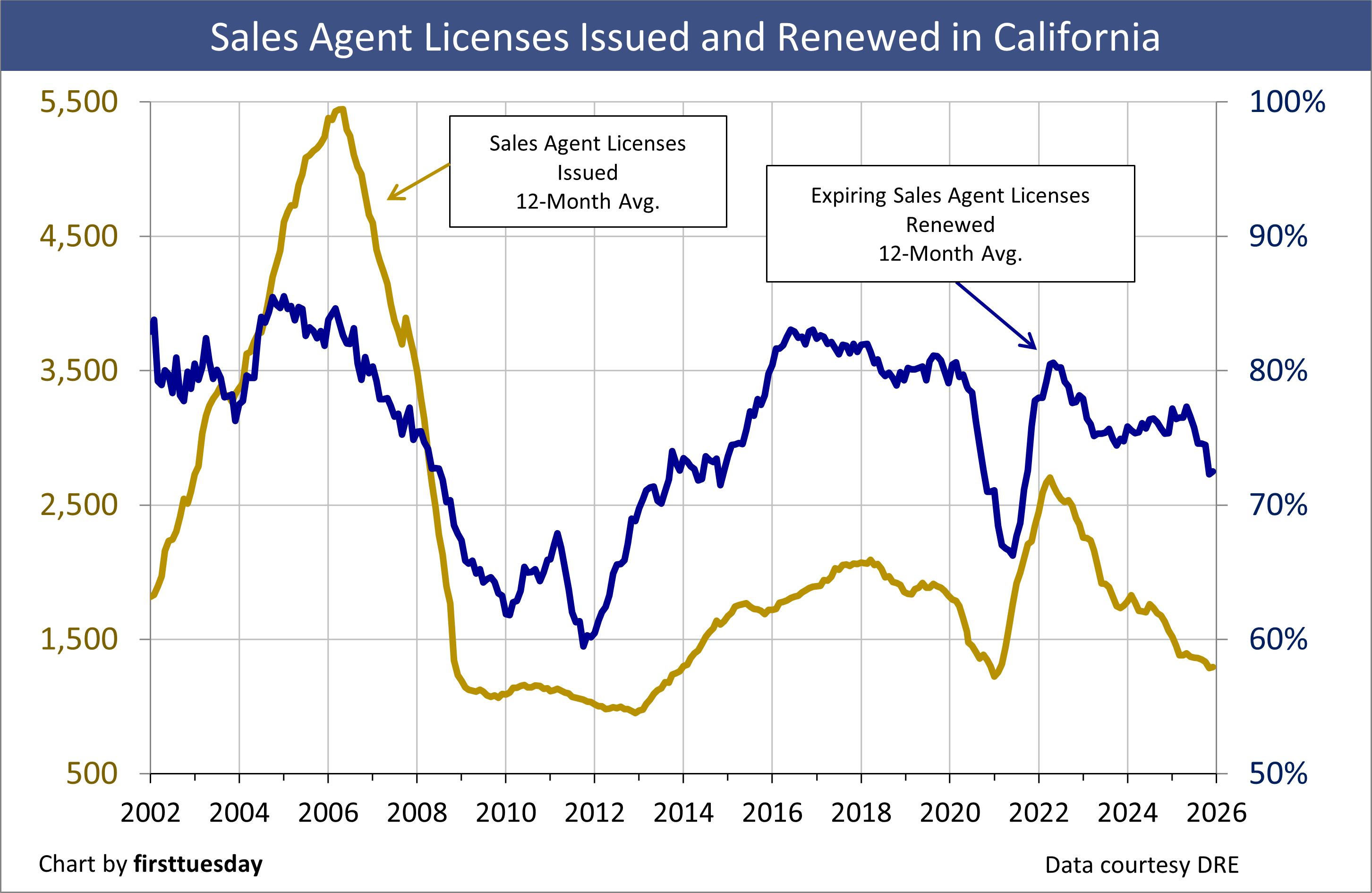
Chart update 04/13/26
| Dec 2025 | Nov 2025 | Dec 2024 | |
| Sales agent licenses issued | 1,300 | 1,000 | 1,100 |
| Expiring Sales agent licenses renewed | 68% | 63% | 83% |
Agent licensing and renewal activity fluctuates from month to month. To clarify trends, the chart above displays a 12-month moving average of monthly licensing and renewal rates, offering a bird’s eye view of the long-term trends without the monthly distractions.
So what causes above-average licensee turnover — that is, expirations without renewals? One answer is sales volume as it directly affects active agents’ income. Brokerage income from sales and mortgage financing has suffered heavily over the last several years as sales volume remained flat. Members of the public — the source of prospective agents — never hear about sales volume or how well agents are doing. Instead, the media — infatuated with pricing — touts the 10% and 20% year over year home price gains common to volatile asset pricing in the US.
Sales agents become licensed
Chart 2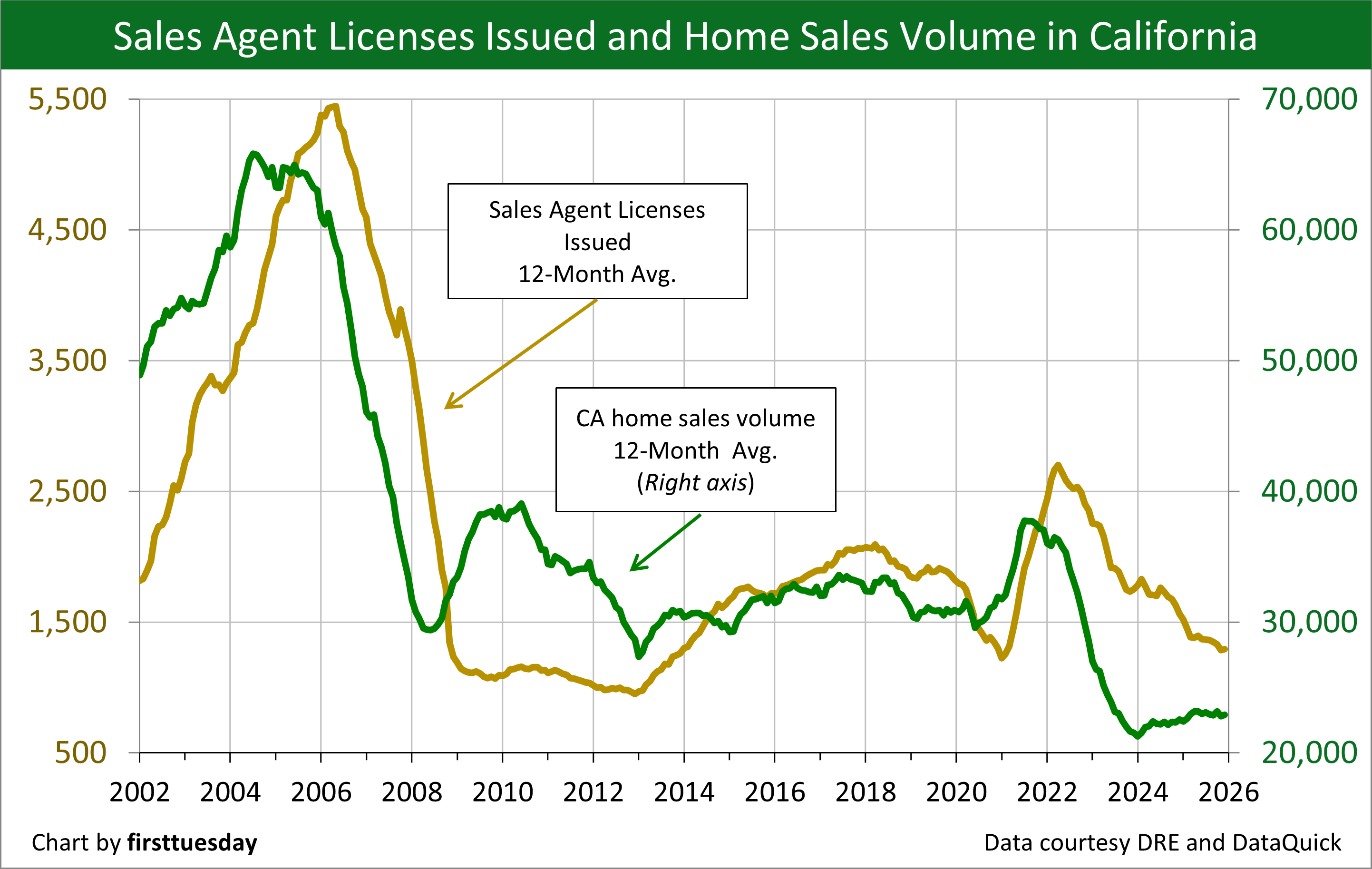 Chart update 04/13/26
| Dec 2025 | Nov 2025 | Dec 2024 | |
| Sales agent licenses issued | 1,300 | 1,100 | 2,000 |
| Home sales volume | 22,400 | 21,600 | 18,400 |
The pricing narrative — which often attracts or dissuades new licensees to enter the brokerage profession — excludes more telling data such as sales volume, changing job opportunities and mortgage rates. Thus, potential new arrivals see easy money to earn as agents when prices spiral upward. For them, price momentum means success as a real estate agent lurks in brokerage offices. Wrong footed, but that is where licensees, old and new, find themselves.
However, new licensees slow to a trickle the moment stories emerge about falling prices, a near certainty this decade as mortgage rates increase and jobs opportunities diminish.
Editor’s note — The percentage of brokers renewing their license on expiration is consistently much higher than sales agents, with an average for brokers of 90% renewing in 2025. Considering the greater amount of education and experience required to obtain a broker’s license, the vast majority of brokers choose to renew. This broker renewal rate is boosted by brokers over the age of 70 licensed for 30 continuous years, reaching the goal for DRE CE exemption. However, many are still simply aging out, allowing their broker license to expire unrenewed as fewer individuals become newly licensed brokers. Many learn to regret dumping their license when a recession hits and they need the net cash flow source offered by brokerage.
As seen in the chart above, the direct correlation between sales volume and agent licensing shows licensing movement changes 6-12 months after a consistent change in home sales volume. This lag time is due to the time period it takes for a prospective agent to:
- complete the required education courses (a minimum of 54 days, but typically spanning several months); and
- pass the state licensing exam (DRE processing time averages two months before an agent takes the state exam).
New licensing activity is high when the outlook for home sales pricing is good for sellers, and low during troughs in the housing market as buyers back off and wait. The notable exception occurred following the 2008 property sales crash.
Sales volume rose in 2009, yet agent licensing remained flat since pricing remained level at best, leaving fees from increased sales to existing brokers and licensees. During this time, the word on main street focused on weak and declining prices in California brought on by hundreds of thousands of foreclosure sales. The reporting of weak sales pricing deterred many potential new licensees from joining the fray.
Agent licensing peaked in 2005 at over 6,000 new licenses issued in a single month. From 2010-2020, licensing hovered around 1,000-2,000 new licenses issued each month. Licensing recently bounced in 2021, due to media reports of significant price increases for real estate, coupled with pandemic-era employment chaos.
Agent licensing to continue falling off
What to expect for agent licensing in 2026 and beyond?
New licensing activity is languishing along with home sales volume and pricing in 2026. A decline in pricing is due to set in and persist until the next upturn in home sales volume. The timing of a sales volume upturn is disrupted by rising consumer prices, trade and military wars, and an uncertain outlook for available jobs.
The road ahead for agent renewals is a bit more complex. Renewal rates tend to take place based on how long an individual has held a license.
For instance, first and even second time renewals are less likely to renew than those who have held their license for 10+ years. The long-time licensees are more likely to renew rather than let their licenses expire due to the hassles of getting licensed all over again when they return to providing real estate services for a living.
On the other end of the scale, Baby Boomers are set to retire in earnest. Many of the older generation are letting their licenses expire when they perceive them as unneeded and taking the risk they won’t return to their professional lives. One exception is an older licensee who qualifies for DRE’s 70/30 rule: when a licensee is aged 70 years or more and was continuously licensed for 30 years or more, they avoid continuing education requirements. Thus, they are more likely to continue renewing.
Despite the many facets forging an annual forecast for renewals, it’s safe to say renewals will follow the same trend as new licensing numbers. That is, renewals rise during a period of increased home sales volume and fall during times of reduced home sales. The only difference is the magnitude of change is smaller for renewals, as seen in Chart 1.
Licensees up for renewal know the lengths it took to obtain a license — and they know choosing not to renew means their invested time and effort has gone to waste. Even when the housing market isn’t in an upswing, most renew their license for its value when real estate opportunities pick up again (and they always do).
For a look at historical licensing trends, see firsttuesday’s chart, Newly licensed agent and broker population.










Yıllardır bu işi elle yapıyordum ve inanılmaz zaman harcıyordum. Keşke bu programı çok daha önce keşfetmiş olsaydım. Benim gibi bilmeyenler için bu yazı gerçekten çok değerli.
The R36 Ultra looks like a solid option for portable retro gaming. It has an interesting design and seems aimed at gamers who want more features in a handheld.
Staying motivated isn’t always easy. Whether you’re learning a language, working toward a personal goal, or simply trying to make progress each day, motivation can disappear when things become difficult.
Oops, I meant to check off the NO’ I will not let my license expire.