

Why this matters: Legislative efforts to boost new construction and encourage solutions to the housing shortage have not delivered a recovery to previous construction levels. Even after significant gains since the 2009 low point of housing starts in California, the 2025 annual construction starts ran into the negative effects of high costs for materials, loss of access to labor, and mortgage rates.
No rise in construction in sight, on site
102,700 housing units — SFRs and multiple — were started in California during 2025, a slight 2.3% increase over 2024. This level of construction was a significant 33% below the historical average of 153,600 annual starts.
Single family residential (SFR) starts continued on a bumpy decline since the 2021 post-pandemic buying frenzy. However, while multi-family construction lifted significantly since the previous year, it is still below recent trends. For construction to reach a full recovery, zoning limitations must be lifted in the state’s most desirable areas.
Updated March 23, 2026.
Chart 1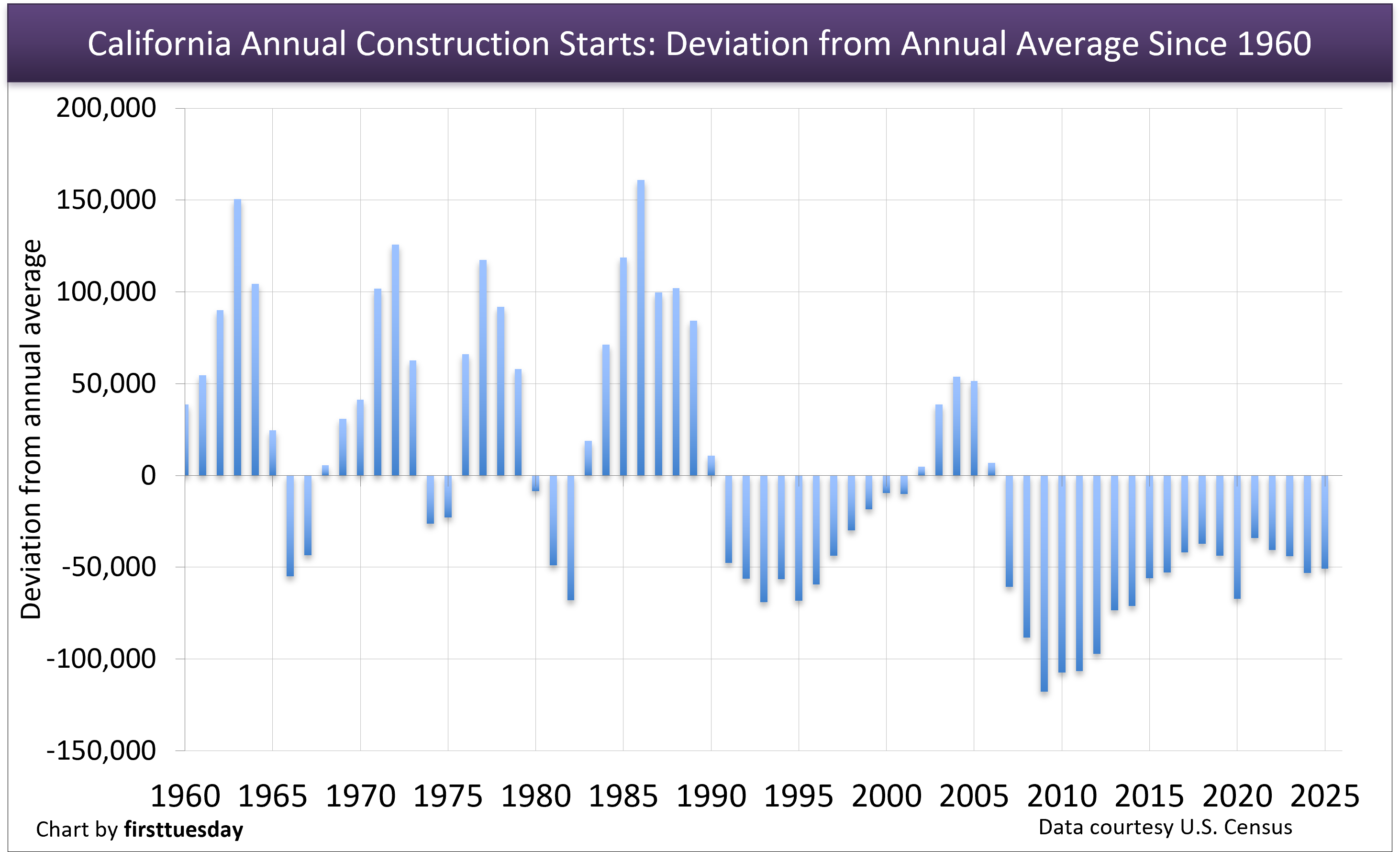
Chart update 3/20/26
| 2026 construction starts | Average annual construction starts | Difference | |
| California construction starts | 102,700 | 153,600 | -50,900| -33% |
The bars in the chart above indicate the deviation from the average annual construction of housing units in California (the left axis). The line that follows the bars corresponds with the actual number of construction starts completed each year (the right axis).
Since 1960, the average construction units started each year hovers just below 153,600 — the horizontal line in the chart above. However, most years since 1990 have seen starts far below the historical average. In 2025, a total of 102,700 housing units were started, consisting of a mix of single family residential (SFR) and multi-family starts. This was 33% below the historical average.
Based on the current trends in home sales volume and home vacancies, construction starts won’t likely return to 1960 levels for years to come.
In the meantime, where is California’s growing population living? It’s hard to imagine how household formations — mostly the younger adult population — are able to occur with new construction staying below average levels almost every year since 1990.
In fact, California’s population has steadily increased each year, despite lagging construction which fails to support any population growth.
Chart 2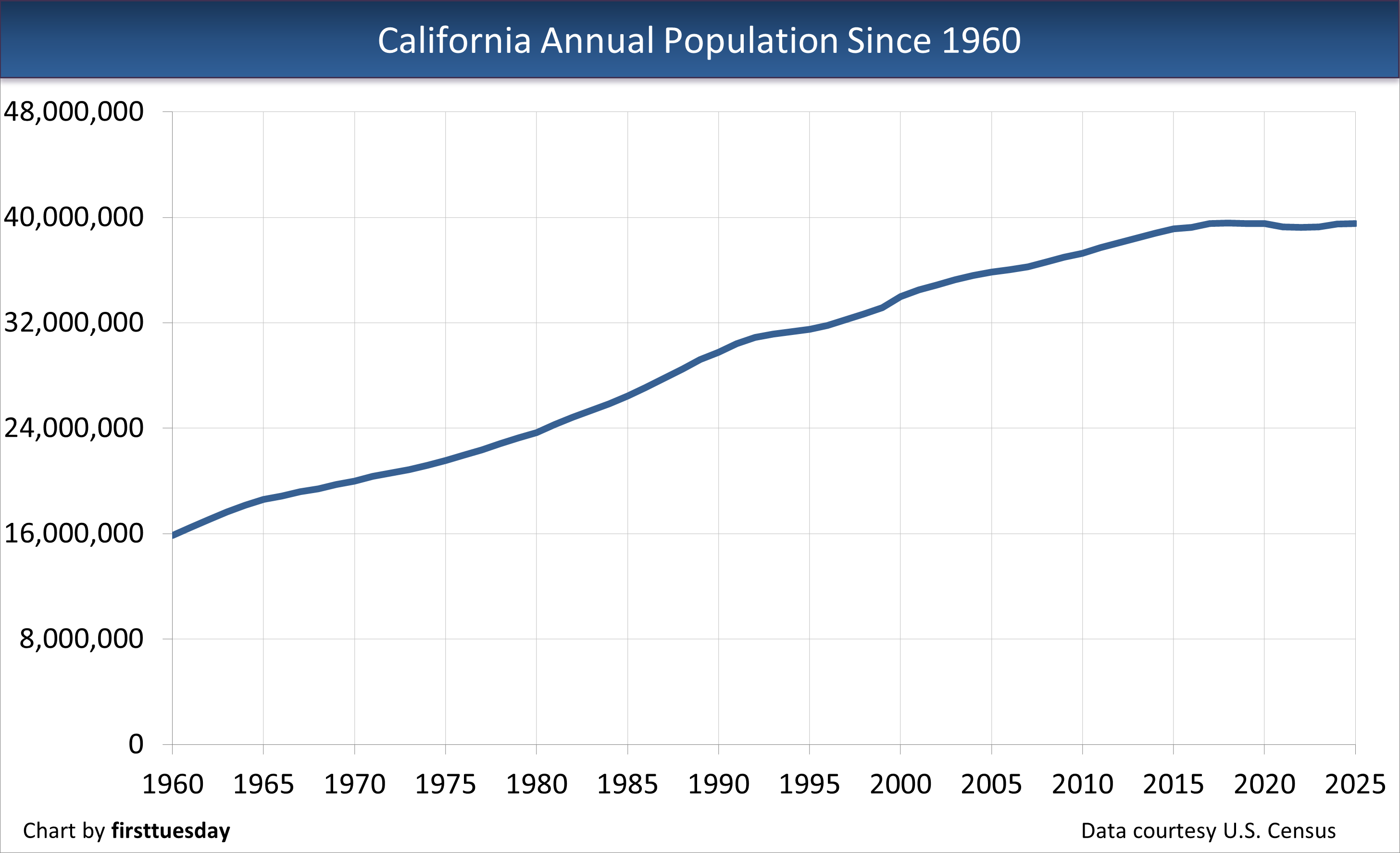
Chart update 3/20/26
| 2025 | 2015 | Change | |
| California population | 39,528,900 | 39,144,800 | +0.98 |
Return from excess
Redfin completed a similar comparison of national construction numbers against the nationwide average experienced since 1970. However, Redfin’s nationwide chart doesn’t paint the full picture of the excess construction which occurred in California during the 1960s through 1980s.
In 1960 — when the charts above begin — there were 5.5 million housing units. Since then, housing has increased 170% to just under 14.9 million housing units, as of 2024. Unlike California’s steady population increase, most of this construction occurred rapidly during 1960s through the late-1980s.
In the meantime, California’s population has stagnated recently. It has not grown more than a percent since 2000, with uncharacteristic decreases in the last five years.
Therefore, while today’s construction falls well below the historical average, another factor at play continues to keep all of California’s residents housed: the building that took place throughout the 1960s, 1970s and 1980s was in fact overbuilding. So much housing was built that California had no need to reach those price inflated years in the 1990s, the 2000s or in this decade.
Housing analysts say more housing units need to be built to keep up with population growth, and they are right, to an extent. Yes, today’s population keeps expanding past what construction can do to keep up. However, they fail to acknowledge the excess building which took place decades ago.
That being said, more construction is started overall compared to when the recession bottomed in 2009. 2025 saw 2.3% more starts than 2024 which stopped the decline in construction starts after 2021. While housing demand is rising, as young adults increasingly leave parents and roommates behind to form more households, insufficient construction continues. This is due to high costs, zoning/permitting issues and an increasing shortage of foreign labor for construction.
In particular, over-restrictive zoning laws have led to airtight markets in desirable areas. San Francisco is a prime example of zoning regulations run amok. There, the resulting building crunch has caused prices to increase far beyond the reach of most residents, causing a rental crisis that continues to make national headlines.
For construction to reach its full potential, local zoning must be over-ridden. This is particularly true for high demand areas. These coincide with parts of the state that experience the strongest job performance, like San Francisco, San Jose, San Diego and parts of Los Angeles.









The gap between the 153,600-unit historical average and the 102,700 starts logged for 2025 is striking, but it does not read as a simple supply story. When restrictive zoning in coastal job centers tightens while household formation among younger adults stays constrained, the shortfall looks more like a mismatch between where housing is permitted and where demand is concentrated. Population growth has continued through the whole period, which points to a regulatory and financial constraint rather than a demographic one.
The historical average framing makes the gap clear – without that 153,600 baseline, 102,700 could almost sound acceptable on its own. The multi-family uptick after 2024 is encouraging, but the zoning constraints in coastal job centers are clearly the bottleneck that no amount of demand can fix on its own.
It is sobering to see that construction starts remain 33% below the historical average despite the clear need for more housing. If we continue to ignore the zoning limitations in high-demand areas, I don’t see how the state can realistically accommodate its growing population or keep housing affordable for younger generations.
It’s surprising to see how high material costs and labor shortages have kept construction starts so far below the historical average, especially in California. I wonder if there are more innovative solutions out there to address these challenges and get things moving again.
Single family residential (SFR) starts continued on a bumpy decline since the 2021 post-pandemic buying frenzy. However, while multi-family construction lifted significantly since the previous year,