Why this matters: Jobs bring income needed to rent or buy a property, and more users of real estate mean more rental or sales transactions — for brokers that’s fees. The level of jobs throughout California’s population tracks with the rate of our labor force participation, but jobs are the better evaluator for transaction levels.
The labor force participation (LFP) rate is the percentage of California’s population who are either employed or unemployed and actively seeking employment.
Presently, the LFP rate in California’s population is turning down after labor force recovered from a period of steep decline in the early months of the 2020 pandemic-era economy. The aging of our population is pushing the current decline. Further, the California population is slipping, as it always does as it cycles into a recession.
During the years of recovery following an economic downturn, California’s LFP rate remains roughly one percentage point below the U.S. average. In 2025, the state and national LFP rates converged, as the U.S. LFP faltered while California’s slow recovery continued. For April 2026, California and the nation are both under 62% LFP rate.
When individuals drop out of the workforce unemployed and no longer seeking employment, a false impression of an improving jobs market is created. The number of unemployed Californians drops, deceptively implying greater employment when in fact the number of jobs in California remains the same or declines.
Another deception (but in reverse) is happening now in the spring of 2026. While the number of employed individuals is rising in California, the LFP rate is declining. Since individuals are dropping out of the work force in greater numbers than the rise in those employed, the total LFP declined for lack of willing workers.
For real estate transactions today, the operative statistic is what is happening to the number of individuals employed — did it drop, rise or hold steady. This is the number of employed individuals in California, the primary source of residential tenants and buyers. In turn, their employers rent or buy commercial space.
California employment — jobs — grew from a pre-pandemic peak in December 2019 of 17.7 million employed individuals. California reached an all-time high of 18.2 million in December 2024. However, by April 2026 our statewide employment figure had slipped, but is 18.1 million and slowly trending up.
This is in contrast to the LFP rate which has stagnated in the last few years but is trending down in 2026.
Brokers who watch the jobs number for the employed along with the LFP rate find the trends useful for forecasting their future brokerage conditions. No reason to concern yourself about the unemployment rate as the unemployed have no earnings from a job.
Updated May 26, 2026.
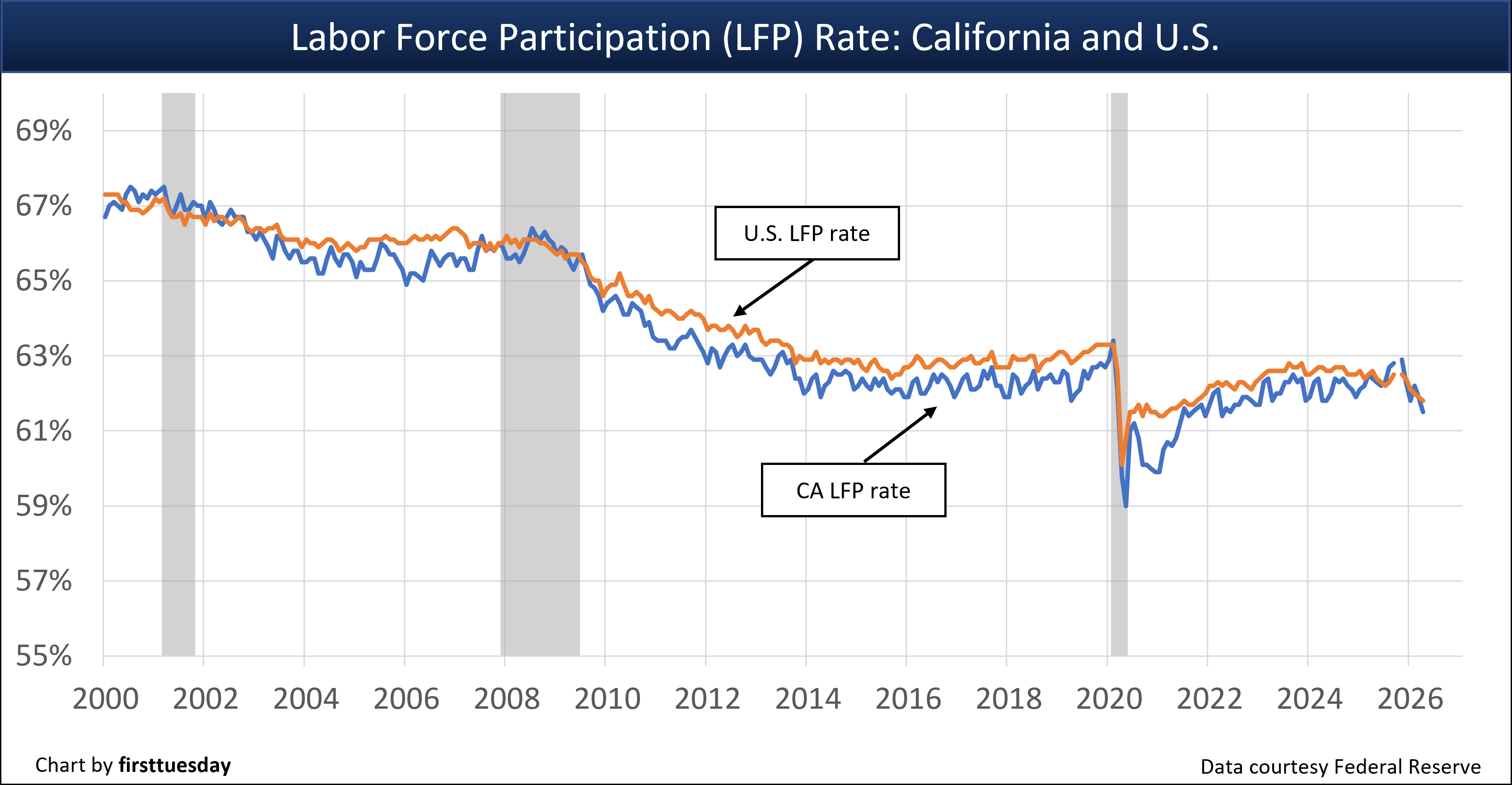
Chart update 5/26/26
April 2026 | March 2026 | April 2025 | |
| California labor force participation (LFP) rate | 61.5% | 61.9% | 62.4% |
| U.S. labor force participation (LFP) rate | 61.8% | 61.9% | 62.6% |
Editor’s note — Due to the 2025 Federal shutdown data was not reported for October 2025.
Jobs mean income, and their income is your income
The trend of the number employed in California drive good markets and bad markets, whether good or bad for buyers or sellers. The employment trend has the most consistent impact on the vigor of the real estate market of any economic factor. Further, when a jobholder considers a home to rent or buy, their financial decision to acquire real estate — whether a leasehold or a fee estate — is nearly always influenced if not controlled by their annual gross income from employment.
A paycheck is the primary financial base for a household’s ability to qualify to lease a residence or obtain mortgage funds to own their residence.
Looking forward, job uncertainty is expected to continue through 2026, and likely beyond for two or three years. The forces pressing this decline include uncertain business conditions, volatile import taxes on products and material bought by consumers and businesses, reduced ability to export, diminished tourism and travel, immigration and other 1930s-type isolationist conditions.
Related article:
Income means housing
Households respond to changes in their income by adjusting monthly housing expenses and changing their choice of location based on job opportunities. For Californians, the retired and those workers with less in-demand skills tend to exit to the interior states while new arrivals come with skills that command wages sufficient to support their relocation to California.
During periods of economic growth, local construction of homes and apartments increases to meet the growing demand for housing — not met by turnover inventory for-rent or for-sale vacated by tenants and owners.
Reductions in local employment normally lead to lower rents and prices paid by tenants and buyers for the occupancy and other types of real estate, with rent for housing being the most stable.
Areas with higher LFP rates support higher absorption rates for properties available for rent or sale.
A sustained dip in LFP rates contributes to reduced transaction volume across all classes of real estate, especially acute in lower- and middle-income brackets.
When employment falters, the result is:
- fewer leases signed; and
- fewer sales closing.
Significantly, most buyers need employment to qualify for mortgage financing, with the amount of borrowing to fund a purchase dependent on their household’s gross income.
Renting or buying means broker fees
Regional differences in LFP growth are used by agents and brokers to assess their relocation to areas more likely to lead to more real estate transactions. Here, branch office operations come into play.
Also, brokers and agents can pinpoint an economically troubled region by its lower absorption rates when they observe:
- slower turnover rates for tenants and owners;
- imbalance in inventory for sale or lease;
- declining trend in sales and leasing transactions; and
- lower average fees per transaction.
In conclusion, a stable rising LFP rate supports enhanced brokerage income flows. A higher LFP helps a broker in search of clients — more fees, more often.