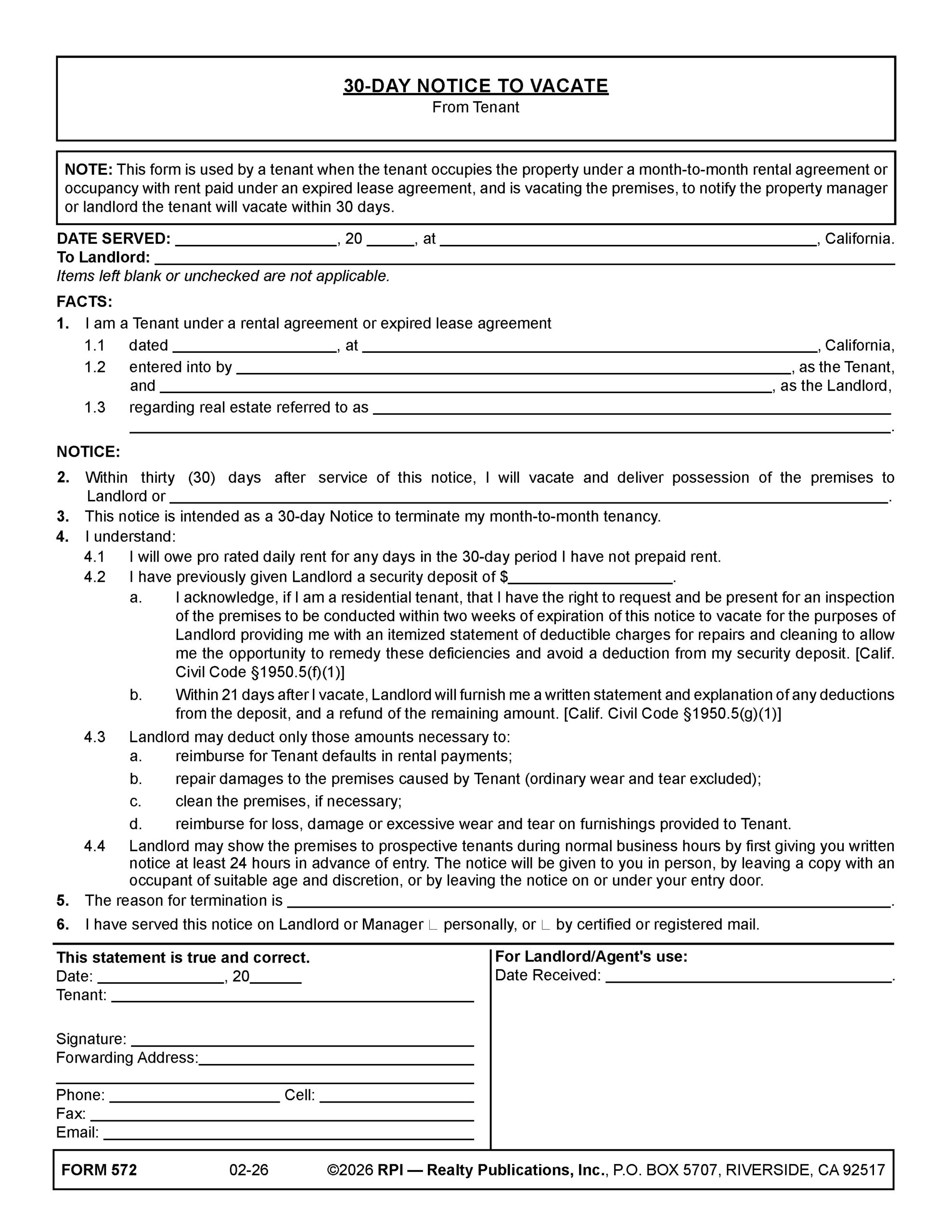
This form is used by a tenant when the tenant occupies the property under a month-to-month rental agreement or occupancy with rent paid under an expired lease agreement, and is vacating the premises, to notify the property manager or landlord the tenant will vacate within 30 days.
The periodic tenancy
A periodic tenancy automatically continues for successive equivalent periods of time, such as a week or a month. The length of each successive period of time is determined by the interval between scheduled rental payments. A periodic tenancy is automatically renewed when the landlord accepts rent.
Examples of periodic payment intervals include:
- annual rental payments, indicating a year-to-year tenancy;
- monthly rental payments, indicating a month-to-month tenancy; and
- weekly rental payments, indicating a week-to-week tenancy.
A periodic tenancy is created when a landlord and tenant enter into a rental agreement. A rental agreement sets the terms of a periodic tenancy, including the rent to be paid, when rent is payable, who will pay which utilities, and the maintenance responsibilities between the landlord and tenant. [See RPI Form 551]
A periodic tenancy also arises due to occupancy under a defective lease agreement. A tenant who enters into possession under an unenforceable lease agreement (e.g., oral or unsigned) and pays rent in monthly intervals that the landlord accepts is a month-to-month tenant.
A periodic tenancy continues until terminated by service of a notice to vacate. This makes a periodic tenancy flexible, since it allows either the landlord or the tenant to terminate a month-to-month tenancy by giving the other the appropriate notice to vacate. [Kingston v. Colburn (1956) 139 CA2d 623; Calif. Civil Code §1946; See RPI Form 569 and 572]
To terminate a periodic tenancy, the notice period needs to be at least as long as the interval between scheduled rental payments but need not exceed 30 days. However, an exception exists when a residential tenant has occupied the property for more than 12 months, which requires a 60-day notice to terminate the periodic tenancy. [CC §1946.1; See RPI Form 569-1]
Tenant’s intent to vacate
A tenant, residential or commercial, who intends to vacate and avoid further liability under a month-to-month rental agreement, serves the landlord with a 30-day advance notice the tenant is vacating.
The notice to vacate may be in the form of a letter personally delivered to the landlord or their agent or sent by certified or registered mail. [CC §1946]
The tenant and landlord are best served by the landlord handing the tenant a blank 30-day notice to vacate form when entering into a rental agreement, but not when entering into a lease agreement. [See RPI Form 572]
The tenant will then have the correct paperwork to complete and deliver documentation to the landlord or property manager. Use of a form lends certainty to the tenant’s understanding of a critical event. [See RPI Form 572]
Tenant acknowledgement
A 30-day notice used by a tenant to advise the landlord they intend to vacate acknowledges:
- the tenancy is terminated on expiration of 30 days after service of the notice on the landlord or the manager;
- the tenant intends to pay pro rata rent;
- the amount of the security deposit;
- the tenant’s right to request a joint pre-expiration inspection and receive an itemized statement of maintenance and cleaning deficiencies for any potential deductions from the security deposit;
- a security deposit statement and refund based on any deductions for cleaning and repairs on a final review of the premises by the landlord or property manager; and
- the landlord’s right to show the premises to a prospective tenant on 24-hour notice.
When a tenant serves the landlord or property manager with a 30-day notice to vacate but fails to vacate the residence after expiration of the notice, they become a holdover tenant unlawfully in possession. The tenancy has been terminated by the tenant’s notice and with it the right to occupancy. The landlord may immediately file an unlawful detainer (UD) action to evict the tenant. No further notice to quit is required since the tenancy has already been terminated.
Service of the tenant’s notice to vacate
A tenant may serve their notice to vacate at any time during the month.
However, a commercial landlord and tenant may agree in a rental agreement that the 30-day notice to vacate may not be served during the last seven days of the month.
In contrast, service of a notice to vacate can occur at any time in a residential periodic tenancy. [CC §1946]
To be effective in commercial tenancies, the notice to vacate from a tenant or landlord needs to be served:
- in the same manner as a three-day notice (in person, by substitution or ultimately post and mail); or
- by certified or registered mail, methods of service not available for three-day notices to quit. [CC §1946]
The date of service is the date the notice is attempted in the following priorities:
- personally served;
- handed to a person of suitable age and discretion at either the residence of the tenant or the tenant’s place of business; or
- posted in a conspicuous place on the leased premises and mailed by certified or registered mail.
The minimum period within which the tenant is to vacate begins to run the day after the date of service, which is day one of the 30- or 60-day period to vacate. [CC §10]
When the day for expiration of the notice is a Saturday, Sunday or a federal holiday, the tenant is not required to vacate until the next business day. [Calif. Code of Civil Procedure §12]
Analyzing the 30-day notice to vacate from tenant
A tenant uses the 30-Day Notice to Vacate — From Tenant published by Realty Publications, Inc. (RPI) when the tenant occupies the property under a month-to-month rental agreement or the occupancy is under an expired lease agreement and rent has been paid and the tenant is vacating the premises. It allows the tenant to notify the property manager or landlord the tenant will vacate within 30 days. [See RPI Form 572]
The 30-Day Notice to Vacate — From Tenant contains:
- date served, to establish the tenant is to vacate within 30 days after the date given;
- landlord’s name;
- Facts, including the:
- date of the rental agreement or expired lease agreement granting the tenancy;
- tenant’s identity;
- landlord’s identity; and
- real estate involved [See RPI Form 572 §1];
- who the tenant will return the leased premises to within 30 days of service of the notice [See RPI Form 572 §2];
- a statement verifying the notice is intended as a 30-day notice to terminate the tenant’s month-to-month tenancy [See RPI Form 572 §3];
- the tenant’s understanding that:
- they owe prorated daily rent for any days in the 30-day period they have not prepaid rent;
- residential tenants have a right to request and be present for an inspection of the premises prior to vacating to become aware of deficiencies needing correction to avoid a deduction from the tenant’s security deposit;
- within 21 days after the tenant vacates, the landlord furnishes a written statement and explanation of any deductions from the deposit, and a refund of the remaining amount;
- the landlord may deduct from the security deposit only those amounts necessary to:
- reimburse for tenant defaults in rental payments;
- repair damages to the premises caused by the tenant, minus ordinary wear and tear;
- clean the premises; and
- reimburse for loss, damage or excessive wear and tear on furnishings; and
- the landlord may show the premises to prospective tenants during normal business hours by first giving the tenant written notice at least 24 hours in advance of entry [See RPI Form 572 §4];
- the tenant’s reason for the termination of the month-to-month rental agreement [See RPI Form 572 §5];
- whether the tenant served the notice personally or by certified or registered mail [See RPI Form 572 §6]; and
- the tenant’s name, signature and date, as well as forwarding address and contact information, and the date the landlord received the notice from the tenant. [See RPI Form 572]
Form updated 2026.
Form navigation page published 10-2026.
Form-of-the-Week: Tenant notices to landlord — to vacate, and to surrender personal property — Forms 572 and 582
Recent Case Decision: May a landlord accept rent payments from a holdover tenant after their lease agreement expires without creating a month-to-month tenancy?
Recent Case Decision: Is a tenant in a subsidized low-income housing development entitled to money losses when the landlord serves an improper notice to terminate the tenancy?
Page: Property Management 101
Video: The Periodic Tenancy