
Why this matters: Real estate comprises the largest holder and source of wealth for over half of American households. When personal and business bankruptcies involve equity in real estate, the filings reflect a downward trajectory already in motion for the owners.
California parallels national lead
Bankruptcy filings began to inch higher during 2025, with 138,200 personal bankruptcies and 6,400 business bankruptcies filed nationwide in Q4 2025. Further, bankruptcies continued to increase during 2026, up 11% in 2025 from a year earlier after a recent low point in 2022 following the covid pandemic.
With a below average filing share, California represents approximately 9% of the national filings versus 11.5% of the nation’s population.
Bankruptcies plummeted during the 2020-2021 pandemic period, despite the prior onset of the 2020 recession. Without pandemic interference, bankruptcies would have risen significantly, as in any recession. Zombie businesses which otherwise would have folded found fuel in economic stimulus and the accelerated consumer inflation it generated.
Bankruptcies are on their way up again with 9,600 business bankruptcies filed in California during 2024, a fraction of the 63,200 filings that were recorded during the 2011 peak of the 2008 recession. In 2025, this number increased to 10,000 business bankruptcies.
When it comes to forecasting recessions, bankruptcy numbers are a lagging indicator. That is, many businesses hold on until they run out of cash, bleeding off market share and disrupting the recovery while they exist as zombie businesses. Eventually they give in to market forces and throw in the towel. Compared to businesses and real estate investors, bankruptcy offers few benefits for individual households, though bankruptcy proceedings extend the foreclosure process by several months for homeowners.
In 2026, the economy has stalled, creating a different experience for consumers watching every day costs remain high while larger businesses bet on expansion while lending flourishes. Borrowing to cover the shortfall in income is taking place for households, businesses, and government.
With the ongoing trade wars and heavy bond market investment in AI, employment is in limbo while mortgage rates and rents grow. The result is reflected in a forward cyclically disproportionate rise in bankruptcy filings over the next four plus years.
For the housing market, the reduction in home sales volume, which took a dramatic turn in late 2021 producing a rapid doubling of mortgage rates, saw home values fall in 2022 to wipe out nearly 1/3rd of the prior year’s home price increase. Since then, prices have not increased — interfering with real estate’s hedge against consumer inflation due to the rise in mortgage rates and buyer caution. Extensive HELOC and reverse mortgage originations have diminished net equity in owner’s homes as they borrow and spend.
Homeowners who see the equity in their home diminish are more likely to seek bankruptcy protection when household financial stresses occur such as death, divorce or job loss. As the struggle for homeowners to realize their asking prices sinks in, and buyers simply wait for prices to trough, expect more personal and business bankruptcy filings, expected to peak around 2031.
Updated October 19, 2026. 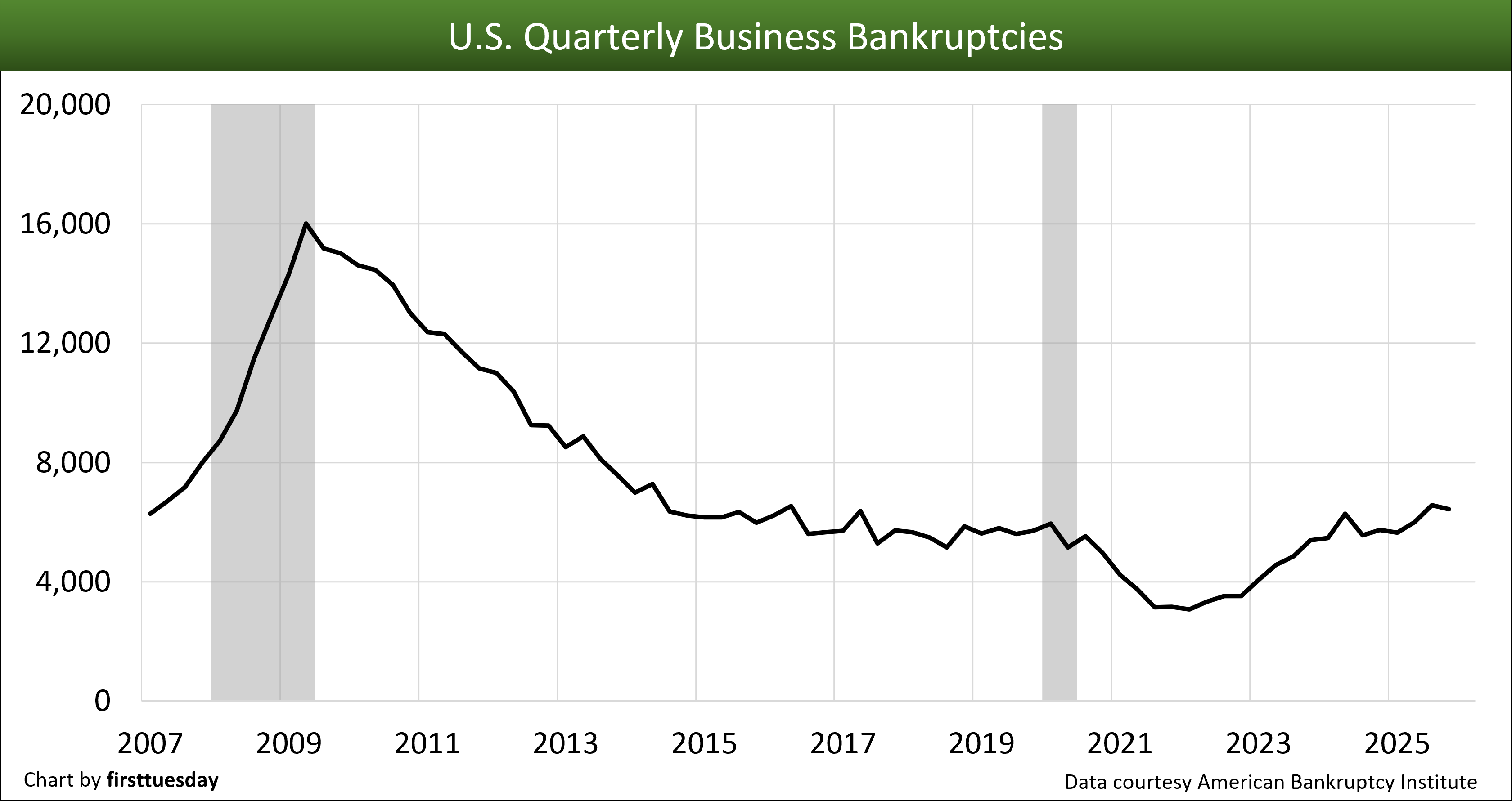 Chart update 10/19/26
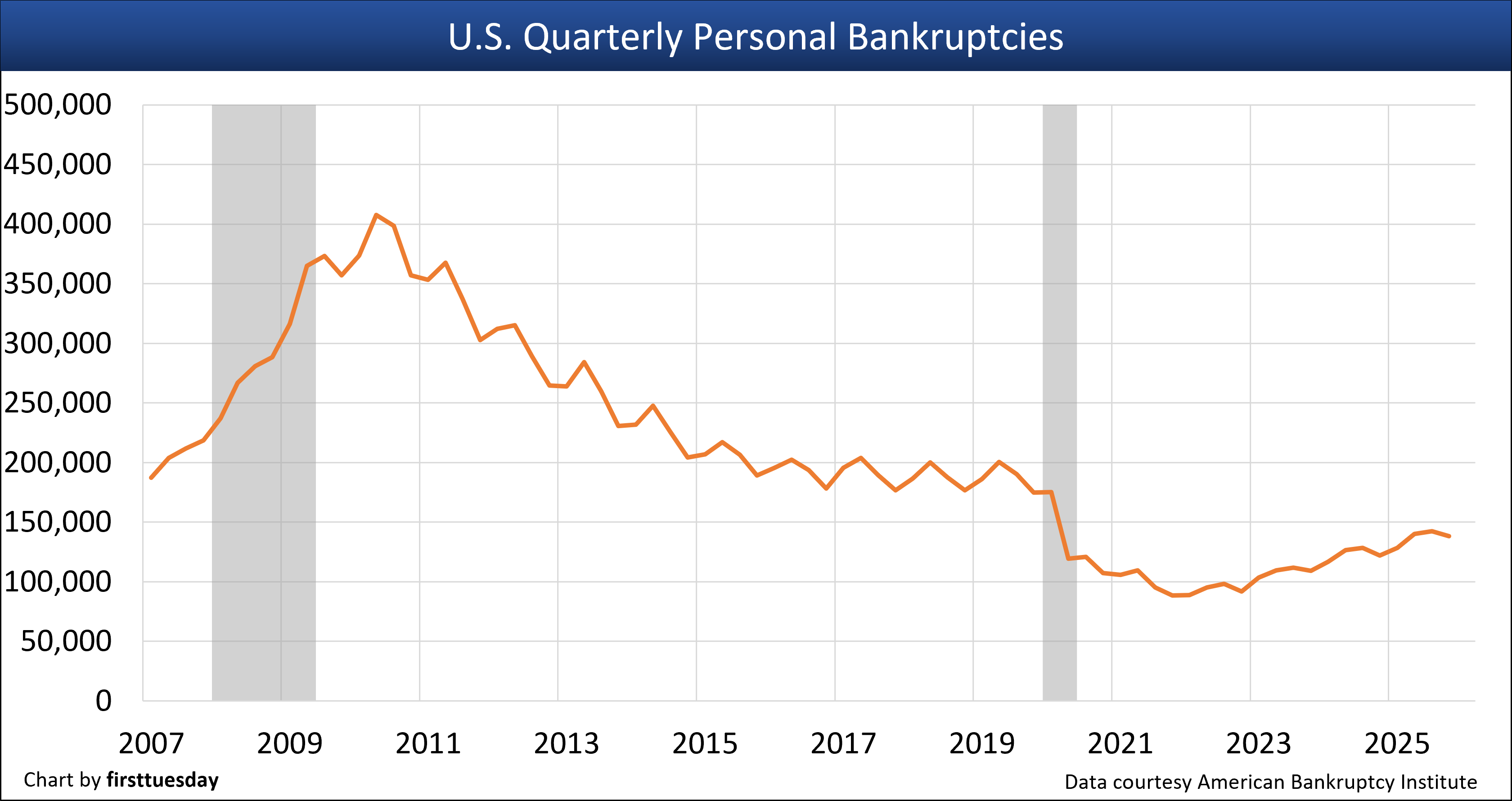 Chart update 10/16/26
| Q4 2025 | Q4 2024 | Q4 2023 | |
| Personal Bankruptcies | 138,200 | 122,200 | 109,400 |
| Business Bankruptcies | 6,400 | 5,700 | 5,400 |
Focusing on California
The number of bankruptcy filings decreased each year since the Great Recession ended in 2011, eventually bottoming in 2021.
In 2025, California’s Central District had the most bankruptcy filings in the country:
- Central California, with 20,300 personal bankruptcies and 4,600 business filings;
- Los Angeles, with 12,000 personal bankruptcies and 2,000 business filings; and
- Riverside, with 8,200 personal bankruptcies and 1,400 business filings.
The majority of these personal bankruptcy filings were completed through Chapter 7.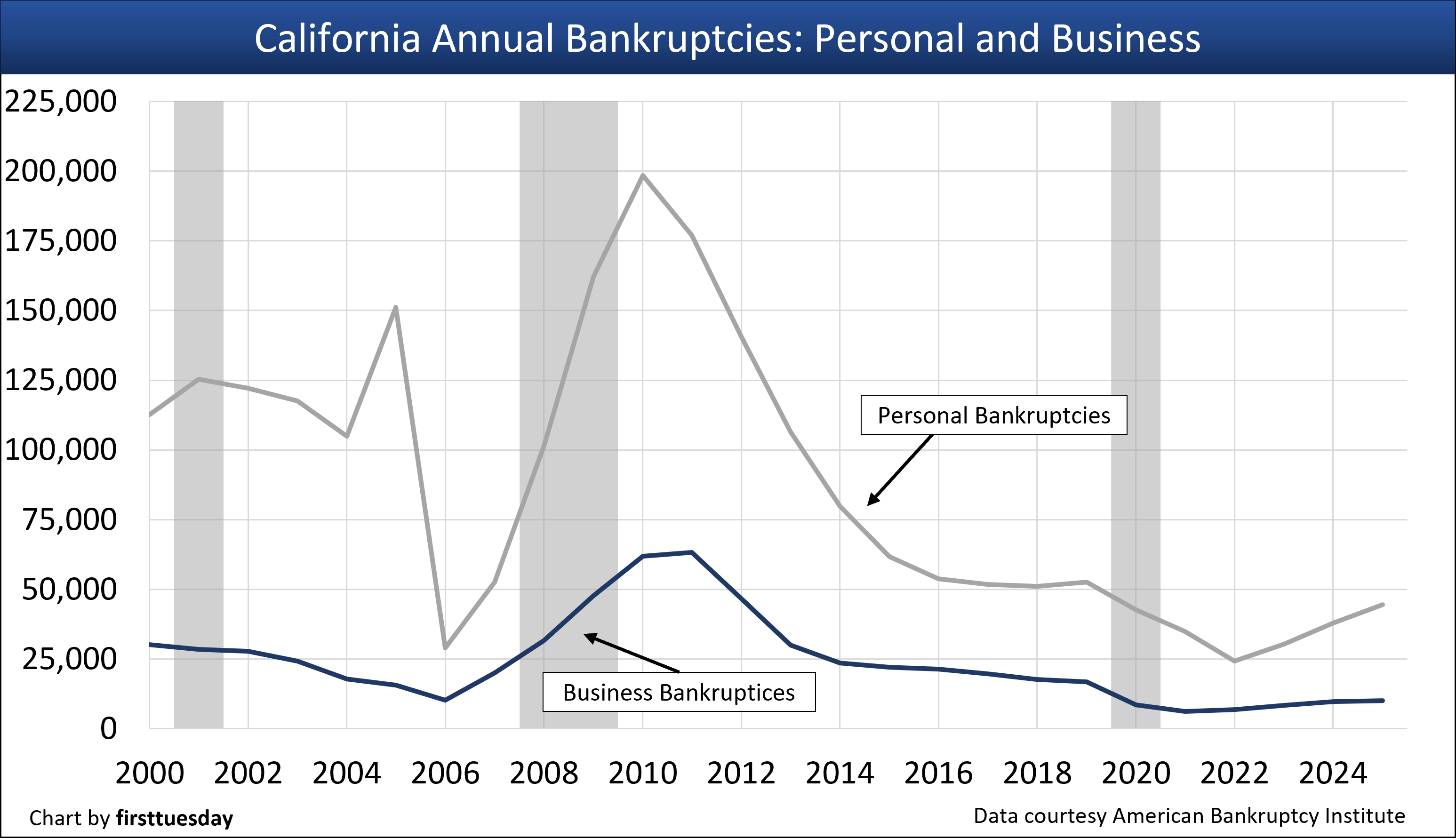 Chart update 10/19/26
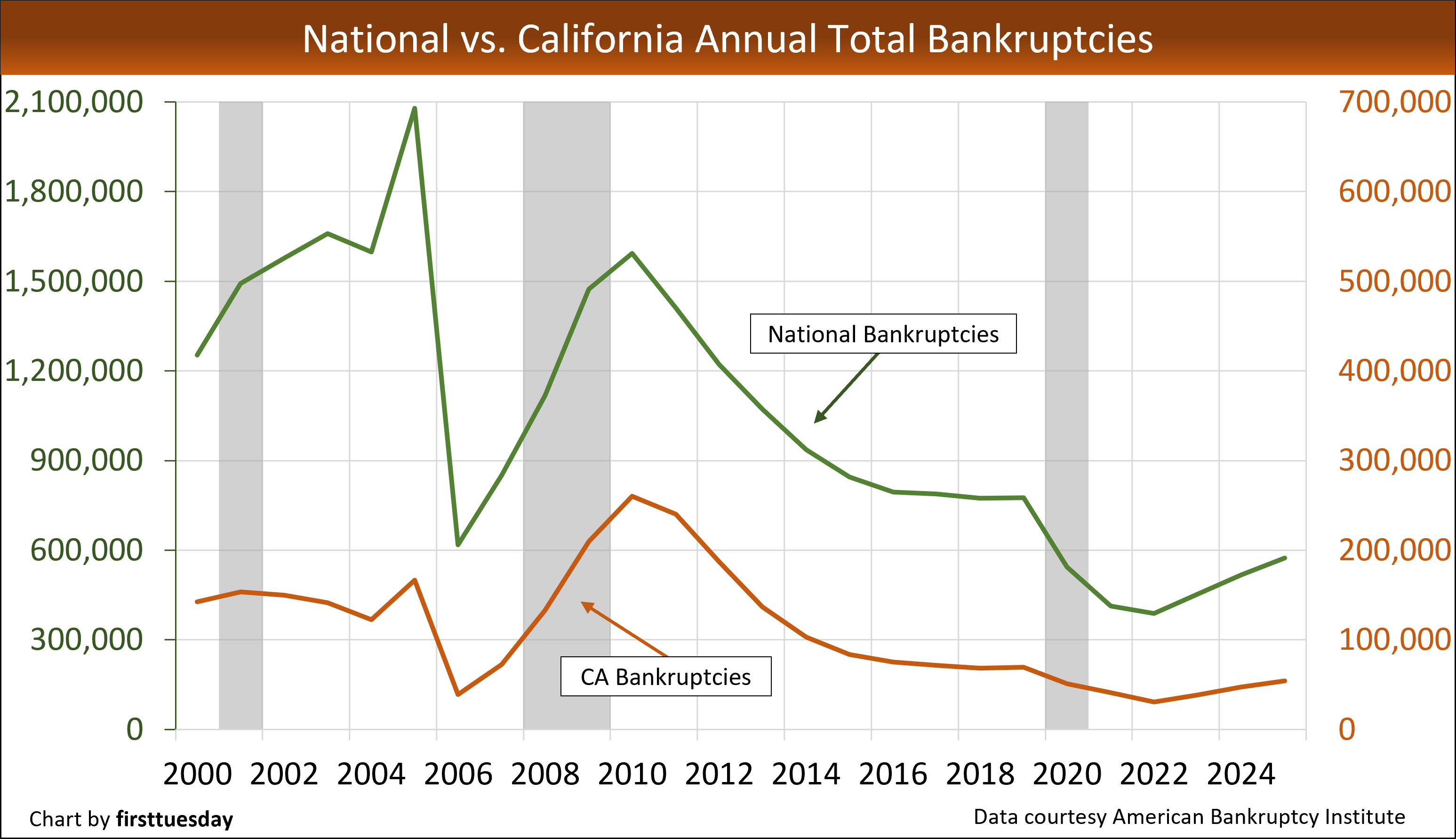 Chart update 10/19/26
Two forms of bankruptcy
Two separate bankruptcy procedures exist, both governed by federal law.
Chapter 7 bankruptcy requires the insolvent homeowner in bankruptcy to repay their debt from whatever assets they possess, unless those assets have dollar values lower than state-allowed levels of exempt assets and income. In Chapter 7 bankruptcy, a home without equity above the owner’s exception is counted among these assets and foreclosed upon.
Chapter 13 bankruptcy, on the other hand, requires the homeowner to repay their delinquent debts over a longer period of time than originally agreed to, after deducting reasonable living expenses.
The Chapter 13 repayment plan can include the sale of the owner’s home, when the home has equity exceeding their homestead exemption. More critically, bankruptcy law since 2005 no longer permits the reduction of a homeowner’s mortgage by a bankruptcy court (a cramdown of principal amount to the value of the home).
However, Chapter 7 bankruptcy voids any deficiency obligations on recourse mortgage refinancing, just as it voids all unsecured debt with a value exceeding the amount of the homeowner’s nonexempt assets.
More importantly for homeowners, a bankruptcy filing puts an immediate stop to lender collection efforts. The process for bankruptcy allows a homeowner to pay delinquent mortgage payments over a three-to-five-year period. Troubled homeowners often choose to file Chapter 13 Bankruptcy to discharge their non-mortgage (unsecured) personal debts and then use the newly freed funds to make future payments on their mortgages.
Homestead exemption protections
Bankruptcy laws do enforce California homestead exemption. For positive equity homeowners, this exemption acts as an incentive to file bankruptcy to avoid unsecured debts and free up cash flow by making it available under the homestead.
On the other hand, the homestead exemption has no effect on the priority or payment of an owner’s mortgage. The bankruptcy process does adversely affect creditors who obtained involuntary liens (judgment liens) against a homeowner’s title.
In 2026, California homeowners qualify for a net equity homestead exemption of:
- up to $300,000; or
- the median sale price for a single family residence (SFR) in the homeowner’s county in the calendar year prior to the year in which they claim the exemption, not to exceed $600,000 (adjusted annually for inflation). [CCP §704.730]
Related article:
California’s homestead exemption falls short of full protection for homeowners
Bankruptcy and foreclosure
From a mortgage holder’s point of view, the most adverse aspect of bankruptcy is the “automatic stay” provision. This provision of bankruptcy law also delivers the most direct and immediate benefit for financially troubled homeowners. Under the automatic stay provision, any real estate owner who files bankruptcy immediately triggers an automatic stay on all collection efforts against them, including foreclosure sales.
Lenders prefer to quickly move to complete a foreclosure sale, take title to the property, and get what proceeds they can to cut their losses. However, they are hamstrung by the automatic stay provision when the owner files a bankruptcy petition.
Under the automatic stay, a mortgage lender is forced to wait until a bankruptcy court allows them to proceed. The stay provision increases the lender’s costs of dealing with a homeowner who does not maintain their mortgage payments while in bankruptcy.
On average, filing Chapter 7 bankruptcy extends the foreclosure process from six months to a year. Chapter 13 delays the foreclosure sale even longer, often drawing it out to a year and a half. A homeowner who files bankruptcy without the ability to make payments on their mortgage merely extends the time before the eventual foreclosure sale.
For the lender, the bankruptcy process increases the risk of damage to the home or drop in market value before the foreclosure sale takes place, increasing the lender’s eventual loss.
Lenders thus have a vested interest in government regulations that make it difficult for homeowners in bankruptcy to obtain relief on their mortgages. Further, they intend to keep their hard-fought legislative gain in 2005 of a cramdown-free bankruptcy law for homeowners intact.
Lenders don’t want the threat of a bankruptcy judge endowed with the power to reset the loan balance at exactly the amount the mortgaged property is worth (which, of course, is all the lender can expect to get from foreclosure anyway).
When bankruptcy stops the mortgage lender, the lender wants out of bankruptcy court as quickly as possible. Often, they are persuaded to agree to a short sale in order to hasten the process while cutting their losses. Thus, bankruptcy is an effective way for homeowners to force the lender’s hand.
Costs and benefits of bankruptcy
So does filing bankruptcy (and thereby discharging unsecured debt and putting off a potential foreclosure sale) actually help homeowners pay their mortgages, or do the other costs of bankruptcy cancel out the benefits?
Evidence is mixed, but homeowners and their attorneys certainly seem to believe that bankruptcy can be beneficial. Troubled homeowners already make up the majority of those who file for Chapter 13 bankruptcy (studies in other states found that over 80% of filers were paying for homes with a loan to value ratio (LTV) over 90%).
A 2018 study from CUNY School of Law found that half of homeowner debtors who filed a plan for Chapter 13 bankruptcy by employing an attorney avoided foreclosure and successfully completed repayment plans.
Certainly, bankruptcy does, at least on occasion, have a positive effect for desperate homeowners who turn to filing as a last resort. It is also sure that bankruptcy will almost always have a negative effect for lenders.
Equally important, homeowners who file for bankruptcy will find their past bankruptcy interferes with their future ability to qualify for mortgage financing. This forces the household to become tenants which does permit greater job mobility. In turn, they must place their savings in investments other than real estate — all due to the credit agency rules controlled by lenders.








The information is very useful. I have a reseach relate to.
It’s interesting that you mention that filing for Chapter 13 bankruptcy can help you save your house from foreclosure. I have been falling behind on my mortgage payments for several months due to an injury that prevents me from working, so I’m considering seeking the services of a bankruptcy attorney. I’m going to search for a good bankruptcy attorney in my area to use.
“Over the past few decades, Prop 13 has accomplished this — and more — at the expense of new homeowners and renters.
Some of the negative effects spread by Prop 13 include:
• reduced sales volume, as current homeowners are incentivized to stay in their current home to keep their low tax rate;
• * new homebuyers — typically young families with less wealth than their more established neighbors — pay higher tax rates than their neighbors, who benefit from the same government services their property taxes support.”
*New homebuyers may be paying higher property taxes than their neighbors, but they too are protected from spiraling out control property tax increases. This seems to be a poor argument.
“Of the total number of homeowners who file bankruptcy, only about 33% successfully kept their homes. It is certain that bankruptcy does, at least on occasion, have a positive effect” One out od three keep their homes! That’s not “On Occasion”, it’s pretty good odds! Get a grip!