Why this matters: A corporate broker uses a Designated Officer Employment Agreement to establish a corporate broker-officer’s duties and fee schedule for earnings as designated officer of the real estate corporation and licensees held under the same broker use a Real Estate Team Agreement to form a real estate team and establish each team member’s responsibilities and fee sharing.
The designated officer and the corporate broker
A designated officer is the licensed real estate broker who is appointed as the responsible officer for a corporation conducting real estate brokerage activities as licensed and governed by the California Department of Real Estate (DRE).
A corporation may not qualify to hold a broker license on its own. Thus, the DRE requires an individual licensed as a broker to be a corporate officer — such as a president, vice president or secretary — to act and be also licensed as the corporation’s designated officer (DO).
The DO is responsible for supervising the corporation’s employees and their real estate activities to ensure compliance with California real estate law, a duty owed the DRE. The DO may assign supervisory responsibilities over licensed salespersons of the corporation to additional licensed broker-officers. The corporation gives the DRE written notice of this change within five days of the assignment. [See RE 210]
Through the DO, the corporation is authorized to perform brokerage services and employ licensed salespersons and broker-associates.
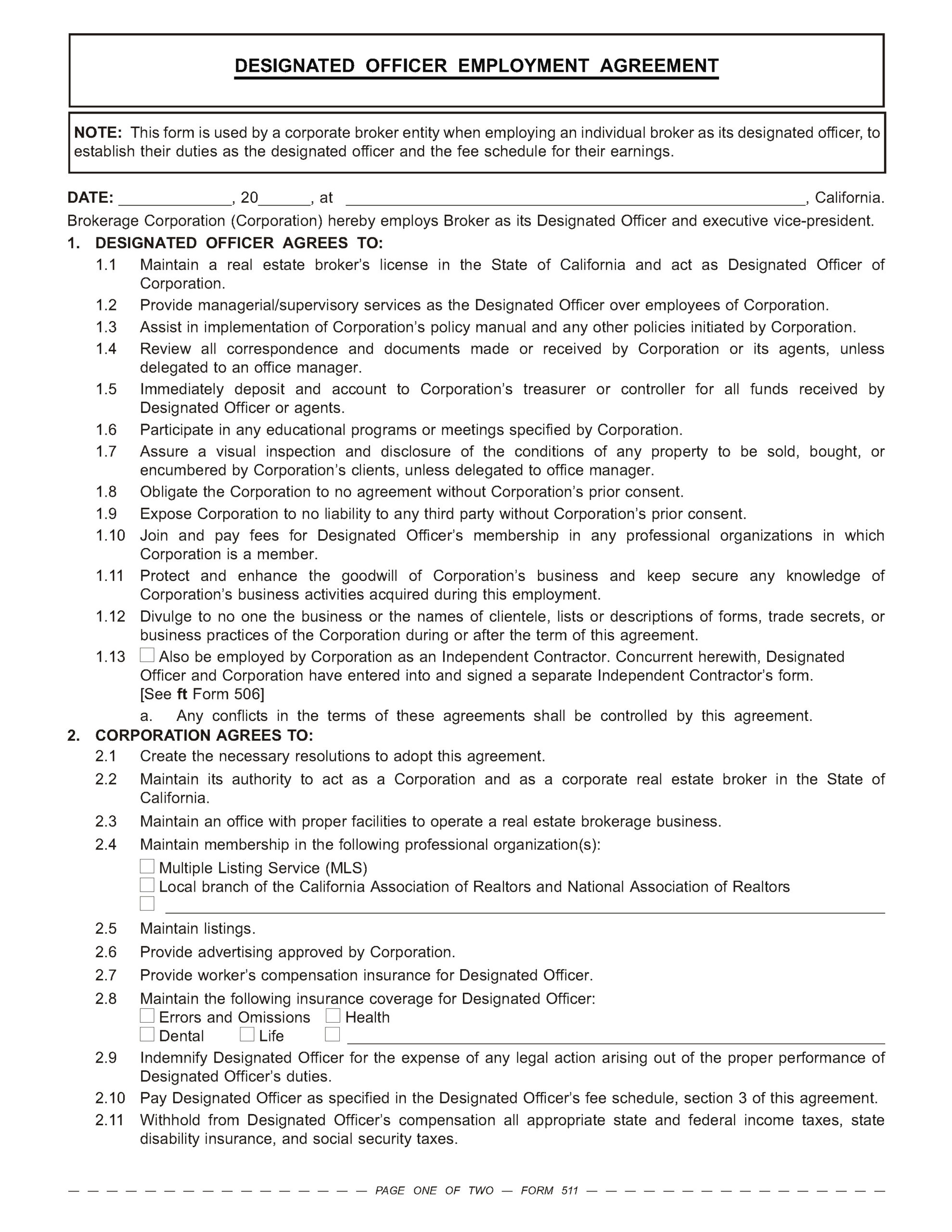
A real estate corporation employs an individual broker as its designated officer and establishes their duties as the designated officer and fee schedule for their earnings using the Designated Officer Employment Agreement. [See RPI Form 511]
Related article:
DRE Hot Seat: Designated officer assumes responsibility over mismanaged brokerage
Real estate teams
Real estate teams allow brokers and salespersons to expand their reach and improve client services and transaction volume. The team members benefit by the synergy brought on by efficiencies and an aggregation of human resources.
A real estate team consists of two or more licensees who work together under the supervision of the licensed broker who employs them. They often assign to one another on the team the responsibility for marketing, administration and clients.
While teams may use many different strategies, they always need to function within the framework of California real estate licensing laws and the supervision requirements imposed on the employing broker by the DRE.
In California, a real estate team is not a separate licensee situation, like a designated officer. Instead, all licensed members of the team are affiliated with and supervised by the same responsible broker.
The broker remains fully responsible for the real estate activities conducted by each team member, including advertising, negotiations and transaction management. The employing broker needs to agree on the team’s operations and establish administrative policies governing how the teams operate, how compensation is distributed and how client relationships are managed.
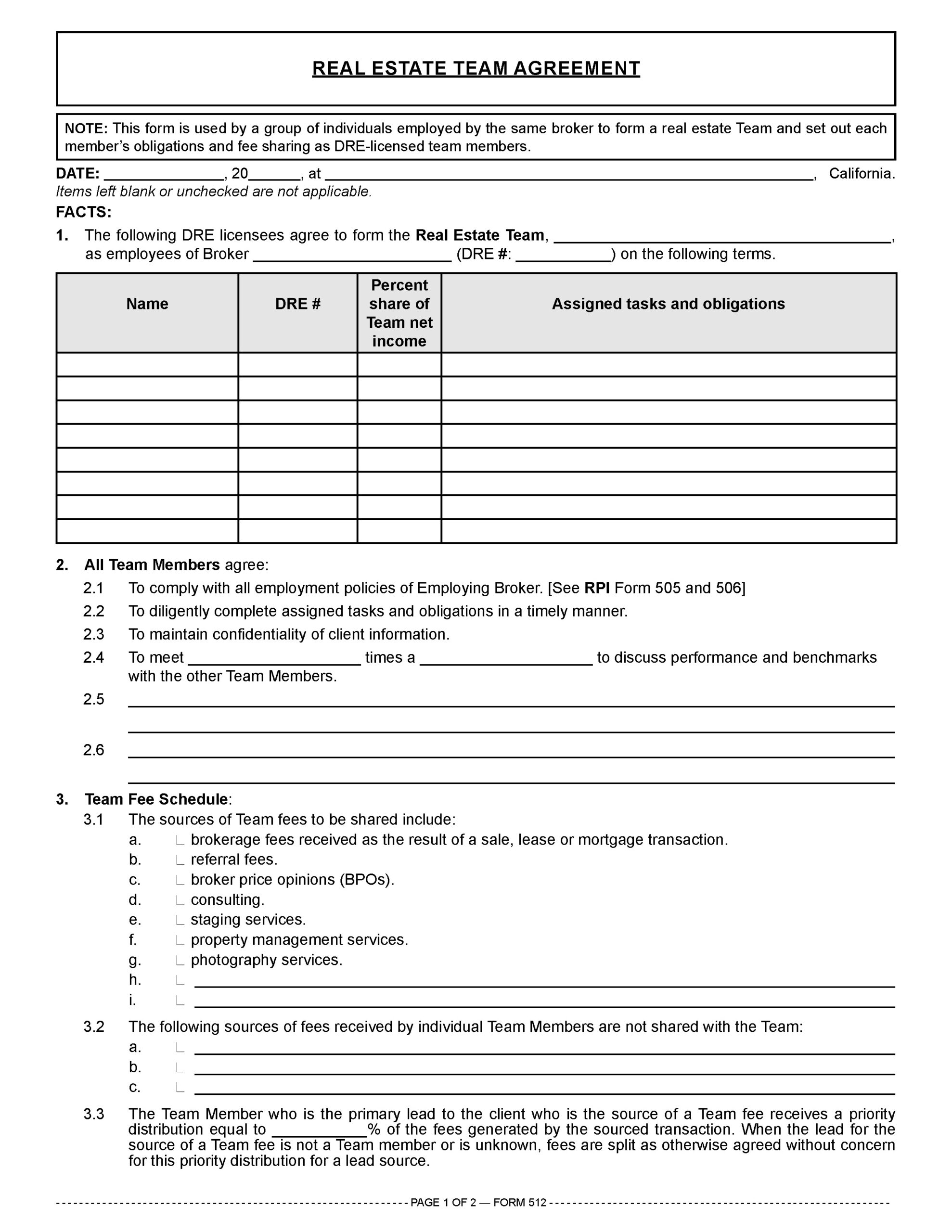
A broker-associate or salesperson and their employing broker use a Real Estate Team Agreement to form a real estate team, setting out each member’s obligations and fee sharing as DRE-licensed team members. [See RPI Form 512]
Related article:
The power of many: Building and operating a real estate team in California
Real estate teams and advertising
A team is allowed to market themselves under a team name, but the advertising needs to clearly identify the employing broker. [Calif. Business and Professions Code §10159.6(b)]
The team name used by members employed by a broker may not imply the group operates as an independent entity separate from their employing broker. [Bus & P C §10159.6(c)]
Thus, the team name will include the last name of at least one of the licensees on the team, either a broker-associate or salesperson, in addition to the word:
- associates;
- group; or
- team. [Bus & P C §10159.7(a)(3)(B)]
Advertising materials including a team name are to include the last name and license number of at least one of the licensed team members. [Bus & P C §10159.6(c)]
Further, the employing broker’s name is displayed as prominently as the team name on all advertising materials. For example, the broker’s name needs to appear in the same or larger font size than the team name. [Bus & P C §10159.6(b)]
Advertising material includes:
- real estate transaction documents;
- business cards;
- stationary;
- advertising flyers;
- television ads;
- print ads;
- electronic media;
- directional signs; and
- any other materials soliciting business from members of the public. [Bus & P C §10140.6(b)(3)]
Related video:
Read more about agent marketing and advertising.
Breaking down the DO employment agreement
A corporation to be licensed as a broker uses the Designated Officer Employment Agreement published by Realty Publications, Inc. (RPI) when employing an individual broker as its designated officer (DO). The agreement establishes the DO’s duties as the designated officer and the fee schedule for their earnings. [See RPI Form 511]
The Designated Officer Employment Agreement contains:
- the date the corporation employs the broker as its designated officer;
- a list of boilerplate conditions of the employment the designated officer agrees to [See RPI Form 511 §1];
- a checkbox indicating whether the DO is also employed as an independent contractor of the corporation to also be a broker-associate dealing with members of the public on behalf of the corporation [See RPI Form 511 §1.13];
- a list of boilerplate conditions of the employment the corporation agrees to, with a blank for listing other conditions [See RPI Form 511 §2];
- the designated officer’s fee schedule, including the percentage of monthly fees for which the DO is to be compensated [See RPI Form 511 §3];
- termination conditions, which requires termination in writing, the DO to not interfere with the corporation’s relationship with clients and employees for one year after termination, and for one year after termination and within 25 miles of the office, the DO will not employ any real estate licensee employed by the corporation during the six months prior to termination [See RPI Form 511 §4];
- general provisions, including dispute resolution agreements and a checkbox where an addendum may be attached for additional terms [See RPI Form 511 §5]; and
- signatures of the designated officer and brokerage corporation, creating the assignment of the broker as the corporation’s designated officer. [See RPI Form 511]
Related video:
Read more about broker supervision.
Breaking down the real estate team agreement
A group of broker-associates and salespersons and their employing broker use the Real Estate Team Agreement published by RPI to form a real estate team and set out each member’s obligations and fee sharing as DRE-licensed team members under the employing broker. [See RPI Form 512]
The Real Estate Team Agreement contains:
- date of the agreement;
- the name of the real estate team [See RPI Form 512 §1];
- the employing broker’s name and DRE license number [See RPI Form 512 §1];
- the name and DRE license number of each member on the team, percentage of the team’s net income each team member receives, and each team member’s initially assigned tasks and obligations [See RPI Form 512 §1];
- team members will:
- comply with all employment policies of the employing broker [See RPI Form 512 §2.1];
- diligently complete assigned tasks and obligations in a timely manner [See RPI Form 512 §2.2];
- maintain confidentiality of client information [See RPI Form 512 §2.3];
- meet at pre-determined times to discuss performance and benchmarks with other team members [See RPI Form 512 §2.4]; and
- abide by any other provisions listed in the blank spaces [See RPI Form 512 §§2.5 and 2.6];
- team fee schedule, the sources of team fees shared among team members, to include:
- brokerage fees received as the result of a sale, lease or mortgage transaction;
- referral fees;
- broker price opinions (BPOs);
- consulting;
- staging services;
- property management services;
- photography services; and
- other (listed in blank spaces) [See RPI Form 512 §3.1];
- a list of blanks to enter any sources of fees received by individual team members not shared with the team [See RPI Form 512 §3.2];
- a priority distribution percentage of fees a team member earns when they are the primary lead to the client who is the source of the team fee [See RPI Form 512 §3.3];
- shared team expenses incurred and paid by individual team members include the cost of:
- print/advertising expenses;
- unlicensed assistant/transaction coordinator;
- office/desk space; and
- other (blank) [See RPI Form 512 §4];
- termination agreement, which states the agreement continues until terminated by mutual written consent or 30 days after a team member gives a written Notice of Termination [See RPI Form 512 §5];
- general provisions, including all disputes arising between team members are resolved as stated in the team members’ employment agreement with the employing broker [See RPI Form 512 §6];
- blank for listing other provisions [See RPI Form 512 §7]; and
- signatures of the team members and employing broker. [See RPI Form 512]
Related article: