

Why this matters: Real estate agents use historical age-group data on first-time buyers to locate clientele who need fee-based services. Today’s first-time age group includes the children of over one million California households directly affected by the loss of their home due to the 2007-2012 mortgage-foreclosure debacle. This invasive mortgage debt experience is embedded in their memory. Further, this group carries a full load of student debt, suggesting a far older age group sets the parameters for locating the bulk of today’s first-time buyers. Remember, they are tenants acquiring leasehold estates but want to step up to the fee estate – homeownership.
Aging into ownership
California’s established first-time homebuyer population (aged 25-34) inched higher in 2025, over 5.7 million. This population is up 10% from before the 2008 recession but has slipped since peaking in 2018, down 5% in 2025 from the peak.
Despite the past decade of growth in this first-time homebuyer population, homeownership rates sank across all ages, decimated by predatory ARM mortgages in the mid-2000s.
In 2025, the state’s homeownership rate held at 55.3% but sank lower in the first half of 2026, reaching 54.3% in Q2. This rate is well below the past generation’s peak of 60.7% in 2006, which concluded with the onset of the Great Recession of 2008.
Today’s generation of first-time homebuyers breaking into the housing market face several formidable barriers to entry, including:
- high levels of student debt payments (which reduce mortgage funding capacity);
- disproportionate past rent increases (compared to wage increases, reducing available down payment savings);
- high upward trending mortgage rates; and
- excessive home pricing (after years of very low for-sale inventory).
California’s homeownership rate will remain near its present level until the conclusion of the coming recessionary period we now face. With California’s real estate recession relentlessly underway since mid-2022, the next wave of current tenants will likely enter the market as potential homebuyers around 2030. Then, the homeownership rate will again grow gradually.
Updated August 24, 2026. 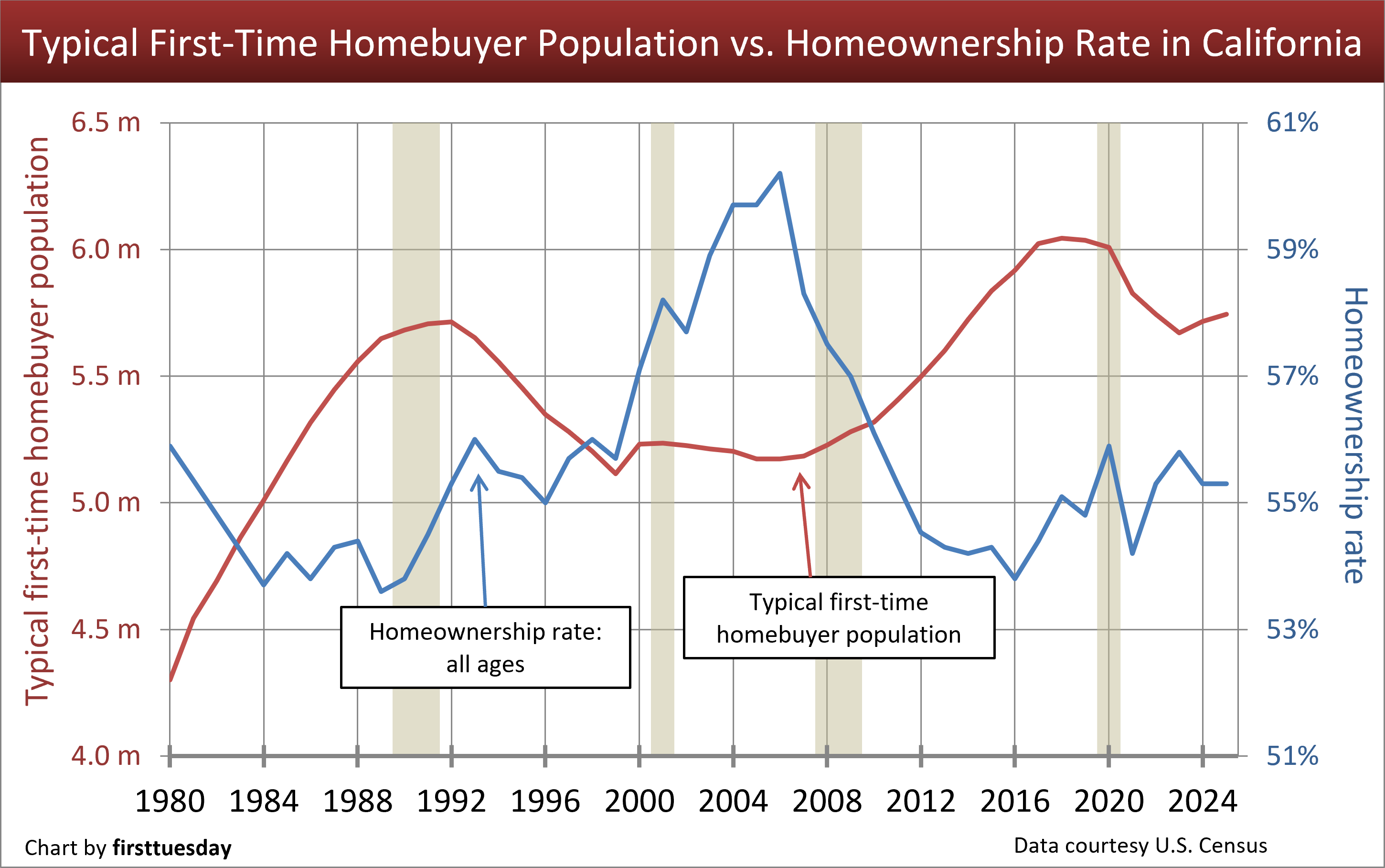 Chart update 8/24/26
| 2025 | 2024 | 2023 | |
| Potential first-time homebuyers | 5,744,500 | 5,716,100 | 5,670,600 |
| CA homeownership rate | 55.3% | 55.3% | 55.8% |
Over the past decade, first-time homebuyers have had a minimal (positive) impact on California’s homeownership rate. Homeownership dropped even as the number of 25- to 34-year-olds (the typical age of first-time homebuyers), rose. This age group, which currently consists of members of Millennials and the younger Gen Z, presently has little positive effect on homeownership.
Homeownership enemy #1: Unemployment and under-employment
The biggest obstacle for Millennials has been employment. Or rather, lack of employment — jobs.
Since the Great Recession ended, California finally regained all jobs lost to the crash. However, this momentum collapsed in 2020 as employment, the economy and daily life came to a stop at the onset of a global pandemic. Today, the California employment number is only 2.5% higher than the total number of Californians employed in 2019.
Members of Gen Z graduated into the Covid lockdown and now face other negative factors affecting the consuming public:
- international trade chaos,
- volatile and unpredictable business conditions;
- excessive cost of living; and
- out-of-state attacks on necessary California immigration.
Consequently, willing young would-be homebuyers have only begun to start saving for their first home purchase.
Homeownership enemy #2: Student debt
Heavy loads of student debt are a major creditworthiness problem for a first-time buyer. To become a first-time homebuyer, a purchase-assist mortgage is near mandatory. However, the amount of the mortgage is limited as the first timer’s payments on all household debt cannot exceed a standard 41% back-end debt-to-income ratio (DTI). This includes the mortgage, auto loans, credit card debt and education loans.
Most college grads need to clear their student debt before qualifying for a maximum home mortgage. Alternatively, they might settle for a home with less amenities and space than the apartment or home they rent. This process of paying back student loans typically takes twenty years. By then, a thirty-year FRM remains well into their retirement.
In today’s economic climate, the 25-34 age group is simply too young and indebted to target as highly likely, first-time homebuyers. Instead, 30-40 years or 35-45 are better ranges for the typical age of future first-time buyers when they have reduced their debt burden.
Millennials are going to look into the housing market following the current recession, as the buyer’s market fills up with available inventory and seller pricing drops. Together with a reservoir of prior homeowners-turned-tenants, expect to see them gradually drive up the homeownership rate for the next real estate recovery.
City lights
As Baby Boomers begin to retire, those who own homes will, on the whole, remain homeowners. The sale of a smaller more centrally located home or simply a reverse-mortgage retention of their home will not influence the homeownership rate. But their turnover for both a sale and a purchase of a home will generate more transactions and broker fees. Brokers and agents with MLO endorsements will benefit from the reverse mortgage boom that takes place when a sale is not the service a boomer wants.
As a consequence of the recent urban housing shift, much of the Millennial generation and Gen-Z will remain renters. Urban homes are more expensive due solely to their prime location and require accumulated wealth to obtain.
The price spread is further influenced by zoning, which is costly for buyers and their agents as it restricts building density. This is made even more difficult by the rising mortgage rates which depress turnover and shrink available mortgage funds.
As first-time homebuyers next look into buying, around 2029, the mark they make on the homeownership rate will reflect local government policy decisions and whether a thriving local culture is what they want.
The new normal?
California’s homeownership rate has always been low compared to the nation’s. We are a very mobile society composed of educated and skilled individuals, curious folks who seek out better opportunities. As of 2025, we are the state with the second-lowest homeownership rate in the nation, at 55.3% (only above New York and Washington D.C.).
There is a reason California is the fourth largest economy on earth. Its population is progressive, not conversative and ready for an early lockdown with homeownership, at least when they are financially well established.
It is clear that the high homeownership rate achieved during the Millennium Boom was an abrasive anomaly. Re-regulation of lenders and creation of the nation’s first consumer protection agency in 2010 was designed to ensure this won’t happen again — at least until we and our Congress forget, and everyone goes through another flameout.
Expect the next wave of first-time homebuyers to arrive later and in smaller numbers than in the recent past, regardless of government incentive handouts. Still, agents can prepare to cater to this population by focusing their efforts in urban areas. Or, for the more versatile and diligent agents, property management may be the answer as the number of renters will increase, maybe dramatically. That’s California.












Thank you for this insightful and sobering analysis.
You’ve painted a clear picture of why the traditional 25–34 first-time buyer model is broken in California—buried under student debt, scarred by the foreclosure crisis, and priced out by a market that refuses to bend. The 2030 timeline feels realistic, not optimistic, and your point about targeting 35–45 year-olds instead is a crucial shift in thinking for agents.
I especially appreciate the historical grounding (2006 peak vs. today’s 54.3%) and the honest acknowledgment that California’s low homeownership rate isn’t a bug—it’s a feature of a mobile, high-cost, progressive economy. And the nod to property management as a viable pivot for agents? That’s the kind of practical wisdom this conversation needs.
California is on a 8-12 year cycle since WW2. When the high school & college grads buy with EMOTIONS, they become the 1st time “consumers” not “investors”. If they buy at the bottoms of the market, they are REAL FRUGAL INVESTORS AND IF THEY SELL AT THE TOP, WHICH IS TOUGH AND EMOTIONALLY DRAINING, THEY will make a BRUTAL SCARY KILLING. Some will make as much as 1000 to 3000% on their down payments…. Yes, that much if they buy @ the low and sell @ the top. But most, sorry to say, learn from mistake, and not from GRAPHS & CHARTS…. This Real Estate Cycle, then burns the 1st home buyers (if they sell wrong or hold too long) and then the 2nd time they experience this LOW to HIGH, they will buy & then sell @ the top if their “significant other” agrees to sell too @ the top without EMOTIONS…. I have done this buy low and sell high since 1976 and if your EMOTIONAL, this is a TOUGH DECISION (almost as tough as divorcing) your wife or girlfriends to make HUGE IRR RETURNS. I have averaged 27.12% net net net per month from 1999 to 2008 on 198 sale escrows, and this is with RAW MATH ANALYSIS & ZERO EMOTIONAL INPUT!