

Why this matters: An agent after entering into a representation agreement with a client uses the Modification of Representation Agreement to change the terms of the employment without canceling it. To terminate the authorization to represent, an agent uses the Release and Cancellation of Representation Agreement.
Exclusive representation agreements
A broker’s right to act on behalf of a client and collect a fee earned for their services always originates with a written employment agreement. The employment agreement entered into by brokers and clients is commonly called a representation agreement, also still referred to as a listing.
For example, a seller of real estate employs and authorizes a licensed broker as their sole representative to market the property, locate a buyer, negotiate a transaction and close it on behalf of the seller by entering into an exclusive seller representation agreement. [See RPI Form 102]
A broker likewise acts as the sole representative of a client under several sets of consumer service activities:
- a buyer of real estate employs and authorizes a buyer broker to locate and negotiate the acquisition of suitable property by entering into an exclusive buyer representation agreement [See RPI Form 103.1 and 103.2];
- an owner or buyer employs and authorizes a mortgage broker to locate a mortgage loan originator (MLO) and arrange and originate a mortgage by entering into an exclusive borrower representation agreement [See RPI Form 104];
- an owner of income property employs and authorizes a leasing agent to locate a tenant and negotiate a lease agreement by entering into an exclusive landlord representation agreement [See RPI Form 106]; and
- a commercial tenant employs and authorizes a leasing agent to locate space for occupancy and negotiate a lease agreement with the landlord by entering into an exclusive tenant representation agreement. [See RPI Form 105.1 and 105.2]
A property owner under an exclusive seller representation agreement grants their broker sole authority to:
- market the property;
- locate a buyer; and
- negotiate a sale.
The representation agreement also specifies:
- the fee amount the seller agrees the broker receives when earned; and
- the conditions met by the broker or the seller for the broker to earn the agreed fee.
Related video:
Read more about representing a client.
Modification of the representation
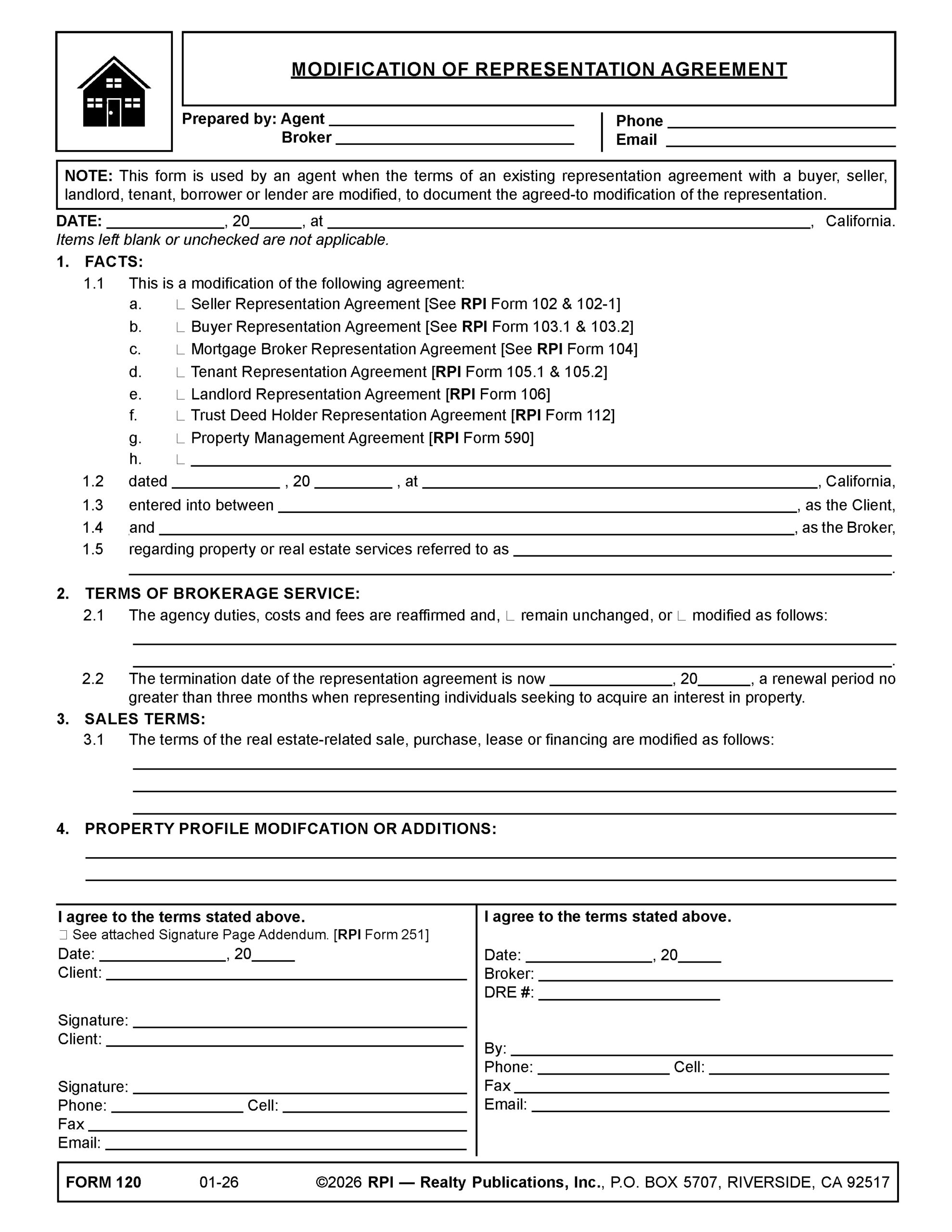
A modification of representation agreement changes specific terms of an existing seller representation agreement without ending it. [See RPI Form 120]
In practice, the modification of representation agreement is used when the seller and broker want to keep working together but need to adjust the terms. [See RPI Form 120]
The terms changed may include:
- the market price;
- authority to order property reports;
- buyer incentives;
- the length of the retainer period; or
- the broker fee.
A broker and seller mutually agree to the modification of representation agreement by signing it. When signed, the original representation agreement remains in effect, altered by the terms of the modification agreement.
A seller’s dual liability exposure when changing brokers
Consider a seller of a property who enters into an exclusive representation agreement with a seller broker.
Despite the diligent efforts of the broker and their agent, the representation agreement expires without a sale of the property, and without being renewed.
The broker registers the identity of prospective buyers the broker and their agent had direct or indirect contact with during the retainer period with the seller.
But the seller intends to sell their property, just that they will retain a different broker and agent to market the property to locate a ready, willing and able buyer.
The seller contacts an agent employed by a different broker who solicited the seller to employ their broker’s office to sell the property.
In their discussion about retaining the agent’s broker, the issue of the expired representation by the first broker and their registration of prospective buyers is discussed.
The agent obtains details from the prospective client about the safety clause situation in the prior representation agreement.
The agent’s concern is the dilemma the seller faces due to the remaining effects of the prior representation, created by:
- the retainer period under a new representation agreement with the agent’s broker; which
- overlaps the safety clause period in an expired prior representation agreement with the first broker.
The agent confirms the seller understands they are exposed to multiple fees when a buyer registered by the original broker acquires an interest in the seller’s property. One of these buyers may be the best buyer for the property.
The best solution is for the seller to enter into an agreement to modify the expired seller representation agreement with the prior broker. The modification eliminates the safety clause through the seller negotiating directly with the prior broker.
When the seller obtains an agreement to eliminate the safety clause fee exposure, the second broker no longer is concerned about the prior broker’s representation and safety clause.
The Release and Cancellation of Employment Agreement documents the seller and prior broker cancellation of their representation and bars any claims arising from the expired employment. [See RPI Form 121]
As an alternative, the new broker might negotiate a fee-sharing agreement with the first broker regarding prospective buyers the broker registered. [See RPI Form 114]
For a seller to avoid dual liability exposure by changing brokers and agents, they best renew the representation agreement with the first broker, rather than employing a different broker.
A renewal is an advantage held by the first broker and their agents on expiration of the representation agreement. A broker’s renewal of a representation agreement preserves the efforts of both the broker and their agents spent advising and educating the seller-client, compiling marketing package information on the property and locating prospective buyers.
Since the renewal or extension of a representation agreement sets a new date for the retainer period to expire, the renewal resets the need to register prospective buyers until the new retainer period expires. [See RPI Form 120]
Related video:
Read more about the safety clause dilemma.
Analyzing the modification of representation agreement
An agent or broker uses the Modification of Representation Agreement published by Realty Publications, Inc. (RPI) when the terms of an existing representation agreement with a buyer, seller, landlord, tenant, borrower or lender are modified. It documents the agreed-to modification of the employment the agent negotiated with the client. [See RPI Form 120]
The Modification of Representation Agreement contains:
- Facts: The date, identities of client and broker, and real estate address and whether the modification applies to a(n):
- seller representation agreement [See RPI Form 102];
- buyer representation agreement [See RPI Form 103.1 and 103.2];
- mortgage broker representation agreement [See RPI Form 104];
- tenant representation agreement [See RPI Form 105.1 and 105.2];
- landlord representation agreement [See RPI Form 106];
- trust deed holder representation agreement [See RPI Form 112];
- property management agreement [See RPI Form 590]; or
- agreement other than one of the ones listed. [See RPI Form 120 §1]
- Terms of brokerage service: Checkboxes indicating whether the terms remain the same or are modified and a blank for entering the terms of the representation agreement which are modified. Also, the new expiration for the representation agreement. When representing individuals seeking to buy real estate, the new period for continued representation may be no greater than three months from the date of the renewal agreement. [See RPI Form 120 §2]
- Sales terms: The modification of the representation agreement related to the sale, purchase, lease or finance of the real estate. [See RPI Form 120 §3]
- Property profile modification or additions: A blank to list changes when something about the property’s information found in public records, such as address, lot size, year built, square footage or sales history needs to be amended. [See RPI Form 120 §4]
- Signatures: The broker and client sign and date the form to alter the terms of the original representation agreement. [See RPI Form 120]
Related article:
Release and cancellation of the employment
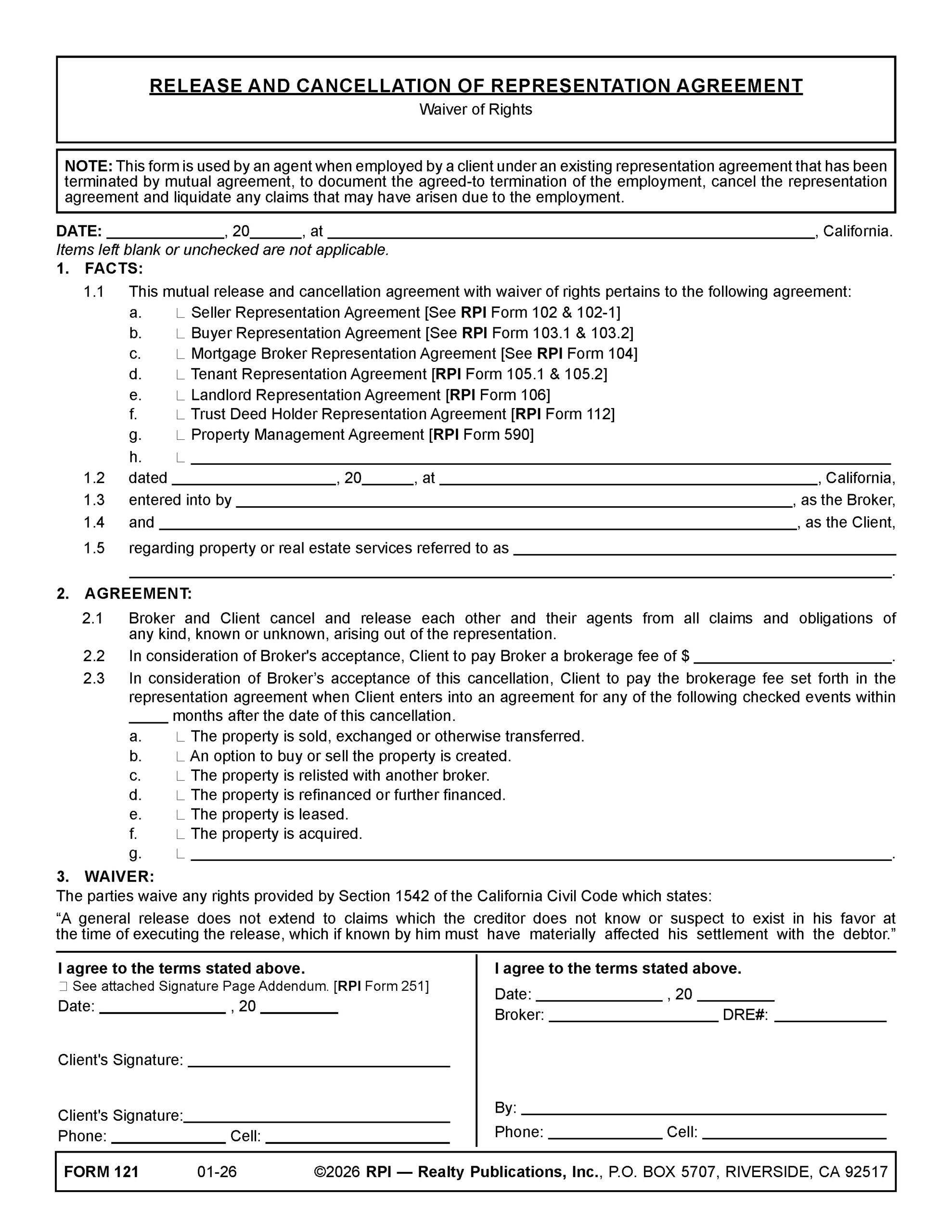
A Release and Cancellation of Employment Agreement terminates the representation agreement entirely and releases both participants from future obligations. [See RPI Form 121]
In practice, the Release and Cancellation of Employment Agreement is used when:
- the broker and client mutually agree to part ways and no longer work together;
- the seller withdraws the property from the market;
- the client wants to employ a different broker; or
- the agency relationship breaks down and is resolved by termination.
A broker and client sign and date the prepared Release and Cancellation of Employment Agreement to end the broker’s authority to represent the client.
While the Release and Cancellation of Employment Agreement ends the employment relationship, it does address fees earned and unpaid, when:
- the broker fee was already earned by procuring a ready, willing and able buyer;
- the participants agree to compensation in the release form;
- the original representation agreement requires reimbursement; or
- the property sells shortly after cancellation to a buyer introduced by the broker under the safety clause.
Related video:
Read more about safety clause basics.
Documenting the cancellation
When a seller, by word or by conduct, clearly indicates they no longer want to sell the property, the agent prepares a Release and Cancellation of Employment Agreement form for the seller to review and sign. [See RPI Form 121]
The release and cancellation agreement may call for immediate payment of the full brokerage fee agreed to in the representation in exchange for mutually agreeing to cancel the representation agreement.
Alternatively, it may call for payment when, within a specified time period, say, one year after the date of the agreement, the property is sold, again placed on the market, exchanged, optioned, refinanced (when the broker was retained to arrange new financing) or leased to anyone. A compromise might be the payment of a partial fee with the balance due when the property is sold during an agreed-to period.
This release and cancellation agreement is also used when a buyer wants to cancel an exclusive buyer representation agreement. On cancellation, the broker is deprived of the opportunity acquired under the representation to earn a contingency fee.
Related article:
Analyzing the Release and Cancellation
An agent or broker uses the Release and Cancellation of Employment Agreement published by RPI when employed by a client under an existing representation agreement to document its termination by mutual agreement. The form prepared and signed by the client and the agent cancels the representation agreement and eliminates any claims arising from the employment. [See RPI Form 121]
The Release and Cancellation of Employment Agreement contains:
- Facts: The date, identity of the broker and client and real estate involved and whether the employment agreement is a(n):
- seller representation agreement [See RPI Form 102];
- buyer representation agreement [See RPI Form 103.1 and 103.2];
- mortgage broker representation agreement [See RPI Form 104];
- tenant representation agreement [See RPI Form 105.1 and 105.2];
- landlord representation agreement [See RPI Form 106];
- trust deed holder representation agreement [See RPI Form 112];
- property management agreement [See RPI Form 590]; or
- agreement other than one of the ones listed. [See RPI Form 121 §1]
- Agreement: The broker and client agree to the following terms:
- they cancel and release each other and their agents from all claims and obligations of any kind arising out of the employment [See RPI Form 121 §2.1];
- the broker fee the client agrees to pay the broker in consideration for the broker’s lost earnings opportunity due to the cancellation [See RPI Form 121 §2.2];
- when the client enters into a transaction after the representation agreement is canceled and the broker earns a fee, the broker enters the time period and events which earn the broker a fee:
- the property is sold, exchanged or otherwise transferred;
- an option to buy or sell the property is created;
- the property is relisted with another broker;
- the property is refinanced or further financed;
- the property is leased;
- the property is acquired; or
- a blank for entering other options. [See RPI Form 121 §2.3]
- Waiver: The participants agree to give up the right to later bring claims they don’t currently know about against each other, making the cancellation final and comprehensive. [See RPI Form 121 §3]
- Signatures: The broker and client sign and date the form to cancel the employment. [See RPI Form 121]
Related article:
Fees for withdrawal or termination of a representation agreement









I like your idea in this content!