
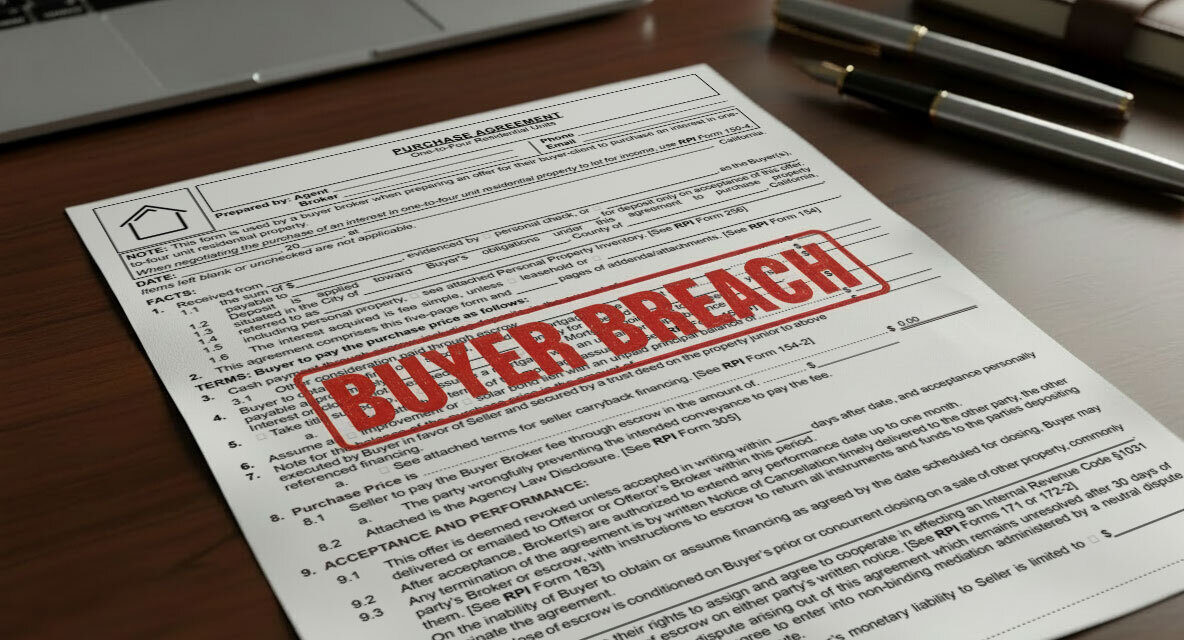
Why this matters: Follow the steps of a buyer agent from representation agreement to closing on a buyer’s acquisition of property and recognize a buyer’s breach of the purchase agreement.
Follow along with an audio reading of this article adapted as a chapter from our upcoming Real Estate Practice course update.
A buyer agent transaction from start to finish
Consider a buyer agent who solicits a prospective buyer as a client for their real estate services. Following an appointment to discuss representation, the prospective buyer concludes the agent is the one best suited to assist them to locate and acquire the real estate they want. The amount of the broker fee on a purchase transaction is negotiated and orally agreed to.
The buyer agent prepares a buyer representation agreement for review with the buyer, which the agent, on behalf of their broker, and the prospective buyer will enter into by signing it. [See RPI Form 103.1 or 103.2]
The buyer representation agreement contains provisions for the buyer broker to receive a fee. The fee is earned when the buyer contracts to acquire an interest in real estate substantially the same as the type described in the agreement. [See RPI Form 103.1 and 103.2 §4.1(a)]
Arrangements for payment of a fee earned by the buyer broker in a transaction, or otherwise, is the buyer’s responsibility, whether it is paid by the seller or the buyer. However, all purchase agreements, exchange agreements or options to buy entered into by the buyer provide for the seller to pay the fee earned by the buyer broker on the transaction. [See RPI Form 103.1 and 103.2 §4.2]

On the agent’s review of the representation agreement with the buyer, the agent and buyer sign the agreement to commence the employment.
The agent locates and gathers preliminary information on properties available for sale that meet the buyer-client’s criteria — bedrooms, bathrooms, architecture style, neighborhood and amenities. The properties are reviewed with the buyer, who selects a few as preferences. The agent contacts the seller agents for the properties selected and requests the seller agent’s marketing package for each.
On receipt of the marketing packages, the agent reviews them with the buyer-client. The buyer decides they want to look further into a couple of the properties.
On viewing the properties, one stands out from the rest as most usable by the buyer. The buyer agent and the buyer further review details in the marketing package, specifically the seller’s Transfer Disclosure Statement (TDS). The agent answers the buyer’s many questions about the property generated by details in the marketing package the seller agent provided.
The buyer decides to make an offer on the property, and the price and terms are orally agreed to with the agent. The agent prepares a purchase agreement offer, which is reviewed with the buyer-client. The purchase agreement calls for the seller to pay the buyer broker fee called for in the buyer representation agreement. The buyer-client signs the purchase agreement, and the agent submits it to the seller agent. [See RPI Form 150 §8.1]
The seller accepts the buyer’s offer. Escrow instructions are prepared which provide for payment of the earned fee by the seller. The transaction closes with the buyer acquiring fee ownership. On closing, the agent’s broker is paid their fee by escrow from funds accruing to the seller from the buyer’s payment of the purchase price.
Related video:
Read more about fees earned under the buyer representation agreement.
An example of a buyer breach, and the fee earned
Now consider a prospective buyer who is solicited as a client by a broker’s agent. The buyer agrees to employ the agent’s broker as their representative to locate and buy a property. The amount of the broker fee for services is negotiated as a percentage of the property the buyer contracts to acquire, rather than set as a fixed dollar amount.
The agent prepares a buyer representation agreement and reviews its provisions with the buyer. The buyer understands they are responsible for providing for the payment of the fee when earned. Further, that the buyer will place the burden for payment of the fee on the seller in all purchase agreements entered into by the buyer. The buyer and the agent on behalf of their broker then enter into the representation agreement. [See RPI Form 103.1 and 103.2 §§4.1 and 4.2]
The diligent performance of agreed services
The agent locates a few properties available for sale which meet the buyer-client’s criteria as described in the representation agreement. Marketing packages are gathered and reviewed with the buyer for selection of a suitable property for acquisition.
In the marketing package the seller agent delivered, the buyer agent reviews with their buyer-client the:
- TDS;
- Home Inspection Report (HIR); and
- Natural Hazard Disclosure (NHD) Statement.
With these disclosures, the buyer-client is aware of all enhancements and defects affecting the use and value of the property. These material facts are taken into consideration when determining what price and terms the buyer offers to acquire the property.
The agent prepares a purchase agreement offer on the terms discussed, including payment of the buyer broker’s fee by the seller. [See RPI Form 150 §8]
On submission of the offer, the seller accepts the buyer’s offer and escrow is opened.
At some point before escrow closes, the buyer has second thoughts about acquiring the property, or any property at all. The buyer takes steps to withdraw from the purchase by instructing escrow to draw cancellation instructions.
Cancellation instructions are prepared and the buyer signs and hands the cancellation to escrow. The buyer has no legal justification for cancelling the purchase agreement and escrow instruction. Thus, the buyer breaches the purchase agreement.
By cancellation, a provision in the purchase agreement for payment of the fee earned by the buyer broker is triggered. Since it is the buyer who breached by interfering with closing, the buyer is now obligated to pay their broker the agreed fee. [See RPI Form 150 §8.1(a)]
Related article:
Buyer representation agreement or purchase agreement as controlling the fee
Here, the fee provisions in a purchase agreement only provide for payment of the broker fee lawfully earned by the buyer broker on the transaction. However, the buyer broker is not a party who can enforce performance of the purchase agreement as the broker is the agent of the buyer, not a principal in the transaction.
Thus, the buyer broker is a third-party beneficiary receiving payment of their fee under a provision in the purchase agreement on closing or on an unjustified cancellation of the purchase.
But to collect a fee, the broker must first hold the right to earn that fee under fee provisions in a written and signed representation agreement with the buyer-client. It is a legal prerequisite to receive payment.
Thus, it is the buyer representation agreement which establishes the buyer broker’s right to a fee earned for assisting a buyer, not later transactional documents calling for payment of that earned fee on a closing. This right to receive a fee is not established by the purchase agreement, but the purchase agreement does establish who is to pay the fee and when paid.
The right to earn a fee expected for assisting a buyer must be expressed in a representation agreement entered into by the buyer-client. Further, the buyer representation agreement must be entered into ASAP on undertaking the assistance of a buyer, and thus always before the buyer enters into a purchase agreement offer or letter of intent (LOI) proposal.
Typically, the seller agrees to pay the buyer broker fee at closing. The fee as disbursed by escrow is deducted from funds accruing to the seller in the transaction. Thus, the buyer broker fee is indirectly funded by the buyer’s payment of the purchase price at closing.
A common contingency which may be used to justifiably prevent the closing of a transaction is a property inspection contingency. Here, the buyer checks for defects revealed in the property by a home inspector they or the seller hire.
When defects previously undisclosed are discovered by the home inspector, the buyer at their option may request the seller make the necessary repairs, adjust the price or cancel the agreement. Once the buyer is satisfied, they remove the inspection contingency, signaling they are ready to move toward closing.
The buyer has a duty to make a good-faith effort to eliminate all contingencies in a purchase agreement to allow the transaction to close. When the transaction does not close due to a buyer’s failure to take ordinary and reasonable steps to perform as agreed, a breach has occurred.
In addition to fees due the buyer broker when a buyer breaches the purchase agreement, the buyer separately is liable for the seller’s out-of-pocket money loss caused by the breach.
Related article:
Contingency in a purchase agreement offer
A contingency provision in a purchase agreement states a condition which must be met, approved or waived by the party whose benefit the provision was included for before a real estate purchase becomes enforceable by the other party. Though a purchase agreement is a binding contract, when a condition isn’t met, the buyer (or the seller when the provision is for their benefit) may cancel the agreement rendering the agreement unenforceable.
Common contingency provisions include:
- mortgage financing contingency: The buyer must be able to record a purchase-assist mortgage to fund the closing.
- inspection (property condition) contingency: The buyer may inspect the home and cancel the purchase agreement when a material defect is discovered.
- appraisal contingency: The property must appraise for at least the purchase price.
- sale of buyer’s property contingency: The buyer may cancel the purchase agreement when they are unable to first sell their current home.
Related Client Q&A:
Client Q&A: What are contingency provisions? Do I need them?
A buyer’s breach is an unjustified failure to close
Some common events the buyer initiates to terminate a purchase agreement without legal justification include:
- failure of a good-faith effort to assist the mortgage loan originator (MLO) on an application for a purchase-assist mortgage to provide information requested by the MLO, sign mortgage origination documents or simply cancel the application to cause the MLO to close their file without funding;
- failure to provide escrow with information required by the title company to issue insurance or items requested by escrow for closing;
- failure to deposit funds as agreed in the purchase agreement or escrow instructions;
- failure to close escrow on the agreed date when all contingency provisions have been met or waived;
- refusal to sign closing documents after all contingencies are removed; and
- withdrawal from the purchase due to “buyer’s remorse” rather than a legal justification.
These examples result from a buyer deliberately failing to perform activities required to close escrow — interference with closing solely to terminate the transaction. However, most transactions fail to move on to closing due to failed due diligence obligations of the seller broker to simply investigate and disclose what it is they are selling — property information.
Thus, most contingency provisions included in purchase agreements regard conditions inherent in a property, though some are related to financial conditions regarding external sources of funding. Contingencies addressing property conditions and follow-on cancellations or disputes in a transaction are avoidable since property information is known or readily knowable by seller brokers before they market a property for sale.
However, for a buyer agent to gather and disclose property information at the outset of negotiations — before making an offer to purchase a property — it requires the seller agent to deliver them. The catch-22 involved is that seller brokers deliberately refuse to generate a marketing package to disclose, when asked, what they know until the price has been set and accepted by the seller. [See RPI Form 352]
Related article:
Related forms
Besides the buyer representation agreement and purchase agreement, the buyer agent is mandated to also prepare and hand the buyer the Agency Law Disclosure. [See RPI Form 305]
The Agency Law Disclosure is delivered to all participants in all brokered sales and leasing transactions, with no exceptions. [See RPI Form 305]
Likewise, an agent locating space for a tenant-client to lease enters into a Tenant Representation Agreement, the leasing agent’s equivalent to a buyer representation agreement. [See RPI Form 105.1 and 105.2]
Like the buyer representation agreement, the tenant representation agreement is entered into ASAP when the tenant retains the broker as their exclusive agent and always before entering into a lease. [See RPI Form 105.1 and 105.2]
Related video:
Read more about tenant representation.










dsf