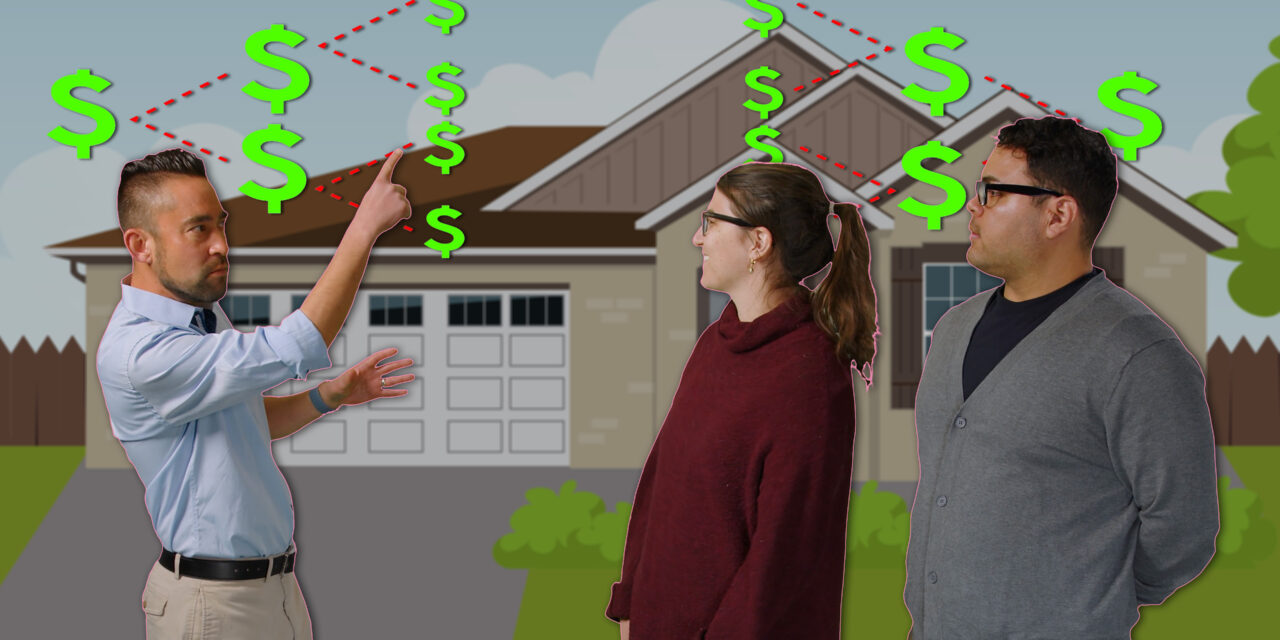
Introducing our latest video series: Turning Tenants into Buyers.
This series breaks down the core mortgage fundamentals every DRE licensee needs to master when guiding first-time buyers toward homeownership. Throughout the series, we illustrate the distinct financial advantages of purchasing a home with a 20% down payment.
In this fourth episode, we show how a buyer agent helps their first-time buyers understand the full financial scope of mortgage-funded ownership.
Watch the third episode here.
Uncovering the hidden costs
When buyers are setting their homeownership budget, they typically are sheltered from the full scope of fees, costs, and financial tradeoffs associated with the acquisition of mortgage-funded homeownership.
Consider a home priced at $500,000 and a buyer who is prepared to make a 20% down payment, plus closing and moving costs as well as holding a six-month cash reserve. Given recent mortgage rates and a buyer with good credit, we’ll estimate a 6% fixed rate mortgage (FRM) and a monthly principal and interest (PI) payment of $2,400 — 31% or less than the household income of the buyer.
With their down payment of 20% in hand — $100,000 — the buyer is positioned to make a series of decisions that greatly affect their financial health as a homeowner.
The buyer needs to consider transactional costs to simply acquire a home, in addition to the down payment, for:
- mortgage points, including any discount points;
- necessary third-party property reports not available from the seller;
- mortgage insurance (MIP or PMI) for down payments less than 20%; and
- any costs associated with selling or leasing out their current home.
These costs and financial penalties become repressive for every mortgage funded purchase of a home when the down payment is less than 20% of the price.
Homeowners spend how much on what?
Property taxes are about 1% of the buyer’s purchase price. They are not the amount of property taxes the seller pays. The annual increases in assessed value are capped at 2% per year under Proposition 13 (Prop 13). Thus, they do not increase more than the cost-of-living adjustment (COLA) wage increases in the future.
Property taxes are billed annually or semi-annually rather than monthly. Most mortgage holders require buyers to pay one-twelfth of the annual tax amount each month into an impound account as part of their mortgage payment.
For the example home, an owner pays $5,000 or a bit more in property taxes — $425 monthly — the first year of ownership.
For homeowner insurance coverage required by the mortgage holder, as well as being a necessity for the largest financial investment in most people’s lives, the premiums are volatile — that is they often rise alarmingly.
The annual premiums rise primarily due to the rising costs of replacement materials and rising risks of wildfires or other environmental hazards as a result of climate change. Our example first-time buyer — barring any high-risk complications — is expected to budget around $150 a month, set aside as reserves for paying the annual premium.
A more familiar expense — utilities and government service fees — are costs renters understand since they have likely dealt with them before.
But there are other charges to be considered, leaving bills closer to $150 to $250. These include public services such as:
- garbage collection;
- street lighting; and
- water bills.
Owners bear other responsibilities that renters do not, such as covering all maintenance and repairs required for the ground area and improvements.
When a homeowner belongs to a homeowners’ association (HOA) they do not directly incur these ownership obligations. With an HOA involved, the owner pays monthly HOA fees, in our example estimated around $300, which include the costs of care and maintenance of grounds and improvements.
All totaled together, the range of ongoing homeownership costs exists between $850 to $1,300 a month for a $500,000 home.
Like all budgets, homeownership plans offer opportunities to trim expenses and save. However, these ongoing costs remain in addition to the mortgage payment, making them a critical focus of the buyer agent’s financial coaching.
Editor’s note — Stay tuned! The remainder of this series continues to illustrate how an agent or broker fully and effectively communicates the costs of worthwhile mortgage-leveraged homeownership to their prospective buyers, and the long-term financial security a 20% down payment provides.