
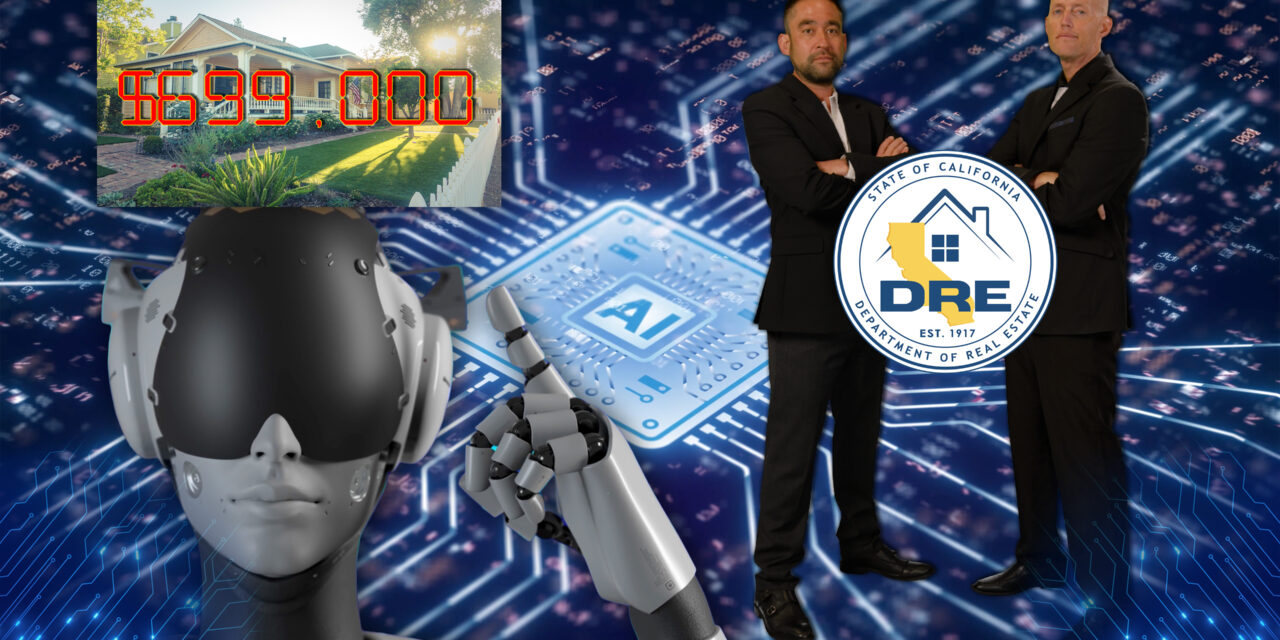
We are delighted to introduce a timely, pragmatic new training suite for California licensees: Artificial Intelligence Training: Harnessing AI While Managing Risk™.
This premium training fully illustrates how to safely augment your practice with AI-powered tools while maintaining absolute regulatory compliance — without sacrificing human intuition. Over the coming weeks, the firsttuesday Journal will feature exclusive excerpts from this multi-media suite.
This final installment dramatizes the critical boundary where predictive valuation tech meets real-world expertise, proving that human intuition remains the ultimate counterbalance to AI’s analytical advantages.
The complete, video-focused Artificial Intelligence Training™ is available at no additional charge to students enrolling in any firsttuesday licensing or renewal course — a FREE service to students. Or it may be separately purchased for $35.
Exclusively Californian: specifically firsttuesday.
Never attach a pledge of expertise to a hallucination
Remember how MAD agents used to get about the prices Zillow posts on property offered for sale?
As all practicing agents are well aware, Zillow uses an algorithm to provide “Zestimates” of property.
For years, agents and brokers fought a losing battle against algorithms that spit out property values with zero context, uninformed by real-time factual knowledge of a property’s characteristics, neighborhood and market environment.
But consider a seller agent tasked with presenting an asking price to their seller-client when entering into a seller representation agreement.
When the agent leans solely on AI to dictate a sales price to a client, they aren’t just being lazy — they become the very valuation aggregator they once despised.
Worse, when presenting an asking price that may well be nothing better than a digital hallucination they are attaching a pledge of expertise — their licensed status.
They are substituting their hard-earned license, training and reputation with an AI chatbot. And when an agent acts like a chatbot, they might as well be replaced by one, as now they are nothing more than an unlicensed assistant working with a client.
Professional intuition — always
AI is one formidable place to start a property evaluation, but it is an insufficient place to finish a broker price opinion (BPO). It’s the broker’s opinion, not AI’s.
Even the most sophisticated valuation engines remain blind to the nuanced variables that define a property’s true marketability — which is where the licensed gatekeepers come in. A licensed agent generates a comparative market analysis (CMA) BPO distinguishing recent sales of selected comparable property by adjusting their sales price to reflect the different amenities of the subject property.
Let’s cover some examples of how AI can be productively harnessed — when wielded by a human expert, of course.
AI’s strength lies in its ability to collapse time. It provides instant analysis, processing thousands of data points — zoning, crime statistics, school ratings, and municipal codes — in seconds. Routine math and placement without room for discretionary enhancement. Just numbers, if you please.
The Human Counterbalance. While the AI sees only data, the licensee intuits market momentum which AI does not yet know.
An algorithm cannot sense a shift in local sentiment or the specific vibe of an evolving neighborhood.
AI is a historian, wholly reliant on the public record. In many California counties where data is fragmented or delayed, a “silicon” estimate is often working with expired or misleading information — a particular problem in a rapidly changing market.
However, brokers and agents know about property soon to come on the market, and that improper pocket listing three doors down that hasn’t yet been declared available for sale.
In other words, the AI is looking at the rearview mirror of public records. YOU are looking through the windshield at the house coming on the market tomorrow.
The tech-backed fiduciary
Brokers and agents augment any raw data provided by AI with their own real-world expertise and observations which AI has no ability to gather as the facts have not yet evolved. Agents always have opinions about the future of real estate, but for AI an opinion is pure conjecture.
AI can instantly calculate an evaluation using agent-developed cap rates, income figures and operating costs. Yet a bot only sees pixels — static data points, which for real estate do not exist but for the moment.
The Human Counterbalance. A bot cannot advise a seller of the bot’s opinion about which $10,000 upgrade or improvement will likely trigger a $40,000 price jump in the local market.
AI knows what a house was sold for, but it rarely knows WHY. It cannot account for the motivations of a frantic seller, an undisclosed foundation issue discovered in escrow, or the unique timeline or FOMO attitude of a hyper-motivated buyer. And this context is strategic for a client’s agent negotiating the price and terms of a transaction, a position causing AI to default.
Only human brokers and agents have the vision and empathy to secure the best possible outcome for their client.
What motivates the buyer and seller in a particular transaction is unknown to AI, but known to an alert transaction agent.
Thus, brokers and agents intelligently APPLY data in ways only an individual may to assist a client for a fee — when licensed by the DRE.
Sensory blind spots: the visceral reality
AI can perceive a new kitchen in a high-resolution interior photo, but of course lacks a visceral sense of its reality in CMA pricing.
The Human Counterbalance. Silicon cannot smell the neighborhood, hear the low hum of a nearby freeway, or feel the settling of a floor.
These are flesh and blood factors — sensory perception — an agent catches instantly during their walkthrough observation of a property — factors that can quickly dictate necessary negotiations.
Thus, brokers and agents apply their senses — and experience in the field — to historical data provided by AI.
Data vs. judgment: the licensee’s final frontier
AI is quickly becoming an essential tool for the tech-savvy agent. However, technology is singularly incapable and cannot replace the expertise of a licensee’s observations and opinions. Experts automatically factor observations into their decision making and advice; not a capability of AI.
But you — the broker or agent — remain the Responsible Team Member directing and cleaning up after the unlicensed AI assistant.
You provide the final, individual judgment of a trained licensee that molds a digital guesstimate into a professional valuation — a broker price opinion, also known as a BPO.
Remember: At the end of the day, the DRE doesn’t discipline code, just individuals. It’s your license on the line for misrepresentation and violations, not the AI’s.
Use the silicon to inform your work — but never let it replace your signature.
Editor’s note — Get the full training suite today — FREE — with any enrollment in our Agent Licensing, Broker Licensing, DRE CE or NMLS CE courses.
Purchase the training separately as a standalone masterclass for $35.












My experience in financial modeling shows that relying solely on algorithms often overlooks subtle market shifts. This specific scenario required a manual adjustment to the expected returns.