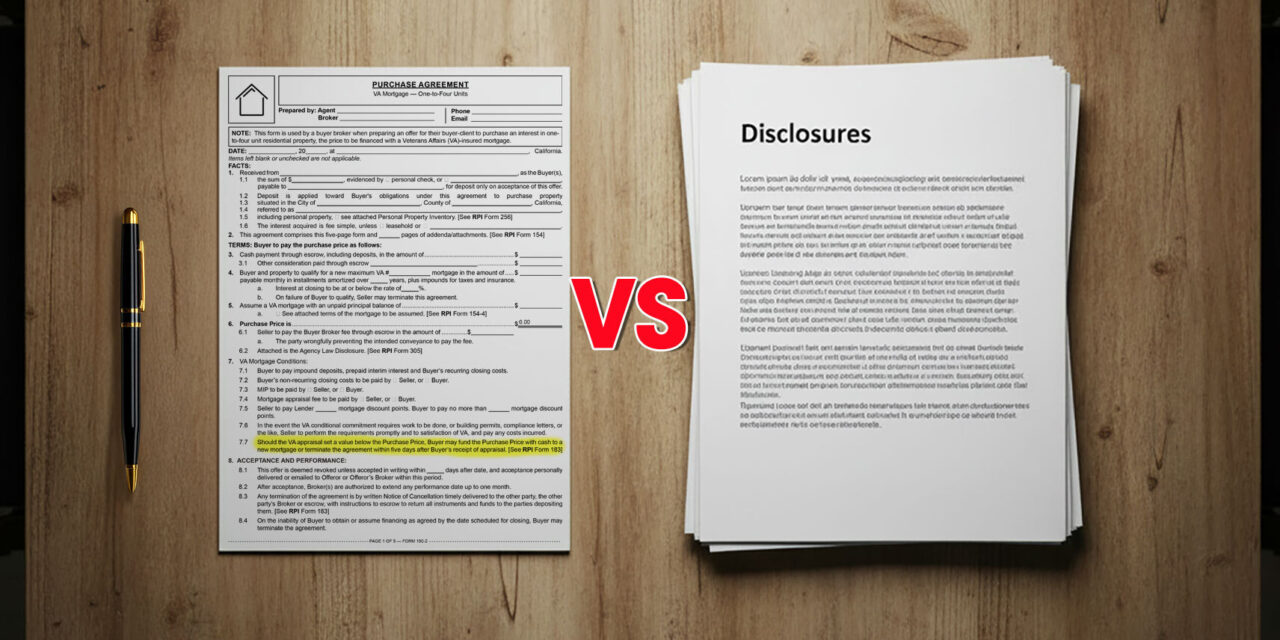
Why this matters: A provision in the purchase agreement achieves the same objective as a separate addendum with paragraphs of legal jargon. The difference: our forms are engineered simple.
Question:
I’m looking for the U.S. Department of Veterans Affairs (VA) Amendatory Clause published by the California Association of Realtors (CAR)®. Why don’t you publish it?
Answer:
We publish the intent of the FHA/VA Amendatory Clause in a provision in the FHA/VA purchase agreement. The entirety of the 350-word addendum is contained within the FHA/VA purchase agreements in a 35-word provision.
Addendum vs. provision
The FHA/VA Amendatory Clause is one example of extraneous legalese used in real estate transactions.
The FHA/VA Amendatory Clause published by CAR® contains 350 words which state, in essence, that the buyer is not obligated to complete the purchase or incur any penalty when the property’s appraisal comes in below the agreed purchase price. However, it’s padded with legal jargon that obfuscates this point.
In contrast, Realty Publications, Inc. (RPI) publishes:
- an FHA purchase agreement [See RPI Form 150-1]; and
- a VA purchase agreement. [See RPI Form 150-2]
Both purchase agreements contain a provision that states:
Should the FHA/VA appraisal set a value below the Purchase Price, Buyer may fund the Purchase Price with cash to a new mortgage or terminate the agreement within five days after Buyer’s receipt of appraisal.
35 words as a provision in the purchase agreement accomplishes what a separate addendum is used to do. No need to remember all the extra addenda required to complete an agreement when preparing a purchase agreement for an FHA or VA-mortgaged property. [See RPI Form 150-1 and 150-2 §7.7]
Avoiding unnecessary forms
RPI purposefully does not publish some of the extraneous forms provided by CAR®, such as the Market Conditions Advisory (MCA) and the Statewide Buyer and Seller Advisory (SBSA).
These two forms, unlike the FHA/VA appraised value conditions, are nonmandatory and entirely redundant to a transaction. They only add clutter and distract a buyer and seller from the mandated disclosures that actually pertain to the transaction at hand. To protect everyone involved, that is the seller, the buyer and all the agents, simply get a Home Inspection Report (HIR) and attach it to the Transfer Disclosure Statement (TDS) and make sure you also have a Natural Hazard Disclosure (NHD) Statement upfront. Bingo.
Worse, the CAR® advisory forms potentially mislead principals by referencing factual situations and practices that are mostly not of concern to the subject transaction. When affirmative advice is needed to protect the client-buyer, these advisory catch-all statements do not inform regarding the subject property. It is always the duty of the buyer agent to voluntarily advise the buyer what they need to do to properly manage the acquisition being considered.
RPI forms are engineered simple. No need to cover pages to state what one sentence in plain English fully achieves. Legalese jargon is not needed to make an enforceable contract — it’s just conversation among attorneys.
Do you have a question for the firsttuesday editorial department? Email us at editorial@firsttuesday.us and your topic may be presented in the next Letter to the Editor!
Related article: