

Why this matters: As the combined forces of rising mortgage rates and high asking prices push the goal of homeownership further into the future, demand for California rentals reaches peak competition. Without an abundance of new units, managements of residential income properties gain greater pricing power, disrupting the rental market.
Who lives where?
California’s homeownership rate averages 55.3% in 2025. This is level with the prior year but far below the 2006 peak of 60.7%. The long-term culture of renting continues, as homeownership is pushed out of reach by persistent high acquisition costs for all but the most determined (and those with access to cash).
Expect California’s homeownership rate to remain flat-to-down until the local permitting process for residential construction — free standing or CIDs — encourages a significant uptick in starts.
A delay in homeownership by first timers means an increase in the population of renters; the new norm for California. The question becomes: Is multi-family construction rising to meet today’s growing renter population?
Not quickly enough — the state’s rental vacancy rate remains below healthy levels, averaging 4.8% in 2025, continuing the low vacancy rates since the 2008 recession. In recent years, the narrow rental vacancy rate has contributed to quickly rising rents across the state.
In 2022, after two years of eviction moratoriums and extended noticing requirements, pandemic complications altering the rental market came to an end.
But the overall vacancy trend remains low — below 7% — until residential construction is sufficient to exceed current demand. As rising building material costs and labor shortages bump up against local zoning restrictions and not-in-my-backyard (NIMBY) disruptions, don’t expect construction to rise in any meaningful way until the years following 2029.
Also, the ongoing real estate recession beginning mid-2022 is expected to gradually increase rental vacancy rates as single-occupancy tenants consolidate their housing arrangement with others out of financial necessity.
Updated August 26, 2026.
Chart 1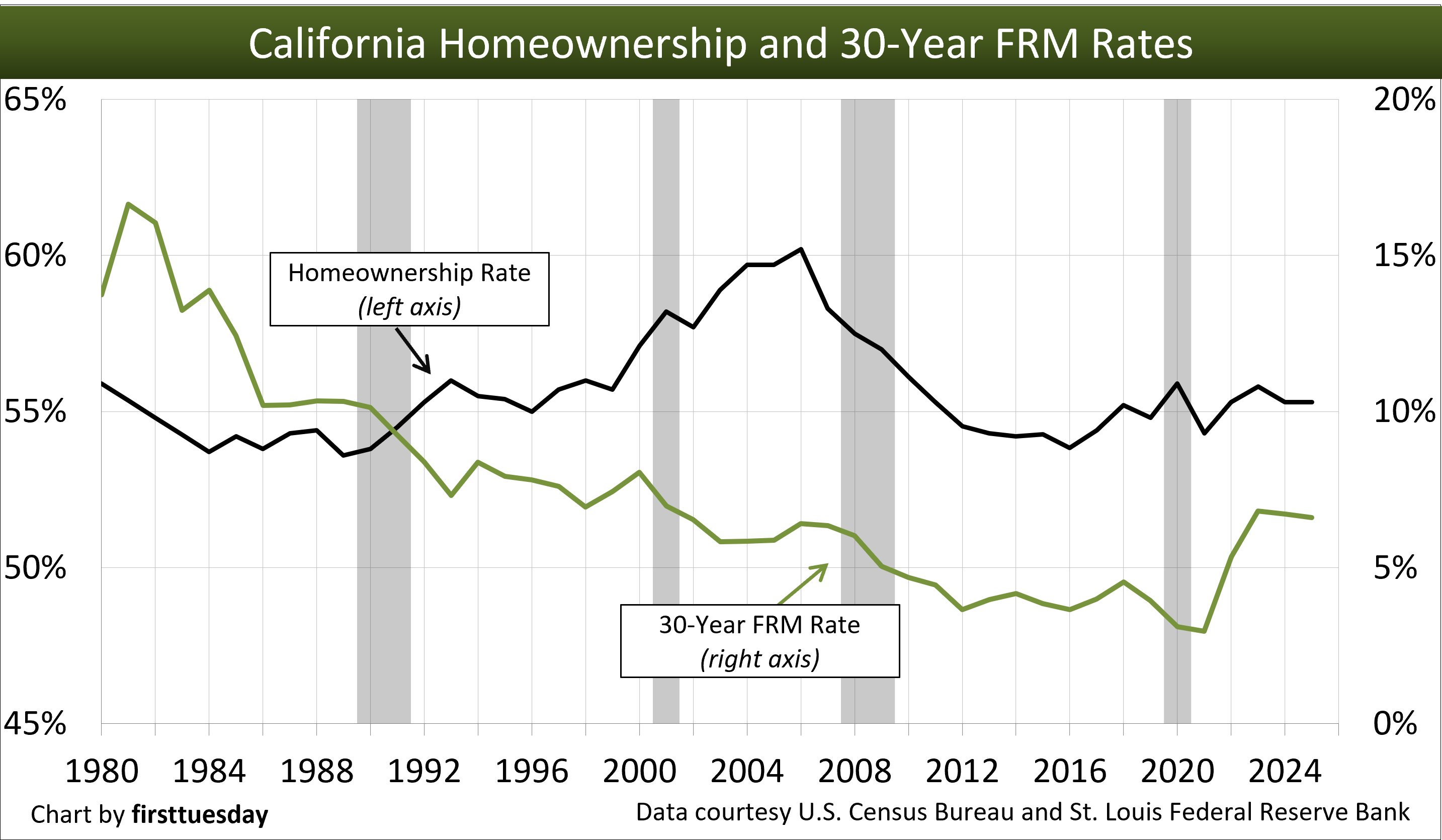 Chart update 08/26/26
| 2025 | 2006: Peak year of homeownership | 1989: 30-year homeownership low | |
| Homeownership rate | 55.3% | 60.7% | 53.6% |
| 30-year FRM | 6.6% | 6.4% | 10.3% |
Chart 2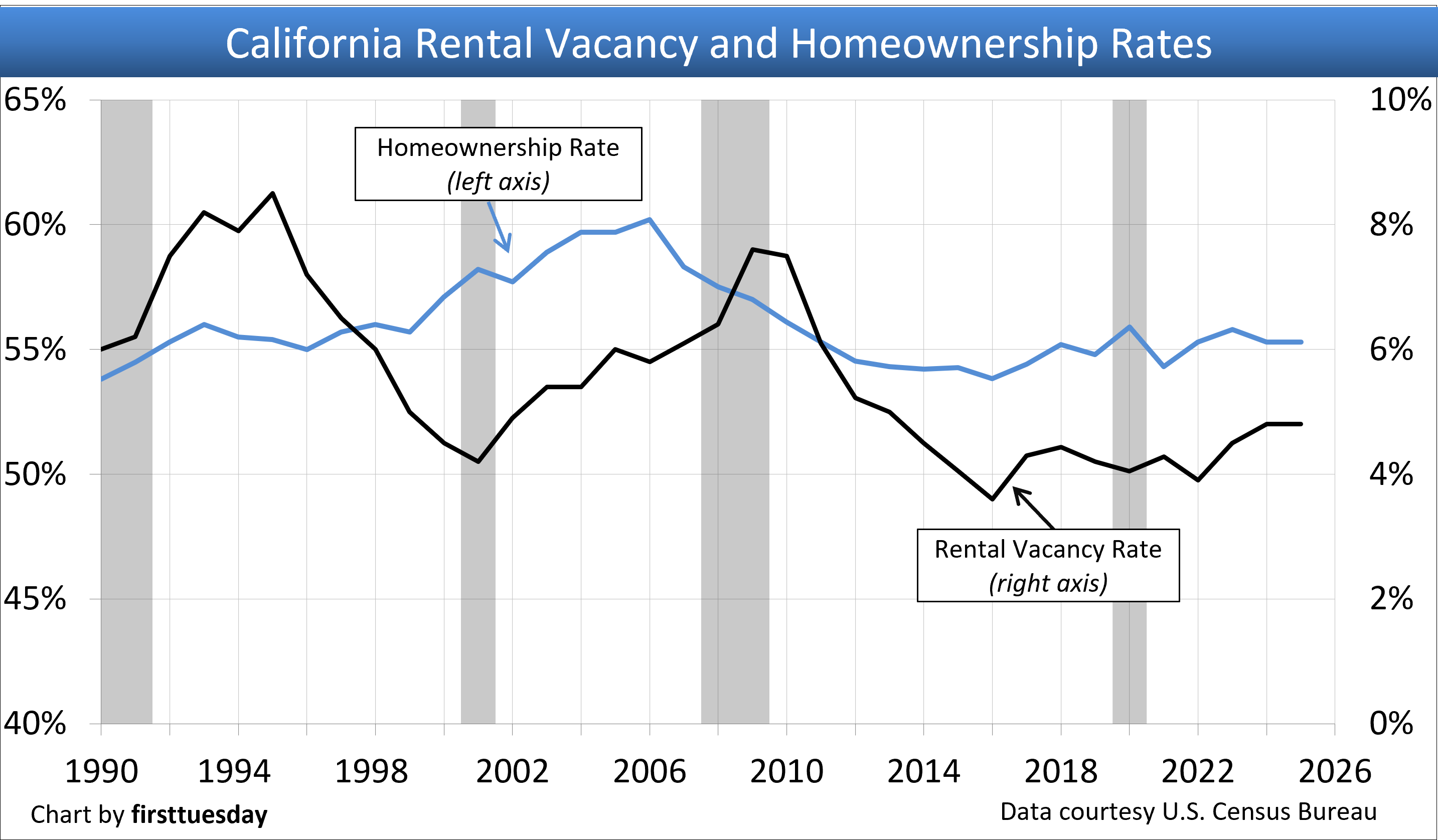 Chart update 08/26/26
| 2025 | 2024 | 2023 | |
| Rental vacancy rate | 4.8% | 4.8% | 4.5% |
California’s current state of homeownership
California’s homeownership rate is historically around 10 percentage points below the national homeownership rate (at 65% in Q2 2026). This is primarily due to the lesser impact done by pushing lore about the “American Dream” of homeownership on more mobile, free-spirited Californians up against California’s sky-high property prices.
California’s rate of homeownership has declined dramatically since the 2008 recession, a full five percentage point drop since its peak of 60.7% in 2006. The initial drop in ownership after 2006 was due to the abundance of non-conventional sales through 2012 — foreclosures and short sales.
Homeownership rates drop when mortgage rates move upward as reflected in the declining rate of homeownership during the 1960s through the early 1980s. Chart 1 displays the generally unacknowledged inverse relationship between the average 30-year mortgage rate and the homeownership rate (and home price trends) from early 1980 until 2006, when the upward ride of the Millennium Boom reversed course.
However, in our bumpy plateau recovery following the 2008 Great Recession, mortgage rates turned upward in 2013, further forcing homeownership rates to drop. Today, the homeownership rate is mostly stable, at around 55%, due to the 2010 financial market re-regulation of Wall Street mortgage origination and servicing conduct. This balanced SFRs sales and rentals by implementing sound mortgage lending again.
Looking back for a look forward
California’s homeownership rate enjoyed an upward trend since the early 1980s, peaking in 2006. This long-term increase and the following crash were brought about by declining mortgage rates along with property tax and home sales income tax factors (with a home becoming a full-blown profit center by the late 1990s).
During the 30 years from 1983 to 2013, interest rates were in a continual state of decline providing more mortgage funds for buyers which drove home prices up.
Further, annual property assessments and thus annual tax increases for a homeowner were limited to 40% of the increasing fair market value of all types of property. This allowed homeowners to annually save increasing amounts as they avoided paying what new owners in the neighborhood paid. Also, property tax treatment as a financial force causes owners to retain the property or keep it in the family rather than relocating to more suitable housing as they age.
Further, reverse mortgages as an income flow causes aging homeowners to retain ownership, accessing their home equity as though an ATM. This also reduces the financial incentive to turn over ownership and relocate to more reasonable housing.
Over the next 20 years or so, expect mortgage rates to trend upwards, continuing to inhibit homeownership growth while encouraging renting.
Related article:
In 2001, just as the recession set in to clear inefficiencies in the economy, the fiscal and monetary stimulus post-9/11 led directly to the Millennium Boom. In the boom, as aided and abetted by financial deregulation, low-tier home prices were artificially driven to a three-fold high.
A new real estate paradigm was erroneously declared in the 2000s, pitching the wonderful idea prices would go up and up forever, in defiance of economic principles attributed to capital assets. Bond rating agencies, wrongfully induced by Wall Street Bankers, fully endorsed the concept as no risk for mortgage investors due to diminished property owner default.
Of course, this false paradigm came crashing down in 2007, which resulted in the most significant U.S. recession since the Great Depression. Once the recovery was complete, around 2017, it was only a few short years until the Covid-19 pandemic swept changes through the country’s employment and housing once more.
While California finally returned to its pre-pandemic 2019 jobs peak in October 2022, not enough jobs are available and wages have not kept up with rising costs of living. Profits have risen measurably, for the time being.
Related article:
The rental alternative
Apart from the effects of various economic factors, the evolving societal mores (and the grasp of debt-driven math) of the younger generations (Millennial and Gen Z) show an increasing tendency towards renting, rather than owning one’s shelter. Although, the post-2020 buying spree fueled by fear of missing out (FOMO) shows a willingness to enter homeownership when the mortgage rates, or prices, are right.
In lieu of homeownership, potential homebuyers seek advantages in their only other option: renting. Often they will rent detached SFRs, currently the playground for ownership among many adventurous buy-to-let investors.
The rental activity of potential homeowners financially forced to occupy rental units will increase rental occupancy rates for the short term. To keep rents stable in their urban centers and transit hubs, city councils need to permit the construction of high-density multi-family units.
Without proper administration of permits for new housing starts, rents will increase and eventually cause a shift in housing preference to homeownership of SFRs. Then it will be back to suburban sprawl all over again — unless cities resolve their resistance to density.
Empty units do not indicate lack of tenants
Logic dictates that any large decrease in California homeownership should lead to a correspondingly large increase in demand for rental housing. But the builders are not able to meet this response — stopped by the difficulty of securing construction funding and navigating local zoning ordinances limiting feasibility due to density, height, parking, etc.
That said, multi-family construction in 2025 was up from the previous year while SFRs starts were down.
As household formations increase, first-time homebuyers are delayed while Californians deal with the nascent job-market. The potential demand for rental housing will produce a sharp rebound in apartment construction, but for the moment, rental housing is not scarce, particularly in the inland communities.
Related article:
Are rentals a passing trend, or a permanent change?
California has fully stabilized at its historic 55% homeownership rate. In the coming decade, household occupancy of rental property will continue as the standard alternative to homeownership. For brokers interested in homeowner turnover, it is not likely to improve for another decade, except for a marginal increase in a recession. Additional developing risks damping down increased turnover are owners already financed at a lower mortgage rate than today’s FRM rates as they are less likely to sell and upgrade or downsize.
Less risky than traditional homeownership, renting is poised to fill the gap for households needing to relocate, especially following:
- job disruptions from trade and military wars, an aging population and declining labor force participation;
- attacks on the vital immigrant population who assist population and economic growth at a time of declining birth rates and lost entitlement funding;
- massive accumulation of private and public debt now confronted with high and increasing interest charges;
- excessive inflation due to uncontrolled private and public spending financed by borrowing, not earning;
- obstructive political polarization barring legislative progress; and
- the eminent cyclical arrival of an economic recession.
But are rentals the wave of the future? Or will the population and the government return to pushing single family homeownership when pocketbooks and anxieties finish recovering from the worst of the coming recession’s pain? The answers wait with the large new generation of potential homebuyers in Gen Z who are coming of age.
In the immediate future, firsttuesday forecasts that the population will become increasingly centered in the cities, where jobs, culture and personal conveniences are ready at hand. California, which has always had a homeownership rate roughly 10% lower than the nation as a whole, is especially susceptible to this trend.
For a mobile, contemporary and more youthful population like California’s, rentals will more often be the natural choice.
Related article:











Analyzing rental market shifts in California highlights critical trends for housing investors and tenants alike. Navigating complex property dynamics and economic factors requires careful planning, far beyond playing casual Easy Games for quick leisure. In-depth articles like this offer valuable foresight for making smart long-term real estate choices!
Great article! The future of real estate in California is definitely leaning toward rentals, especially with rising home prices and a shift in demand. As the post highlights, more people are renting for longer periods, driven by factors like high down payments, limited inventory, and uncertain economic conditions. It’s clear that investors who focus on rental properties, especially in high-demand areas, may be positioned for long-term success.
The article also touches on how rent control laws and tenant protections are playing a significant role in shaping the rental market. Understanding these regulations is crucial for anyone looking to enter the space. As we’ve seen in recent trends, housing affordability will likely continue to push more people toward renting, so being prepared for this shift will be key to staying ahead in the market.
I live in Lodi just a few miles from Stockton. Stockton has been hurt big time with homes built between 2003 to 2008 showing 60 to 80 % lost to forclosures. Most of these homes were sold to owner occupied families uisng ARM loans with pick your payments that would give negative loan reductions or growing loan amounts due to added unpaid interest to the loan each month. Values in Stockton are still going down. For the first time in a long time we have 2 and 3 families pulling together to rent or buy homes. Rents are also going down in Stockton. All the money given by Government has not changed this.The same Banks that got money from the Government are not working to help the buyers who used good loans to purchase their home but are now paying the price for the Bank Loans that were pushed on most buyers during this time that did not really understand what a pick a loan payment was all about. I can not believe anyone would use this loan product if the loan product was really explained to the borrower in the first place.
From what I hear from friends in California, the housing seems to have stabilized already. New homes in desirable cities and towns are once again being snapped up fast. Same is the case with distressed homes even in the bubble-bust cities and towns. Multiple offers is the order of the day. Low interest rates definitely seems to have had a positive effect on housing. Jumbo loans that had become extinct, have reportedly made a comeback. Hopefully, with the new regulations, we don’t go back to the 2004 – 2006 style irrational exuberance!!
I read your article with great interest since Property Management is our core business – and the majority of our managed properties are single family homes or condos/townhomes. H.M.S. has been around since the early 70’s so it has seen the rental market up’s and down’s – which used to follow a seven year cycle.
I agree that all the foreclosures have not increased substantially the demand for rental housing. As your article points out, these families are moving in with family or leaving for other states where there are jobs and housing that is more affordable.
Very interesting that you see rentals as a move for the future — especially with Generation ‘Y’ — that is a very good point.
We still find that having a rental that is clean, updated, and priced at market will rent. Landlords that have a poor image of renters and don’t fix up their properties are having their investments sit empty. Pointing out that the renters of today include professionals, teachers, white & blue collar workers is important. Over the years, we have found that over 95% of the tenants leave the property in a condition that it can be rented out again with minor work.
Right-on about not needing more apartments built at this time!
Hmmm – when you discuss Section 8 housing — did you know that Section 8 policy is different depending on the county? Some counties in California have frozen rents for the last 2 years. In addition, some have not taken applications to get on the waiting list for the last 2 years; nor added anyone to the program. As in other government programs, HUD has had to cut costs as well. I have not researched government financing for Section 8 landlord upgrades to improvements; but I haven’t seen these being available either in the last couple of years.
We, in property management, are beginning to look at what landlords can do to be more energy efficient – i.e. replacing old appliances/furnaces with Energy Efficient ones.
Anyway, thanks so much for the informative article — looking forward to 2012 and a better economy!
Once again, First Tuesday has a pretty good idea of what is going on in the real estate market. To begin with, it has been predicted that over the next 12 months according to the Mortagage Bankers Association, that over 10,400,000 homes will enter foreclosure and according to the Heritage Foundation, another 10,000,000 will lose their jobs between NOW and the end of the FIRST QUARTER OF NEXT YEAR (March 31, 2011!)
What is the cause of this? The current administration in the White House and their belief that more government spending along with HIGHER TAXES will stimulate the economy! However, the opposite is true.
As an example, we only have to look to the GREAT DEPRESSION and how President Roosevelt passed the HIGHEST TAX INCREASE in U.S. History at that point and unemployment went from 15% from President Hoover and the STOCK MARKET CRASH of 1929 to 25% in1933 once the ROOSEVELT TAX INCREASE WAS PASSED! The same thing will happen next year!
More and more economists are predicting that the United States is about to enter a DEPRESSION, one of which this country has never seen or felt because this time it will be more global than the last one.
Watch the real estate market and pay close attention to the REAL unemployment rate, not the White House figure, (it is closer to 17.3% than it is to 9.5% as the White House wants you to believe!)
Remember, the President said that if the stimulus bill was not passed that we would see unemployment above 8%. My question is, now that the stimulus has been passed, why is the unemployment rate above 8%?